Turn your daytime optics into a thermal device with a thermal scope attachment
Quick answer:
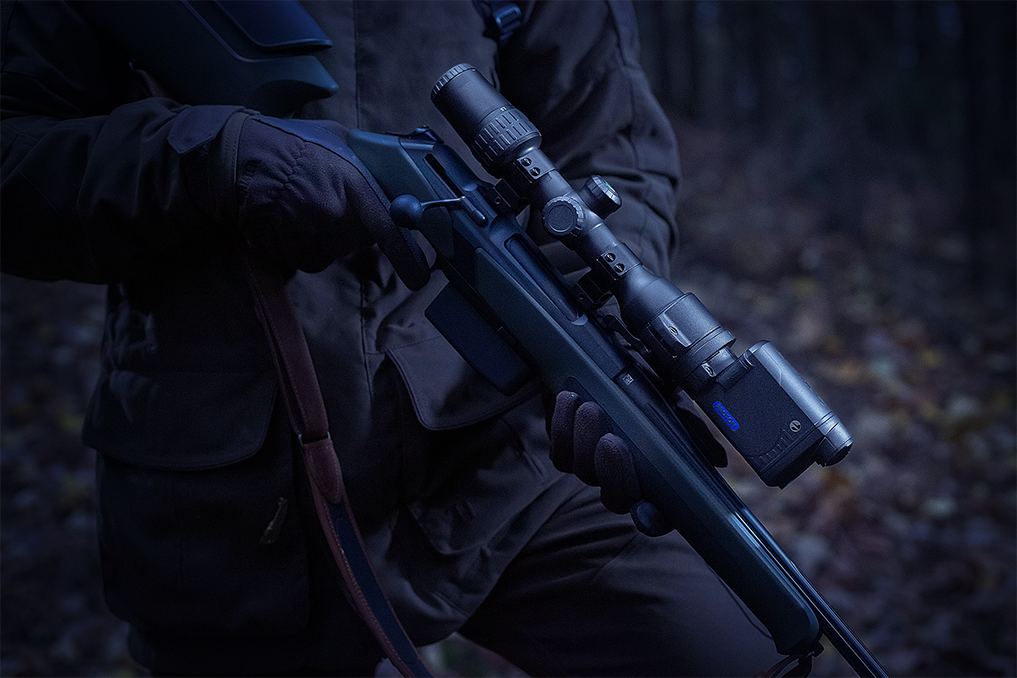
A clip-on thermal scope attachment is a compact, front-mounted system designed to instantly transform your existing riflescope into a powerful thermal imaging device.
- Converts daytime optics into a thermal device: mounts to the front of your riflescope to detect heat signatures instead of visible light.
- Delivers dual-purpose versatility: switch seamlessly between day and night hunts without changing optics or compromising your zero.
- Offers cost-effective, professional performance: enjoy Pulsar’s high-end thermal imaging without buying a separate thermal scope.
- Built for real hunters and harsh conditions: engineered for accuracy, durability, and field reliability proven by Pulsar’s Krypton 2 series.
What is a thermal scope attachment and how does it work?
A thermal scope attachment — also known as a clip-on thermal imaging device — instantly converts your daytime riflescope into a fully functional thermal optic. By detecting infrared heat signatures instead of visible light, it allows hunters and professionals to see targets through darkness, fog, or dense cover without removing or replacing their trusted scope.
- Clip-on: shares your scope’s reticle, magnification, and zero.
- Dedicated scope: restricted to daylight hours.
- Clip-on benefit: quick swap between daylight and thermal modes using one rifle setup.
How it integrates with existing optics
Thermal attachments come in two main mounting styles:
- Front-mounted systems (like the Pulsar Krypton 2 series) attach to the objective lens of your daytime scope, preserving zero and ergonomics.
- Eyepiece-mounted systems – less common in modern setups and hardly used by hunters, they connect to the rear of the optic.
Key components
A clip-on thermal attachment uses advanced digital imaging components to interpret heat:
- Thermal sensor/microbolometer: detects heat energy (infrared radiation).
- Display screen: converts the signal into a visible thermal image.
- Adapter/mount: ensures precise alignment with your riflescope.
- Processing unit: interprets temperature data into color-coded images.
- Power source: high-capacity, field-replaceable battery for extended hunts.
Working principle: From infrared capture to image projection
- The sensor detects temperature differences between the target and its surroundings.
- Those heat signals are processed and converted into a digital thermal image.
- The image is projected through your daytime scope’s optical path.
- You see a live thermal feed while maintaining your own reticle and scope magnification.
This seamless integration gives you true dual-mode capability — thermal precision with your familiar daytime setup.
Example: Pulsar Krypton 2 FXG50
- Krypton 2 FXG50: 640×480 px sensor, detection range up to 2,300 m, laser-sharp clarity.
- Krypton 2 FXQ35: 384×288/17 µm sensor, detection range up to 1,250 m, wide-angle and crystal-clear image.
Pulsar’s advanced image algorithms and quick-release bayonet mounting system for consistent accuracy and easy field handling. How does that translate into real-life situations? Here’s what Erik Bjaelkvall, a hunter and equipment expert, thinks:
If you already love your day scope and want to add a thermal without buying a whole new rifle setup, the Krypton 2 system is an absolute winner. It will turn your “day only” rifles into legit night predators without compromising anything for daylight hunts. Another benefit is that with the 3×20 eyepiece, you can transform the Krypton to a handheld thermal scanner and use it for scouting – literally within seconds. One less thing to buy and carry.
Why hunters use thermal clip-on attachments instead of dedicated thermal scopes
Many hunters prefer thermal clip-ons because they extend the life of their existing optics, save money, and keep familiar aiming setups while gaining advanced thermal detection capabilities. With a quick mount, you can move from daylight to darkness without losing your zero — and without carrying two scopes.
Advantages over dedicated thermal scopes
- Cost efficiency
- No need to buy a separate thermal riflescope — the clip-on works with the optics you already own.
- Ideal for hunters who invest in premium daytime glass but want to expand into night hunting.
- Ease of installation and removal
- Attaches and detaches in seconds using Pulsar’s bayonet or adapter system.
- Perfect for mobile hunters switching between daylight and low-light conditions.
- Familiar reticle and ergonomics
- Retain your scope’s original reticle, magnification, and feel.
- Keeps your muscle memory intact — you aim and shoot as you always have.
- Weight and balance
- Typically lighter than carrying a separate thermal optic.
- Maintains rifle balance for accurate shots from prone or offhand positions.
Comparison: Clip-on vs. dedicated thermal scope
| Feature | Clip-on thermal attachment | Dedicated thermal scope |
|---|---|---|
| Zero retention | Uses existing scope zero | Requires its own zero |
| Setup time | Quick mount/detach | Permanent installation |
| Cost | Lower overall | Higher total investment |
| Flexibility | Switch between day/thermal | Thermal-only use |
| Reticle familiarity | Same as your optic | New reticle system |
| Weight | Lighter total setup | Heavier, bulkier system |
Expert insight from Erik:
Hunters who shoot multiple rifles and calibers and want to move the thermal between them without re-zeroing every time should go for a Krypton 2 clip-on. Just buy an extra adapter for each setup, and every rifle you own will work at night as well. If most of your hunts are at night, and you benefit from an integrated laser rangefinder and ballistic solver, then go for a dedicated thermal rifle scope.
Read more: Thermal clip-ons vs. thermal scopes: Which is better?

Compatibility — which daytime optics work with thermal attachments?
Thermal attachments are compatible with most modern riflescopes, but image alignment, magnification range, and mounting type determine how well your thermal overlay performs. Getting these details right ensures a crisp thermal image and accurate point of impact.
Compatibility checklist
- Objective lens diameter
- A minimum of 30 mm provides the best image alignment and field of view.
- Larger objectives capture more light, improving clarity and thermal overlay accuracy.
- Magnification range
- Ideal range: 2× to 6×.
- Higher magnifications reduce image resolution and narrow your field of view.
- Reticle type and field-of-view match
- Simple reticles (like duplex or BDC) align more cleanly with projected thermal images.
- Wide FOV scopes give better edge visibility when using clip-ons.
- Rail or adapter type
- Common mounts include Picatinny, Weaver, and Dovetail systems.
- Use Pulsar’s precision adapters to ensure perfect optical centering.
- Parallax and eye relief
- Confirm that your scope’s parallax is fixed or adjustable for mid-range targets.
- Maintain consistent eye relief for comfortable night-long observation.
- Weight balance and recoil tolerance
- Choose a sturdy, mid-weight optic to balance the added weight of the front-mounted module.
- High-recoil calibers require secure adapter locking for a consistent zero.
Before your first hunt, test-fit your attachment in daylight. This ensures proper focus distance, stable alignment, and full reticle visibility before you ever power on the thermal unit.
How to mount and calibrate a thermal attachment
Proper installation ensures your point of impact and thermal image alignment stay consistent with your daytime scope. A well-mounted thermal clip-on keeps your zero true and guarantees that what you see through your reticle matches where your shot will land.
- Attach the mounting adapter
- Choose the correct adapter for your scope’s objective diameter (usually 40–56 mm).
- Secure it firmly without overtightening to prevent optical stress.
- Lock the thermal module in place
- Insert the clip-on device (like the Pulsar Krypton 2 FXG50) into the adapter’s quick-release system.
- Ensure it clicks securely and sits level with the optical axis.
- Align the Crosshair Center with Display Center.
- Power on the thermal attachment.
- Adjust alignment so the thermal display and your reticle overlap precisely.
- Verify zero at 50–100 meters
- Fire a controlled group at your normal zero distance.
- If impact shifts slightly, use digital alignment settings to fine-tune the image.
A note from Erik:
This is one of those moments when I advise you to read the manual and follow the easy step-by-step instructions. Use the “Display alignment” function and tilt the attachment to align the reticle with the auxiliary cross of the Krypton 2, then tighten the fixing screws. Always confirm your zero to make sure you’re hitting the intended target.
- Test alignment on a stationary heat source
- Aim at a warm object — such as a metal plate or water bottle warmed in the sun — to confirm target clarity and central alignment.
- Practice in low-light conditions
- Before night hunting, spend time observing and tracking in dim light to get familiar with image focus and refresh rate response.
Common mistakes to avoid
- Over-tightening mounts may warp adapters and shift optical alignment.
- An incorrect focus distance can cause blurry targets at mid-range.
- Improper battery placement may lead to intermittent power loss.
- Failing to recheck zero after transport vibration or recoil can affect calibration.
Erik points to one more mistake to avoid – and that is not choosing high-quality mounts:
A common mistake is to use a cheap mount, which will lose its zero due to poor quality. Save time and money (in the longer run) and buy a quality mount for your main rifle scope. It’s easy to blame the new device, but in my experience most of the issues correspond to poor mounting.
Real hunting scenarios where thermal attachments excel
Thermal clip-ons are built for hunters who refuse to quit when visibility fades. Whether you’re glassing dense brush, waiting at dawn, or tracking in fog, a thermal attachment reveals heat where your eyes can’t — giving you the edge when every second counts.

Prime use cases for thermal clip-ons
- Night stalking and boar hunting
- Detect wild boar, coyote, or predator heat signatures long before they spot you.
- Track movement across fields or dense undergrowth, even in complete darkness.
- Detecting hidden or stationary game
- Identify animals bedded down in tall grass or behind tree lines.
- Heat detection cuts through brush and camouflage where optics alone fail.
- Dawn and dusk spotting
- Thermal imaging thrives when visible contrast is low — at first light or just after sunset.
- You’ll pick up game that blends into shadow or haze, staying active longer each day.
- Search and rescue or scouting
- Thermal clip-ons aren’t just for hunting — they’re invaluable for tracking wounded game, locating lost dogs, or scouting terrain safely in low light.
Pulsar thermal attachments to consider
The Pulsar Krypton 2 series delivers professional-grade clip-on performance for every hunting environment. Whether you’re scanning open country or stalking in thick timber, these attachments turn your daytime scope into a reliable, high-resolution thermal imaging system.
| Model | Sensor & optics | Detection range | Core strengths | Best suited for |
|---|---|---|---|---|
| Pulsar Krypton 2 FXG50 | 640×480 / 12 µm sensor F50 / 1.0 lens |
Up to ≈ 2,300 m | Long-range precision • Exceptional image detail • Stable point-of-impact |
Open fields, ridge lines, long-distance predator or boar hunts |
| Pulsar Krypton 2 FXQ35 | 384×288 / 17 µm sensor F35 / 1.0 lens |
Up to ≈ 1,350 m | Lightweight balance • High contrast in fog & humidity • Wide field of view |
Forests, farmland, stalk hunting, humid or mixed terrain |
Both models also feature a Bluetooth remote control for extended convenience in the field. For Erik, it’s a very convenient solution:
The Krypton 2 comes standard with a wireless remote control. I suggest you place it on your rifle, close to your trigger finger. Now you can fine-tune virtually anything without breaking your shooting position. Make sure to play with the placement of that remote during your first range session; get it perfect and you don’t want to live without it afterwards.
See our guide to the best Pulsar thermal clip-on scopes in-depth review to find models suited for your current setup.
Advantages and limitations of using thermal attachments
Thermal attachments offer unmatched versatility and cost efficiency, but like any optical system, they come with a few trade-offs every serious hunter should understand. Knowing both sides helps you make a smart, field-ready decision for your rifle setup.
Advantages
- Keeps your trusted optics: Use your current riflescope — same zero, same reticle, same shooting confidence.
- Quick attach and detach capability: Transition from day to night hunting in seconds without tools or re-zeroing.
- No re-zero required: Once aligned, your point of impact stays true — even after multiple mounts.
- Dual-purpose setup: One rifle, one optic, two modes: daylight clarity and thermal precision.
- Cost-effective upgrade: Adds advanced thermal capability at a fraction of a dedicated scope’s price.
Erik’s advantage from the field:
Pop the Krypton thermal off the rifle, twist on the eyepiece, and you’re ready to start scanning. Twist off, snap back on the scope. 10 seconds total. Perfect for spot-and-stalk or when you’re walking in/glassing before mounting up. It saves you from buying a dedicated handheld monocular and saves weight.
Limitations
- Added front Weight: The clip-on adds extra mass to the front of your rifle, changing the balance slightly.
- Alignment sensitivity: Improper adapter fit or overtightening can shift optical alignment.
- Magnification limitations: Works best between 2×–6×; higher zoom reduces image clarity.
- Legal restrictions: Some regions limit thermal use for hunting — always verify local laws first.

Legal and regional regulations for thermal attachments
Regulations on the use of thermal optics in hunting vary widely by region. Before mounting one on your rifle, always confirm local laws to avoid fines or violations — even the most advanced gear is only as good as the legality behind it.
Overview: EU vs. US thermal optics laws
In the United States:
- Regulations differ by state. Some allow thermal optics for predator or nuisance animal control; others restrict night vision entirely.
- States like Texas, Arizona, and Florida permit thermal hunting for feral hogs and coyotes under specific conditions.
- Always check wildlife agency rules before your hunt — they can change seasonally or by county.
In the European Union:
- Many EU countries classify thermal and night vision as controlled hunting tools.
- Nations like Germany and Austria require special permits for thermal attachments, while Finland and the Czech Republic allow broader use for wild boar and predator management.
- Export and import restrictions may also apply when traveling with your device.
Common restrictions
- Night hunting limitations: Certain species, such as big game, are not legally hunted at night.
- Predator control exceptions: Thermal optics are often approved only for invasive or predator species.
- Landowner permissions: Some regions require written consent for night or thermal hunts.
- Transport laws: Always store the device separately from the firearm when crossing jurisdictions.
Final thoughts — should you add a thermal attachment to your hunting setup?
If you already own a reliable daytime scope and want a cost-efficient way to add night-hunting capability, a thermal clip-on is the smartest upgrade you can make. It bridges the gap between traditional optics and cutting-edge detection, giving you the best of both worlds.
Why it’s worth the upgrade
- No redundant gear — keep your existing riflescope and familiar shooting setup.
- Instant dual-purpose functionality — switch seamlessly between daylight glassing and thermal detection.
- Field-proven precision — Pulsar’s Krypton 2 clip-ons maintain zero, resist recoil, and perform in any condition.
- Professional-level imaging — see heat signatures clearly across distances that defeat visible light.
- Confidence that lasts — backed by Pulsar’s engineering reputation and real-world testing by hunters worldwide.
FAQs
Can I use any riflescope with a thermal clip-on?
Most modern riflescopes are compatible with clip-on thermal attachments, but results depend on optical quality and mounting alignment. For best performance, choose a scope with an objective lens of 40 mm or larger and a magnification range of 2–6×. This balance provides a wide, clear thermal image without distortion or loss of clarity.
Do I need to re-zero my scope after mounting the attachment?
No — high-quality clip-ons like the Pulsar Krypton 2 FXG50 and FXQ35 maintain your existing zero when mounted correctly.
Is thermal imaging legal for hunting in my country?
Regulations vary by region and species. In the U.S., many states allow thermal optics for predator or nuisance animal control, while others restrict night vision entirely. In Europe, countries require permits or limit use to specific game — always check local wildlife laws before heading into the field.
How does image quality compare to a full thermal scope?
A premium clip-on like the Krypton 2 FXG50 delivers image quality nearly identical to a dedicated thermal scope when paired with good glass.
Further reading:
About the experts

Joshua Skovlund has covered stories for Task & Purpose, Outdoor Life, and Coffee or Die Magazine. He has photographed and filmed multinational military exercises and hunting trips in austere environments around the world, with his first archery kill in Kona, Hawaii.
Joshua grew up in South Dakota, learning how to scout and hunt deer, turkey, pheasant, and waterfowl. He currently scouts and hunts black bears, turkeys, and deer, while taking every opportunity to go to the range and further hone his pistol and rifle shooting skills.

Erik Bjaelkvall is a former Arctic Ranger, now a competitive practical shooter, seasoned hunter, and gear expert with decades of field experience.
Operating out of Sweden, Erik has extensively tested thermal imaging equipment across diverse environments – from open plains to rugged mountains, through snow, fog, and sun.