The only night vision scope attachment you’ll ever need — Now upgraded with thermal vision
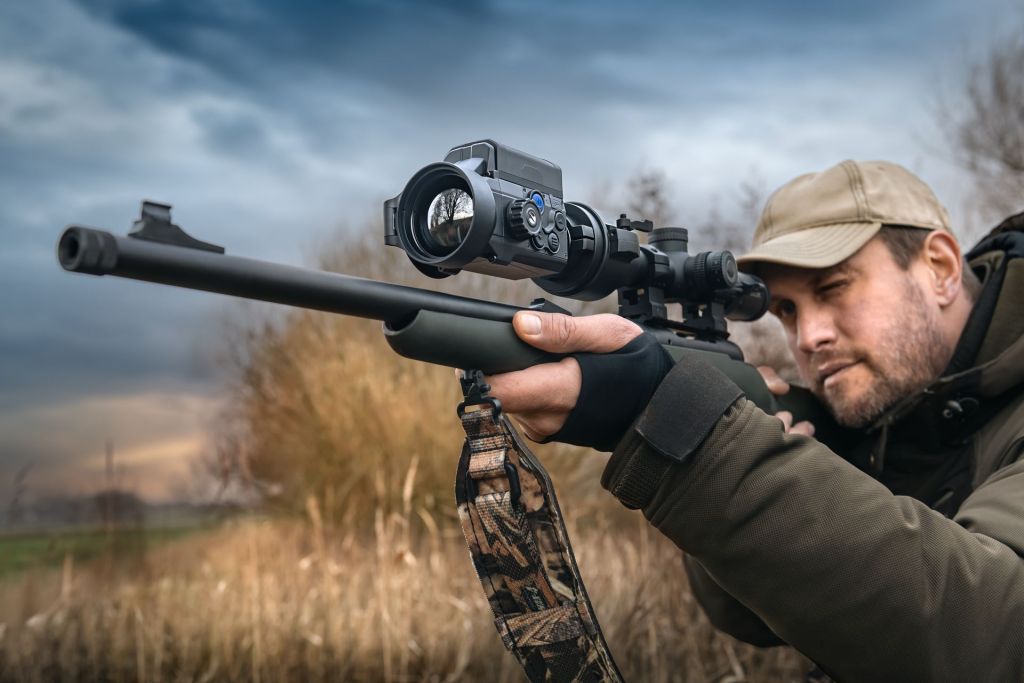
Quick answer
- A night vision scope attachment mounts in front of your daytime riflescope, letting you see and hunt clearly after dark.
- The next-level upgrade is a thermal clip-on, which detects heat signatures instead of relying on light — revealing game through fog, rain, and total darkness.
- To install it, you’ll need a night vision scope adapter — a precision connector that stays attached to your daytime optic and allows quick, repeatable mounting without losing zero.
- Thermal clip-ons like the Pulsar Krypton 2 FXG50 and FXQ35 combine European craftsmanship, rugged magnesium housings, and all-weather performance.
- The result: fast detection, reliable target ID, and seamless day-to-night transitions for confident, ethical hunting.
Pulsar Krypton 2 FXG50 vs FXQ35 — The modern successors
Thermal clip-ons are no longer a niche add-on: they represent the next step after traditional night vision adapters. The FXG50 and FXQ35 in the Krypton 2 series give hunters true thermal detection. They let you keep your daytime optic and mount in front of it, yet deliver heat-based imaging for all-weather, all-light hunting.
Below is a comparison of both models to help you judge which fits your rifle configuration and field conditions best.
Adapters from Pulsar also come with a protective cover. This means that, during the day, when you are not using the night vision device, the cover protects your rifle scope from dust and other possible damage.
| Model | Sensor & optics | Detection range | Core advantages | Ideal use case |
|---|---|---|---|---|
| Pulsar Krypton 2 FXG50 | 640 × 480 px @ 12 µm, F50 / 1.0 lens |
Up to ≈ 2,300 m | Long-range precision Sharp target ID Stable zero |
Open-field, long-distance hunts where identifying target at range counts |
| Pulsar Krypton 2 FXQ35 | 384 × 288 px @ 17 µm, F35 / 1.0 lens |
Up to ≈ 1,350 m | Wide field of view High contrast in fog and humidity Lightweight |
Forests, mixed terrain, close-to-mid-range stalking where agility matters |
Read more: Mastering the Krypton 2: the practical point of view
Key takeaways:
- Pulsar Krypton 2 FXG50 uses a higher resolution sensor (640×480 px at 12 µm) offering finer detail and longer detection range.
- Pulsar Krypton 2 FXQ35 uses a slightly lower resolution sensor (384×288 px at 17 µm), but its larger pixel pitch increases thermal sensitivity, making it especially useful in conditions with poor contrast (fog, humidity).
- Both models share features like a 50 Hz frame-rate, AMOLED HD display, magnesium alloy housing, and up to 11 hours battery life.
For practical tips on choosing the right model for you, we asked Riccardo Tamburini, a hunter who’s tried & tested perhaps all available thermal devices out there:
The first thing to know is that both of sensor class, XQ or XG, allow the hunter to get the desired result; the difference stays in some details which do not depend on the skills of the user.
This is why I often suggest my friends to purchase an XQ class device, because it will be enough to get any result in a lot of scenarios: no matter from their abilities. I think that an XQ aiming system can be considered as the most versatile in the Pulsar offer, considering the average conditions of the nighttime shooting (often around 100 mt) and the affordable price.
But, if you want an higher image quality, or better performance, if you are a skilled shooter with a great experience in long range shooting and if you hunt in wide open areas which force you to shoot to far targets, the XG sensor class is the right choice for you.
A front attachment is probably the most versatile option because it can be matched with the standard scope by simply having a connection system that’s easy to use. Your daytime scope will become a powerful night vision device in less than a minute. An additional thermal scope is not required, and the quick mounts are not needed. It’s probably the lightest option to consider when you hunt stalking or when you quickly pass from a daytime hunt to a nighttime hunt.
Dive deeper into performance, field results, and expert recommendations in our in-depth review of the Best Pulsar thermal clip-on scopes.

Why hunters are moving from night vision to thermal
Night vision has served hunters well for decades, but its limits are clear. Because it depends on ambient light, performance drops on moonless nights or under heavy cloud cover. Bright sources like headlights or campfires can cause glare, while fog, rain, or humidity scatter the light the sensor needs, washing out detail and contrast.
Thermal imaging removes those limits entirely. It detects heat signatures instead of reflected light, showing the temperature difference between animals and their surroundings. This means hunters can see clearly in total darkness, through fog, drizzle, dust, or foliage—conditions that blind any night vision device.
Here’s what Riccardo shares about his transition to, at first, digital night vision, and to thermal later:
I started shooting during the night using an old Pulsar digital night vision front attachment; I was super happy because its use has completely changed my results. Living in the most congested Italian region forces the hunter to go out during the night hoping to meet the wild boars while they are feeding in an open area because it’s not possible to meet them out during the day.
The digital technology solved the situation only partially, because we know that it suffers the weather conditions: rain, humidity, fog and snow are its public enemies. Even the cover reduces the possibility to place a good shot because the shape of the animal merges with the environment. Again, switching on the illuminator, often the most careful and skilled animal goes away before pulling the trigger.
Today, the thermal technology assures the highest precision and reliable security: the hunter will always be sure that his line of fire is clean for kilometers behind the target. The weather conditions don’t affect the precision and safety anymore, and the hunter can always count on the most reliable technology available. They will be always perfectly unseen by every game species, having the chance to wait for the best opportunity to place the right shot.
Read more: Thermal vs night vision: Which to choose?
Krypton 2
Learn moreHow to upgrade — switching from night vision adapter to thermal clip-on
If you already own a night vision adapter, upgrading to a thermal clip-on is quick and straightforward. The Pulsar Krypton 2 series is designed to mount in front of your day scope using the PSP-B quick-release bayonet adapter, making the transition smooth while preserving your rifle’s zero and familiar optics setup.
Here’s how to do it step by step:
1. Remove your old adapter
- Detach the existing night vision adapter or any front accessory mounted on your scope’s objective.
- Make sure the lens surface is clean and free of debris before proceeding.
2. Install the PSP-B adapter
- Choose the PSP-B adapter ring that matches your scope’s objective diameter (available in 42 mm, 50 mm, or 56 mm).
- Insert the correct inner ring to achieve a snug fit without scratching the housing.
- Secure the adapter firmly but avoid overtightening. This adapter can remain permanently on the day scope for fast attachment in the field.
3. Align the device
- Attach the Krypton 2 clip-on to the mounted adapter until it clicks into place.
- Use the screen alignment feature in the device’s menu to ensure the thermal image appears centered and level in your day scope’s view.
- The Krypton 2’s precise alignment mechanism guarantees the thermal display stays consistent every time you reattach it.
4. Test and confirm zero
- Although Pulsar clip-ons are engineered to maintain your day scope’s zero, always test before a hunt.
- Head to the range and fire a few confirmation shots to verify that your point of impact remains unchanged.
- For best results, keep your day scope’s magnification between 2× and 4×, which offers the sharpest thermal image and widest field of view.
Note from Riccardo:
Despite Pulsar’s assurances that its front attachment devices don’t require zeroing the daytime riflescope again, it’s always good to go to the shooting range to verify the situation and get familiar with a new equipment which will be used in the darkness later.
The Krypton family doesn’t require zeroing the rifle again: there’s no zeroing procedure inside the menu to follow, but there is a calibration mode which allows the user to verify the perfect alignment between the front attachment and the daytime scope through the connection system. After doing that, the hunter will be always sure that any following connection won’t lose the old precision. Even after tens of times.
5. Go hunting
- Once confirmed, you can clip the device on and off repeatedly without losing accuracy.
- You retain your day optic’s eye relief, reticle, and balance—now enhanced with thermal power.
Ready to make the switch?
Read more: See which thermal model fits your rifle.
Final thoughts — modern night vision is thermal vision
Traditional night vision scope adapters and attachments once revolutionized hunting after dark — turning ordinary optics into night-ready tools. But today, thermal clip-ons have become the new gold standard.
By detecting heat instead of light, thermal technology lets hunters track and identify game in total darkness, fog, and dense cover, where conventional night vision fails. The result is faster target detection, clearer identification, and more confident, ethical shots in any condition.
The Pulsar Krypton 2 FXG50 and FXQ35 represent this evolution — combining European precision engineering, rugged magnesium builds, and repeatable mounting accuracy through advanced scope adapters like the PSP-B system.
Whether your setup is built for long-range precision or agile woodland stalking, there’s a Krypton 2 thermal attachment perfectly suited to your rifle.
In short: night vision started the era of nocturnal hunting — thermal vision perfects it.
So, are you ready to enter the world of digital night vision?
Find your local Pulsar distributor today and get ready to make unforgettable memories — day or night.
FAQ
Can you add night vision to a regular scope?
Yes. You can attach a night vision or thermal clip-on in front of your existing day scope to make it night-capable. Unlike dedicated night scopes, a clip-on doesn’t replace your optic. It simply enhances it. Devices like the Pulsar Krypton 2 FXG50 or FXQ35 convert your regular scope into a thermal imaging riflescope without changing your reticle or re-zeroing your rifle.
Can scopes be used with night vision?
Absolutely. Modern thermal and digital night vision devices are designed to work seamlessly with most optical scopes. Because thermal clip-ons detect heat rather than light, they function in complete darkness, daylight, or fog, giving you a reliable setup around the clock. You keep your familiar magnification and aiming system while gaining full thermal detection capability.
Is it illegal to have a night vision scope?
It depends on where you hunt. Night vision and thermal devices are regulated differently across countries and even states.
- In the United States, many states allow thermal optics for predator or pest control (such as hogs and coyotes) but ban their use for big game like deer or elk.
- Some states restrict thermal optics on public lands or require special permits.
- In Europe, regulations vary: for example, Scotland prohibits the use of thermal scopes for hunting altogether.
Always check your local and national hunting laws before using any night vision or thermal device to ensure compliance and ethical hunting practices.
Further reading:
About the expert

Riccardo Tamburini is a lifelong outdoorsman, hunter, fisherman, and professional wildlife photographer and filmmaker.
With over 35 years of experience across plains and mountains in Italy and abroad, he combines field expertise with a mechanical engineering background to explain the technology behind rifles, optics, and digital devices.