Night Vision Scope For AR Rifles
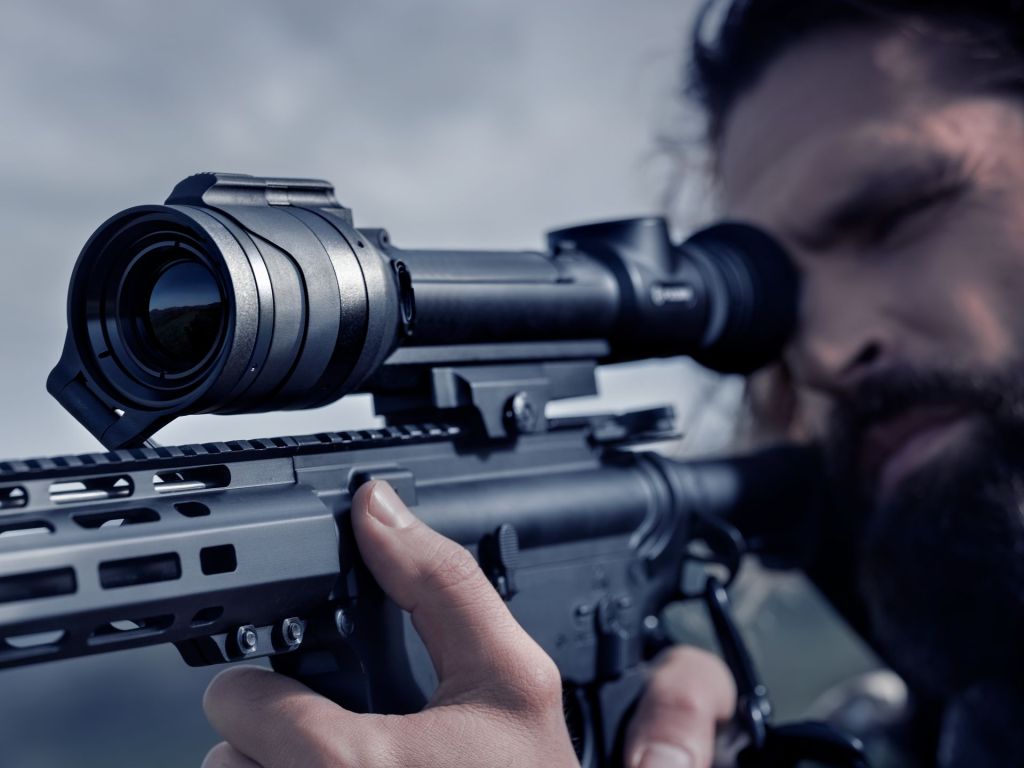
Quick Answer
- Best overall choice: A compact, recoil-rated night vision scope that mounts securely to a Picatinny rail and maintains zero on a semi-auto AR rifle
- Key features to prioritize: Wide field of view, reliable IR illuminator, intuitive controls, and balanced weight for steady shooting
- Alternative worth considering:
- A modern thermal scope or a clip on — such as the Pulsar Krypton 2 line — for faster detection in total darkness or dense cover.
- A dedicated, rail-mounted thermal riflescope — such as the latest Pulsar Trail 3 LRF — for AR setups where recoil stability, fast heat detection, and integrated ranging matter more than traditional night vision imaging.
What makes a night vision scope right for an AR rifle?
A night vision (NV) scope is right for an AR-15 style rifle (AR) when it works with the platform’s recoil, ergonomics, and intended use instead of just “fitting on the rail.” ARs are typically fast, semi-automatic rifles, so the optic has to keep up without adding awkward weight or risking a lost zero from recoil.
ARs or similar modern sporting rifles allow for flexible shooting positions. A good NV scope needs to balance three things: manageable size, rugged construction, and a mounting height that lines up naturally with your cheek weld.
Common NV scope problems:
- The optic sits too high, causing accuracy issues.
- The optic is too long, causing sight picture problems.
- The optic adds unnecessary weight to the front of the gun, causing accuracy issues.
I’ve noticed that AR rifles, depending on the caliber, can punish weak scope mounts. Semi-auto recoil, rapid strings of fire, and frequent transport in trucks or cases can loosen cheap hardware. NV optics should always be tested for keeping a zero and long-lasting toughness.
Key AR-specific requirements for NV scopes
- Mounting compatibility: The scope should clamp directly to a standard Picatinny rail or use rings designed for that interface.
- Recoil rating for the caliber: Make sure it is rated for your cartridge (for example, 5.56, .300 BLK, or .308) in a semi-auto rifle.
- Balanced weight: Ensure your scopes retain a good balance from front to back.
- Controls you can work by feel: On an AR, you may adjust brightness or zoom with the rifle shouldered, so tactile, easy-to-reach buttons matter.
Night vision vs thermal: Which is better for AR rifles?
Night vision or thermal works well for your AR rifle, but it depends on what you are doing. When you need positive identification in low-light settings, night vision is perfect. Thermal is ideal for detecting game quickly in total darkness, fog, or brush.
Traditional night vision amplifies available light, and only in dark conditions. It provides a somewhat natural view of the scene, making it easier to read terrain and identify what you’re aiming at. But on low illumination nights or in thick brush, you won’t see what you’re hunting as easily.
This is where thermal imaging comes in: it detects heat signatures rather than reflected light — and can be used during daylight. Animals stand out as bright shapes against cooler backgrounds, even through light brush or partial cover — ideal for hogs, coyotes, or other nocturnal predators.
When night vision makes more sense
- You hunt where artificial lighting or IR illuminators are allowed and effective.
- You want a more traditional, “daylight-style” sight picture for target ID.
- You shoot mostly at moderate distances and don’t need to scan huge fields.
When thermal is the better fit for an AR rifle
- You hunt in dense cover, mixed terrain, or areas with minimal ambient light.
- You need to detect heat signatures quickly over large fields or pastures.
- You want to track wounded game or locate animals hiding in brush.
Still unsure? Here’s what Vilius Ūksas, a shooting expert, recommends to consider:
Thermal still dominates for fast detection, but modern high-resolution thermals can often handle identification too — especially at typical AR distances. The real difference is consistency: night vision gives a more natural view of terrain and fine details, while thermal gives you unmatched contrast on living targets. On an AR, where shots happen quickly and angles change constantly, choosing the tool that matches your environment matters more than chasing pure image quality.
Read more: Thermal vs night vision: which to choose?
Pulsar thermal scope alternatives to night vision for ARs
Thermal scopes are a powerful night-hunting upgrades for ARs. Below is a high-level overview of how key Pulsar thermal lines work as alternatives to night vision on AR rifles. (Exact specs vary by model; always confirm details on the product page.)
| Series | Category | Sensor class | Main features | Why it’s a strong alternative to night vision for AR rifles |
|---|---|---|---|---|
| Talion Series (e.g., Talion XQ38 Pro, XG35) | Thermal riflescope | 384×288 or 640×480 sensors | Lightweight chassis, flexible mounting position, intuitive controls | Built for maneuverability. Lighter weight keeps the rifle fast to shoulder and reduces fatigue. Adjustable mount positions help set ideal eye relief, which is tricky with longer NV scopes. |
| Krypton 2 Series | Thermal clip-on | 384×288 or 640×480 sensors | Compact, fast mounting, very versatile | Mounts in front of your daytime riflescope. Retain shooting preferences while adding thermal power, less dependent on light or weather than traditional NV. |
| Trail 3 LRF Series | Thermal riflescope | 384×288 or 640×480 sensors | Compact rail-mounted design, monoblock housing, integrated LRF & ballistics | Designed for AR setups where recoil resistance, zero retention, and precise ranging matter more than ultra-light weight. |
A note from Vilius:
Clip-on thermals will always push weight to the front of an AR, so the rifle feels more nose-heavy compared to running just a daytime optic. The tradeoff is flexibility: you keep your regular scope, reticle, and zero, then add thermal on top of that when needed. The other options are going to a dedicated thermal setup or rebuilding around a night-vision clip-on, but both start to lock that rifle into a specific role. A thermal clip-on lets one AR do double duty — daytime optic for normal use, thermal capability when the hunt or job demands it.

Key features to look for in a night vision scope for AR rifles
The best NV scope features for ARs are the ones that directly support fast, accurate shooting in low light, not just impressive catalog specs.
When you decide on which optic is best for you, keep your core use case in mind. Your answers will shape which features matter most. For example, a heavier, high-magnification scope may work fine on a bench rifle, but it can feel clumsy on a lightweight AR used for quick predator hunts.
Detection range and field of view
Night-hunting scenarios are not typically long-range, but having a NV scope with the right detection range and field of view is essential for spotting and following targets within your rifle’s effective range. A scope with a detection range of up to 200 yards and a wide FOV will allow for quick detection and accurate shots. However, keep in mind that thermal devices will deliver a much longer detection range – 2,000 yards are easily achievable.
- Moderate base magnification: A lower base magnification (for example, 2–4x) keeps your field of view wider for scanning and close-range shots.
- Digital zoom vs clarity: Heavy digital zoom can make images grainy. It’s better to have a slightly lower top magnification with clean contrast than a “big number” that’s hard to use.
- Field of view (FOV): A wider FOV is especially useful for fast-moving game like hogs or coyotes, where targets rarely stand still in the center of your view.
Recoil resistance and zero retention
A scope that loses its zero due to recoil defeats its entire purpose. An AR can rapidly send repeated recoil pulses into the optic and mount. Over time, that can shift internal components or loosen mounts if the scope is not built and rated for the job—accuracy is key for ethical hunts.
Some hunters prefer a compact, rail-mounted thermal riflescope with a monoblock design for AR platforms. Pulsar’s Trail 3 LRF, the latest addition to the lineup, is built around this concept to improve zero retention and long-term reliability on semi-auto rifles.
- Look for recoil ratings: Choose optics specifically tested for the AR caliber you attach it to.
- Solid mounting hardware: Use quality rings or one-piece mounts, torqued correctly, and re-check fasteners after your first range sessions.
- Impact resistance: Night scopes get bumped on roll cages, tree stands, and truck racks. A strong housing helps protect the internals and maintains zero despite these impacts.
Additional tip for prioritizing the right features from Vilius:
AR rifles thrive in fast, close-to-mid-range shooting, so a wide field of view is one of the most important features in a night-vision scope. High magnification looks great on paper, but it slows you down. A broad FOV lets you scan the scene, pick up movement, confirm what you’re looking at, and take the shot without losing the target in a tunnel. For AR predator hunting, this matters far more than squeezing out extra zoom.
Mounting system and AR-Platform ergonomics
The mounting system and ergonomics of an AR mount can differ from those of a traditional sport rifle, changing how your eye naturally lines up with the optic, even in the dark.
AR receivers can sit higher than bolt guns, so scope height and eye relief are different. NV scopes designed for non-AR rifles may end up too low or too far forward on an AR, forcing awkward head positions.
- Picatinny compatibility: Ensure the scope or its rings are built for the standard AR rails and need to be positioned for correct eye relief.
- QD vs fixed mounts: Quick-detach mounts are helpful when swapping between optics (e.g., day glass and NV/thermal), but they must be tough and repeatable.
- Eye relief and stock length: With collapsible stocks and different shooting positions, forgiving eye relief helps you keep a clear image without hunting for the “sweet spot.”
Insight from the field: Vilius recommends key aspects to take into when choosing the right mount:
AR-15s are naturally more forgiving when it comes to optic height-over-bore, thanks to their straight-line recoil system and higher receiver. This gives you more freedom to run night-vision or thermal optics slightly higher without breaking your cheek weld. The trick is making sure that added height doesn’t interfere with charging-handle access — many NV scopes made for bolt guns sit low or extend far enough back to block the handle entirely. A proper AR-oriented mount keeps the optic high enough for smooth manipulations and far enough forward for comfortable eye relief without forcing awkward head positions.
IR illuminator quality and wavelength
If you go for digital night vision, you are unlikely to make do without an IR illuminator. Its quality and wavelength determine how well a night vision scope can form a usable image when ambient light is low or inconsistent.
Most NV scopes rely on an onboard or external IR illuminator to “paint” the scene with invisible light. Poor-quality illuminators can cause hot spots, short range, or a narrow beam that misses the edges of your field of view.
850 nm vs 940 nm:
- 850 nm illuminators are brighter and offer more range, but may produce a faint red glow at the emitter.
- 940 nm units are more covert but typically reach shorter distances.
Beam shape and adjustability: A good illuminator can be adjusted from a wide flood for close-up scanning to a tighter beam for longer shots.
Integration: Built-in illuminators simplify the setup on an AR, but dedicated external units can offer more power and flexibility if your local regulations allow them.
Additional considerations: power, controls, and firmware
Battery life, user interface, and firmware updates all affect day-to-day usability on an AR rifle.
Night hunts often stretch late into the night, so hot-swappable batteries or extended runtime are more than conveniences. Intuitive menus, simple button layouts, and features like picture-in-picture or multiple zero profiles can also make a scope much easier to live with across several AR builds.
Related: How to choose the right thermal riflescope for hunting
Night Vision Riflescopes From Pulsar
Learn MoreConclusion
Choosing a night vision scope for an AR comes down to one core idea: the optic must work with the rifle, not against it. A good NV scope balances detection range with FOV, handles recoil without losing zero, firmly mounts onto a Picatinny rail, and delivers reliable performance with a quality IR illuminator.
Modern thermal options like the Pulsar Krypton 2 clip-on push this even further. Instead of replacing your daytime scope, the Krypton mounts in front of it, letting you keep your reticle, zero, and natural ergonomics. When you snap it on, the rifle instantly becomes thermal-capable — and if you ever need to re-zero the unit, the process is quick and simple thanks to its built-in alignment tools.
Choose a Pulsar optic that supports those realities in the field rather than chasing specs on paper. From there, the right scope becomes more than an accessory: it becomes a trusted part of your night-hunting toolkit.
FAQ
What night vision scope works best on an AR-15?
The best night vision scope for an AR-15 is a compact, recoil-rated optic that mounts directly to a Picatinny rail, has a wide FOV, and includes a reliable IR illuminator.
Can you use Gen 3 night vision on an AR?
Yes, you can use Gen 3 night vision on an AR as long as the scope and mount are rated for your rifle’s recoil and properly secured to the rail. Always verify zero after your first live-fire session.
Do night vision scopes hold zero on a semi-auto rifle?
Quality night vision scopes should hold zero on a semi-auto rifle. Problems usually arise from low-quality mounts, loose fasteners, or scopes intended only for low-recoil platforms.
What is the effective range of night vision on an AR-15?
The effective range of night vision on an AR depends on the scope, illuminator, and environmental conditions, but most are practical at a few hundred yards or less.
Is digital night vision good for AR hunting?
Digital night vision can be very good for AR hunting when paired with a strong IR illuminator. It often provides flexible settings, onboard recording, and easier daylight tolerance, making it a versatile choice for mixed-light conditions.
Further Reading:
About the experts

Joshua Skovlund has covered stories for Task & Purpose, Outdoor Life, and Coffee or Die Magazine. He has photographed and filmed multinational military exercises and hunting trips in austere environments around the world, with his first archery kill in Kona, Hawaii.
Joshua grew up in South Dakota, learning how to scout and hunt deer, turkey, pheasant, and waterfowl. He currently scouts and hunts black bears, turkeys, and deer, while taking every opportunity to go to the range and further hone his pistol and rifle shooting skills.

Vilius Ūksas is an experienced precision shooter with a professional background in long-range marksmanship and ballistic application. Active in IPSC, IDPA, and the demanding Brutality match series, he combines practical, pressure-tested shooting skills with a deep understanding of ballistics and real-world rifle performance.