
Expert Contributor:
Riccardo Tamburini
Estimated read time: 7 min.
So you have decided to get a thermal for your hunting rifle, now all that’s left is to choose which one. The most common question I get is: should I choose a dedicated thermal riflescope or a thermal clip-on for my existing setup? The short answer is: it depends on a lot of variables. In this article, I’ll try to give you the best advice, so you can get what suits your needs best. Hopefully, it will save you time and money, and you avoid making beginner’s mistakes.
Note: Please make sure to know your national and local regulations and adhere to them.
Key takeaways:
- Choose a clip-on if you already trust your day scope and want thermal capability without re-zeroing.
- Choose a thermal scope if you’re building a night-only setup, to get digital reticles, rangefinders & ballistics aid, and faster acquisition.
- Clip-ons offer modularity and regulatory flexibility. Thermal riflescopes offer a dedicated solution, with everything integrated into one unit.
- The best solution depends on how, where, and when you hunt. Some advanced users use both for different purposes.
Recommended Pulsar options
- Pulsar Krypton 2 FXQ35 / FXG50 – Thermal clip-on for modular day-to-night use without changing your rifle setup.
- Pulsar Thermion 2 LRF 60 series – Full-featured thermal riflescopes with long-range performance, integrated laser rangefinder, and ballistic support.
- Pulsar Trail 3 LRF (latest model) – Compact, rail-mounted thermal riflescope with integrated rangefinding, designed for balanced thermal setups and reliable zero retention.

What’s the real difference between a thermal clip-on and a thermal scope?
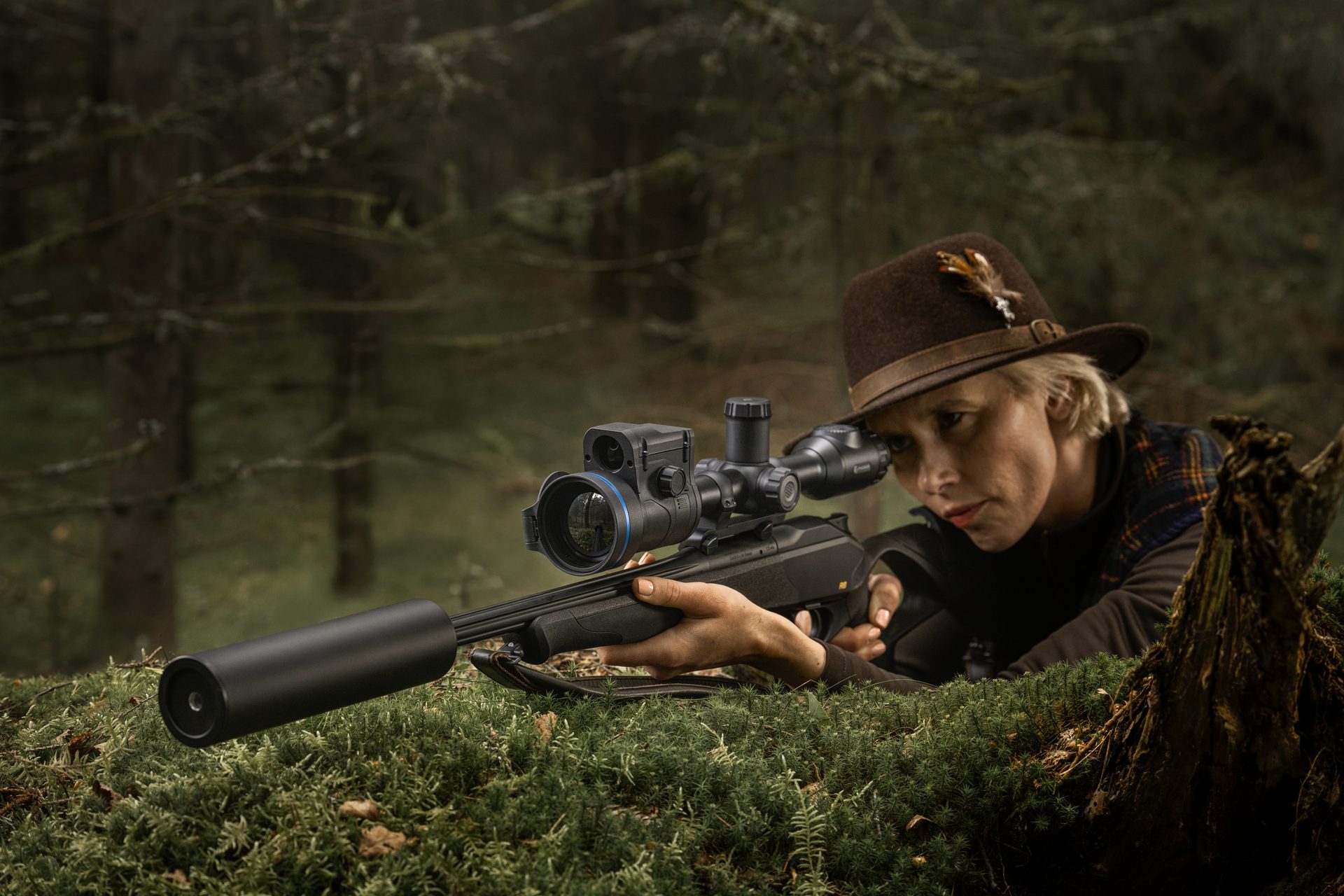
A thermal clip-on transforms your existing day scope into a night-ready optic, while a thermal scope is an all-in-one digital device designed solely for thermal imaging.
This core difference reflects two philosophies: adapt what you already have and trust, or commit to a purpose-built thermal platform as your new night-hunting platform. Each has its merits, depending on how and when you hunt.
| Feature | Thermal clip-on | Thermal scope |
|---|---|---|
| Requires day scope | Yes | No |
| Reticle type | Uses day scope’s reticle | Has built-in digital reticle |
| Mounting | In front of day scope with adapter | Picatinny/Rail-mounted |
| Mounting height | Optimal at 1.5–1.7” | Any |
| Weight distribution | Front-heavy | More balanced on rail |
| Best for | Versatility, regulated areas | Dedicated night setups |
Decision shortcut:
If you already own a premium day scope and want a fast upgrade to thermal without reconfiguring your rifle: the thermal clip-on is your path. But if you’re building a specialized night platform from scratch, a thermal scope gives you the cleanest, most integrated experience. Most of Pulsar’s riflescopes also offer an integrated Laser Range Finder (LRF), with a ballistic calculator to aid your aim in the night. This is not available for thermal clip-ons, and this feature should not be underestimated.
Some seasoned hunters use both: a clip-on for rifles used both day and night, and a thermal scope on a dedicated predator or wild boar setup.
Expert insights & product pairing
Experienced field users typically assess their terrain, legal limits, and preferred optic handling before choosing. For example:
- Flexibility needed? Use the Krypton 2 FXG50 with a daylight optic for modular, on-demand thermal capability. Thermal clip-ons are ideal for regulated hunts or scenarios where daylight hunting extends into nighttime, as they allow seamless switching between day and thermal optics without changing your rifle or ammunition.
- Need fast target reacquisition and integrated tools? Go with the Thermion 2 LRF 60mm series, offering the best thermal imaging combined with onboard Laser Range Finding, Picture-in-Picture aiming, and sub-MOA zeroing built into a single optic.
- Looking for a compact, rail-mounted thermal scope? The latest Pulsar Trail 3 LRF is designed for hunters who want a dedicated thermal setup with integrated rangefinding and ballistic support, but in a lighter, more balanced form factor than traditional full-size riflescopes.
Related: Best thermal clip-on scopes from Pulsar

While both thermal scopes and clip-ons serve essentially the same purpose, it’s already clear that the differences are also plenty. Our expert Riccardo Tamburini, a hunter with extensive experience and knowledge of thermal imaging, explains that these differences lie in the way each device is built:
Before making the choice, it’d better to make some considerations because both the solutions offer great performance. Generally speaking, a thermal riflescope is easier to build because the technicians have more “space” inside the device for all the circuits and the components it needs; furthermore, more space to use means larger sensors to mount. When you need super performances during the night, it could make the difference.
Clip-on is absolutely more difficult to assemble, because they are smaller and also because they have to be calibrated with a day scope one by one before releasing them for sales.
So, which is the best for you? It will depend on the rifle, the daytime scope, and the mount type you have: later I’ll explain when and why. But please, don’t purchase a clip-on thinking about using it as a thermal spotter and as an aiming system at the same time, because working at night, you’d lose the assembling precision and because fog, rain, cold or snow could slow your movements.
What is thermal imaging and how does it work?
Thermal imaging is a technology that detects infrared radiation (heat) emitted by objects and converts it into visible images, enabling hunters to see in total darkness, smoke, or dense vegetation.
Every object above absolute zero emits infrared radiation. Thermal optics capture this energy through a microbolometer sensor and translate it into a thermogram, an image that shows temperature contrasts. Unlike night vision, thermal imaging works without light, making it ideal for foggy, rainy, or brush-filled environments where visibility is compromised. Thermograms help hunters detect animals in low-light or dense environments by highlighting their body heat against cooler surroundings.
Key terms:
- Thermogram: Visual representation of heat
- NETD: Sensor’s ability to detect small temperature differences; lower value is better
- Microbolometer: Sensor that captures infrared energy
Read more: The operating principles of thermal imagers
Did you know?
While all thermal devices detect heat, the clarity and contrast of the resulting image depend heavily on the system’s refresh rate and sensor pixel pitch. For instance, Pulsar’s 12 μm pitch sensors deliver tighter detail and more accurate heat contours than legacy 17 μm models, especially critical for identifying limbs, antlers, or subtle movement in dense terrain.
Read more: Pixel pitch, explained | 12 µm vs. 17 µm
For a comment on refresh rate, we turn to Riccardo:
Refresh rate is very important to have clear and smooth images on the monitor you are watching. 50 Hz is the best compromise between cost and performance, and it’s considered a standard. A 50 Hz refresh rate means the thermal image on the display is updated 50 times per second. This is crucial for tracking fast-moving targets like animals, as it minimizes the lag and stuttering that would be noticeable at lower frame rates. All Pulsar devices feature a 50 Hz refresh rate, according to the international standard.
How do clip-ons work and when are they ideal?
Thermal clip-ons detect infrared energy using a thermal sensor and project that image through your daytime optic.
This makes them an ideal solution for hunters who want to preserve the clarity, zero, and trusted performance of their existing daytime scopes. Instead of replacing your optic, a clip-on enhances it with thermal capability, allowing seamless transitions between day and night use. Particularly in countries with clip-on-only regulations, they provide both legal compliance and technical precision.
Pros:
- No need to re-zero.
- Retains your day scope’s performance, with the same eye-relief.
- Dual-purpose: can be used handheld, as a scanning monocular, or sight-mounted.
Considerations:
- Requires mounting adapter and alignment.
- Adds weight to the front of rifle.
- Works best with scopes below 6× magnification.
- Optimal with 1.5–1.7” ring height for correct sight picture.
So, should you go for it? Let’s ask Riccardo:
The clip-on has the great advantage of being combinable on a rifle with a day scope already zeroed and mounted on a fixed mount. The clip on doesn’t affect zeroing, so the user will be always sure – there is no need to always go to the shooting range to zero the rifle.
If you are using a short barrel rifle with a compact daytime scope, a clip-on will be a great option. Considering the overall use, probably the clip-on is more versatile than a thermal scope. It’s the best compromise to those who use the same rifle hunting during the day and during the night. Above all, if hunting with a digital device during the day is not allowed in your country. Generally speaking, the clip-on system is often cheaper than a thermal riflescope, so if the budget is a key for your purchase, it could be something to consider.
Field reality check:
Always test your day scope and clip-on pairing before field deployment. In the beginning, it can feel a little abstract as your day optic is actually looking into the screen of the clip-on thermal. Make sure you know which button and adjustment changes what, and make sure you get some training in darkness to get the right experience.
Before you hit that ‘purchase’ button, our expert Riccardo adds a few more tips:
Before getting a clip on, a user should answer the following questions: Which type of mounts do you have? Because with quick mounts, it’d be better to have a thermal scope, but with fixed mounts, the clip on is the best choice.
Second, which type of day scope do you have? Some brands produce very long scopes, and they are not the best matching a clip on. Why? Because the system of scope and front attachment could be unbalanced, and not ergonomic.
Third, all hunters know that the best daytime scope mount is closest possible to the barrel. With a clip-on, you must ensure it is possible to mount the sight and the thermal device properly.
If you go hunting with a replica or AR platform rifle, where you don’t have all these kinds of problems, a clip-on becomes an interesting option, for sure.
Finally, although the Pulsar Krypton doesn’t need to be zeroed, I always suggest the hunter to go to the shooting range for a session, just to verify the good assembling and calibration.

How do thermal scopes work and who are they for?
Thermal scopes are standalone devices that include a thermal sensor, display screen, digital reticle, and onboard controls. They operate independently from any daytime scope.
These are purpose-built for night and low-visibility hunting. With fewer mounting complexities and built-in tools like laser rangefinders, professional ballistics aid, multiple zeroing profiles, and onboard recording, scopes offer seamless functionality for hunters who prefer speed and simplicity. Here’s how Riccardo uses his:
Thermal riflescope is my favorite option because I can use it in many different situations: from waiting a boar in the woods firing from short distance to long distance shooting in an open field.
Having the quick mounts on my rifles, I can change the aiming system from the day scope to the thermal scope in a few seconds, using also different calibers with the same thermal unit, thanks to the possibility to save the zeroing settings up to 5 different rifles. This could be very important because I’ll always be able to adapt the performance of my rifle to the situation I have in front of me.
Pros:
- Faster to deploy. The setup is dedicated to one purpose: night hunting.
- Integrated digital tools (reticle, rangefinder, ballistics aid, video).
- Multi-profile zeroing for different rifles or ammo.
- Picture-in-picture mode with ballistics for precision aiming.
Considerations:
- Like any optic, it requires its individual setup and regular zeroing.
- Replaces your day optic, and keeps the weight balance the same.
- The battery life might be slightly shorter due to more internal features.
- The setup is dedicated for thermal-only use.
Remember: A thermal can also be used during daytime.
Not sure which system to go for yet? Riccardo leans towards the riflescopes, and here’s why:
Talking about nighttime use, thermal riflescope certainly has more flexibility than a clip-on; there is the possibility to have an embedded rangefinder, to be more precise at any distance; it is a complete and independent device, and it doesn’t need any other system to properly work. It’s more ergonomic, and it can be fitted on all types of rifles using the right height of the mount rings.
Pulsar riflescopes offer is wider than the clip-ons, which means more devices to choose from at any price level. Generally speaking, the hunter can take advantage of bigger sensors, having consequently better performance. For this reason, it’s possible to work with a bigger magnification than a clip on, above all purchasing a high-end thermal riflescope and without working with the PiP window open (although it helps you in having a better precision and a wide FOV at the same time). The possibility to use an embedded ballistic calculator will give the user the possibility to always be super precise at any distance different from the zeroing distance.
Terrain-based use recommendations
Matching your optic to your hunting environment ensures peak performance in real scenarios – not just lab specs.
| Terrain type | System type | Pulsar model | Why it’s ideal |
|---|---|---|---|
| Fog or snow cover | Sensitive clip-on | Krypton 2 FXQ35 | High sensitivity reveals targets in low contrast |
| Open field / plains | Thermal scope | Thermion 2 LRF XP50 Pro | Long-range clarity + integrated rangefinding |
| Mixed terrain, professional night hunting | Compact rail-mounted thermal scope | Trail 3 LRF (XQ50 / XR50) | Balanced monoblock design with integrated LRF and ballistics, built for reliable zero retention and real-world night hunting |
| On-foot stalking | Lightweight scanner | Axion XG30 Compact (monocular) | Light build, convenient use, and video streaming |
How does NETD affect performance?
NETD (Noise Equivalent Temperature Difference) measures how well a thermal device can detect slight differences in heat. The lower the figure the better.
In misty woods or after rain, animals barely stand out from their surroundings. A NETD of <25 mK can detect subtle heat signatures that cheaper sensors miss entirely. For maximum contrast clarity, Pulsar’s Thermion series use sub-25 mK and even sub-20 mK sensors.
| NETD rating | Image clarity | Ideal for |
|---|---|---|
| <40 mK | Standard | Mild climates, open terrain |
| <25 mK | Enhanced | Fog, snow, heavy vegetation |
| <18 mK | Elite | Expert use, ultra-low contrast |
If you want to dive deeper, Riccardo explains NETD further:
The NETD is probably one of the most important features to consider before buying a thermal scope. The lower the value is, the better the possibility will be to see the smallest differences in temperature. Sometimes, the small details can be the difference to cull the right animal: the length of the nipples of a boar female or the raised lip of a young male can be viewed only using a low NETD device. It’s very important to understand if the NETD is measured to the sensor or to the instrument because in that case, the low value is the result of a filters adding in the algorithm which means more time to process the thermal radiation; this can bring latency in the image transmission and a higher chance to miss the target.
All the sheets included in the Pulsar device manuals, show the NETD value measured to the sensor (real) and to the instrument (s-NETD). NETD is deeply connected to other important features: the size of the pixel pitch (it’s better to have a 17 mm) and the lens aperture, which will have to be f 1.0
Tip: When you read a super low NETD value and a 12 mm pixel pitch, probably you are reading the s-NETD and not the real value gotten from the sensor. You should see the pixel pitch as a box: bigger is the box and bigger will be the number of things you can put inside.

Battery life, charging, and field runtime
Battery performance can determine whether your thermal system supports a full night’s hunt, or forces you to an early retreat.
Pulsar scopes and clip-ons use rechargeable batteries. The runtime varies by model and usage:
- Pulsar Thermion 2 LRF XL60: up to 8 hours
- Krypton 2 FXG50: up to 11 hours
- All models: support USB-C charging, external power banks and spare batteries.
Whether in a stationary blind or mobile stalk, the ability to hot-swap a battery or plug in a power bank ensures you stay active during peak movement hours.
Pulsar field tip: In winter or sub-zero conditions, internal batteries can discharge faster. Carrying a warm spare battery in an inside pocket helps maintain voltage levels.
When should you choose clip-on vs thermal scope?
The choice often comes down to your primary use case. If you’re hunting both day and night, travel between countries with strict optic laws, or need to switch modes quickly without re-zeroing — clip-ons are the answer. They keep your rifle platform intact and let you retain your trusted glass. This is especially helpful when stalking game at dusk that extends into nightfall. Plus, if your hunting starts in daylight and runs into darkness, clip-on systems offer unmatched continuity.
On the other hand, if you hunt predominantly at night or want onboard tools like laser rangefinding and ballistic calculations, a thermal scope offers better integration and control. There’s no adapter to align, no need to worry about front-heavy balance, and everything is designed for speed and simplicity.
Related: Best Pulsar thermal riflescopes for hunting
Decision shortcut: If your day scope is premium and you need fast, modular thermal capability, go clip-on. If you want a seamless, all-in-one system built for nighttime precision, go with a thermal scope.
Field warning: If your day scope has more than 6× magnification or a narrow field of view, your thermal image may degrade with a clip-on. Always test compatibility before field use.
Additional tip from Riccardo:
Today, you have a lot of options to choose from before purchasing a thermal aiming system; when someone asks me which is the best option for them, I try to understand which type of hunter I have in front of me.
The clip-on is the best choice for those who spend less time hunting during the night and want a versatile system which will allow them to use the same tackle (rifle and scope) during the day and during the night.
If you are a professional hunter or a ranger, who spends a lot of time looking for an animal who has nighttime habits, for hunting or pest control action, the thermal riflescope is the best. At the end, the clip-on is an overall versatile option, but the riflescope is a super flexible device for night hunting.
Final takeaway: which one should you choose?
Choosing between a thermal clip-on and a thermal scope comes down to one question: do you want to enhance what you already use, or build a dedicated thermal system from the ground up?
- Go with a clip-on if you value flexibility, already trust your day scope, or need to meet local regulations. It’s a modular, efficient upgrade that protects your existing setup. In almost all cases, it’s also a smaller investment. But if it doesn’t suit your needs perfectly, go for a thermal rifle scope.
- Choose a thermal scope if you’re hunting exclusively in low light, need onboard tools like a rangefinder and ballistic calculations, and want the best overall solution without any compromises.Still unsure?
- Start with the Krypton 2 FXQ35 or the FXG50 if you’re entering thermal for the first time.
- Choose one of the Thermion 2 LRF 60mm models if you’re ready for elite-level integration, image quality and precision.
Whatever path you take, you’re not just buying optics—you’re choosing how you see the hunt.
FAQ
Can I use a thermal clip-on during the day?
Yes, thermal clip-ons function during the day, but they don’t benefit from daylight like traditional scopes. They detect heat, not light. The performance is consistent regardless of ambient light.
Do thermal scopes require re-zeroing every time I switch rifles?
Not necessarily. Pulsar thermal scopes allow you to save multiple rifle profiles, meaning you can switch between guns without re-zeroing—just select the correct profile. Many hunters use Quick-Detach mounts to switch between optics in an instant.
Is image quality better in a clip-on or a scope?
For most users, image quality is similar if the clip-on is properly aligned and used with a quality day scope. However, thermal scopes may provide slightly better contrast at higher magnification levels due to direct digital processing. The high-end thermal scopes will have the best image available.
Are thermal devices legal for hunting in my country?
Regulations vary. In some European countries, clip-ons are allowed while scopes are restricted. Always check local laws or consult your Pulsar dealer.
Can I record video or stream with these devices?
Yes. All new Pulsar devices support Stream Vision 2, allowing video recording, live streaming, and image transfer to your mobile device.
What’s the best option for beginners?
The Krypton 2 FXQ35 or the Krypton 2 FXG50 offers modularity and simplicity for first-time thermal users, while the Thermion 2 LRFs are ideal for those who want to enjoy a fully integrated system.
About the experts
Expert Contributor:
Riccardo Tamburini
Riccardo Tamburini is a lifelong outdoorsman, hunter, fisherman, and professional wildlife photographer and filmmaker.
With over 35 years of experience across plains and mountains in Italy and abroad, he combines field expertise with a mechanical engineering background to explain the technology behind rifles, optics, and digital devices.

Co-Author:
Erik Bjaelkvall
Erik Bjaelkvall is a former Arctic Ranger, now a competitive practical shooter, seasoned hunter, and gear expert with decades of field experience.
Operating out of Sweden, Erik has extensively tested thermal imaging equipment across diverse environments – from open plains to rugged mountains, through snow, fog, and sun.
Before purchasing any night or thermal vision device, please make sure you adhere to the local legislation and only use it when it is allowed. Our ambassadors come from various countries and travel a lot, which allows them to test different devices. We do not encourage or support the illegal use of our devices in any events. If you wish to learn more about export and sales restriction policy, please visit the following link: Export and Sales Restriction Policy.