
Estimated read time: 12 min.
Pest control targeting raccoon dogs in Denmark involves a combination of modern technology and specialized techniques. Night hunting for raccoon dogs is unique in Denmark, as it is the only type of night hunting that is legally permitted. Hunters rely on a good combination of fish bait and trail cameras to attract and observe the raccoon dogs, while using thermal spotters and infrared scopes to identify and observe their movement in the darkness. All these tools work together, enabling hunters to efficiently manage raccoon dog populations and protect native wildlife.

Raccoon dogs vs. raccoons
Raccoon dogs (Nyctereutes procyonoides) are adaptable East Asian canids that thrive in wetlands and edge habitats. In Denmark, they are categorized as pests due to their impact on native wildlife, especially ground-nesting birds and amphibians. Their swimming ability allows them to access areas other predators avoid, leading to increased pressure on species like lapwings, terns, and ducks.

Despite the similar name and appearance, the raccoon dog (Nyctereutes procyonoides) is not related to the raccoon (Procyon lotor). The raccoon belongs to the family Procyonidae, native to North America, while the raccoon dog is a canid, more closely related to foxes and wolves. The resemblance comes from convergent evolution—both species developed a masked face and ringed fur patterns for camouflage. Unlike raccoons, raccoon dogs do not climb trees or use their forepaws like hands, but they are excellent swimmers and ground-dwellers.
Although native to East Asia, raccoon dogs now occupy much of Northern and Eastern Europe. Some countries fight establishment; others already manage widespread populations. Denmark’s aim is to hold Jutland and prevent bridgeheads on Funen and Zealand. The pressure is highest in South Jutland along the German border, and despite heroic local effort, constantly crawling northward.
The spread of raccoon dogs
Encounters with raccoon dogs are still uncommon during regular driven hunts with rifles and shotguns. Native hunting dogs are largely unfamiliar with raccoon dogs, often even avoiding them due to their strong odor and interesting tendency to play dead when cornered. As a result, regular hunters rarely encounter these animals, even with a widespread presence in the area.
| Country | Local name | Status |
|---|---|---|
| Denmark | Raccoon dog | Widespread |
| Sweden | Mårdhund | Not established |
| Norway | Mårhund | Not established |
| Finland | Supikoira | Widespread |
| Germany | Marderhund | Established |
| Poland | Jenot | Widespread |
| Estonia | Kährik | Widespread |
| Latvia | Jenotsuns | Widespread |
| Lithuania | Usūrinis šuo | Widespread |
Ecology and impact: understanding raccoon dog behavior
Raccoon dogs are opportunistic omnivores, with diets that vary according to season: amphibians and small mammals predominate in spring; berries, insects, and bird eggs in summer; and carrion along with agricultural remnants in autumn. This dietary flexibility provides them with a competitive advantage over native predators. In contrast to foxes, raccoon dogs enter a state of light hibernation during winter, which reduces their impact on prey species at that time but facilitates a swift resurgence in predation in spring.
Mating typically occurs between February and March, with females giving birth to litters of six to nine pups following an approximate 60-day gestation period. Both parents contribute to rearing the offspring, a trait that distinguishes raccoon dogs from most other canids. The combination of large litter sizes and biparental care enhances their ability to establish and expand populations rapidly.
Preferred habitats include wetlands, reed beds, and riparian zones, which offer ample food resources and cover. Their swimming proficiency enables them to inhabit islands, marshes, and lakeshores where competitors such as foxes and badgers are infrequently present. The resulting ecological niche overlap contributes to elevated predation pressure on ground-nesting birds like lapwings, curlews, and ducks.
Raccoon dogs are established vectors for parasites and diseases, including sarcoptic mange, rabies, and Echinococcus multilocularis, a hazardous tapeworm species. Their potential to transmit these pathogens is a significant concern for regions aiming to prevent their proliferation, particularly due to the associated public health risks. Handling raccoon dogs should always be conducted with protective gloves, and strict hygiene protocols must be followed when coming into contact with carcasses or contaminated materials.
Are you allowed to hunt raccoon dogs?
Although raccoon dogs can legally be controlled as pest year-round in Denmark, practical control often tends to follow their natural cycle. From 1 November, regulation usually stops as raccoon dogs enter winter torpor and bait sites go quiet. Activity resumes in late February, when they wake and start seeking animal remains. A further pause occurs in May and June, when pairs are raising pups, before pest control efforts continue through summer and autumn. The young pups are often encountered as slightly easier prey at the bait sites during summer.
How to hunt raccoon dogs at night
Although most hunters can distinguish between foxes, badgers, and raccoon dogs during daylight hours, identification becomes more challenging after dark. Given that these three species frequently visit the same bait sites, it is essential for hunters to accurately recognize their distinct nocturnal behaviors and thermal profiles.
- The fox has a lean body and moves with a high step, accompanied by a long tail. The thermal signature shows slim limbs with notable temperature differences, while infrared imaging highlights a narrow nose and pointed ears, as well as frequent head movement.
- The badger has a low, heavy body with rolling shoulders and its head angled downward. Thermal signature displays a concentrated heat core and cooler legs, while infrared imaging reveals a striped facial pattern and wedge-shaped profile.
- The raccoon dog is broader and lower than the fox, with a shorter tail and a stop-and-go gait. It often sniffs the air with a high head, unlike badgers. Thermal signature shows it has a fuller body heat at a slower pace, and infrared highlights its darker facial markings, short nose, and round ears.

What night optics can you use for hunting raccoon dogs in Denmark?
Danish law clearly separates regular hunting from pest control, with different rules applied for these different types of hunting. Since raccoon dogs are registered as an invasive species, the rules of pest control apply, and a lot of the normal “gentleman rules” for hunting are removed in the name of efficiently controlling the numbers. For Racoon dogs this difference in classification spells a certain kind of doom:
- Hunters may legally shoot raccoon dogs at baited sites without restrictions related to daylight hours.
- The use of thermal spotters for detecting raccoon dogs at bait locations is permitted.
- Light-amplifying rifle scopes are authorized for shooting; however, thermal rifle scopes remain prohibited.
These permissions regarding night optics are specific: Raccoon dog pest control is the only situation where thermal spotters are allowed during hunting activities in Denmark, as well as the sole use case permitting an infrared scope on a rifle. No other species or circumstances currently permit the use of night optics for Danish hunters. This reflects the environmental concern associated with the species and the authorities’ commitment to controlling their population. It also indicates that, generally, Danish regulations on night optics for hunting remain restrictive, with new technological methods introduced cautiously.
Hunters in Denmark can apply for a license to purchase and store night-optics, provided the application specifies it is for hunting outside the country. Many Danish hunters legally own a thermal spotter and an infrared or thermal riflescope for wild boar hunting in Sweden, while use of such equipment within Denmark is limited to only raccoon dog control.
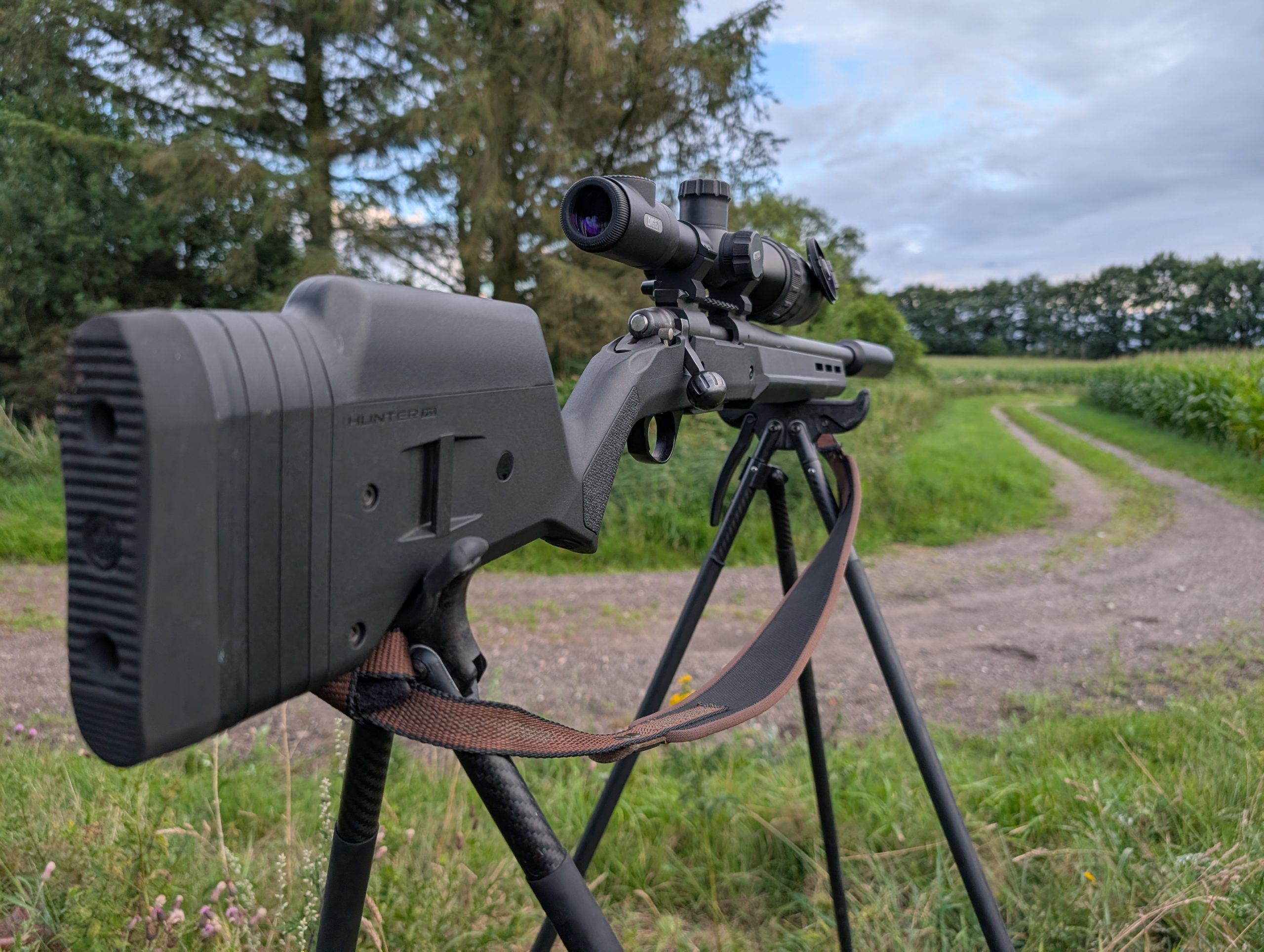
Best thermal and infrared devices for hunting raccoon dogs
Thermal devices detect heat signatures, making it possible to identify warm objects in environments such as reeds or brush. They are particularly effective for short-range detection around bait, and even basic models provide noticeable improvements over moonlight visibility or traditional flashlights. The infrared riflescope with a focusable IR beam provides clear detail for identifying species and sex, allowing you to observe features like head, ears, tail, and gait at night before taking the shot.
For night hunting, I personally use a Remington 700 SPS Tactical in .308 Winchester with a Magpul Hunter stock and Nielsen Paradox suppressor. An IR torch is mounted forward to prevent scope glare, and stability is provided by a Viperflex Styx Pro shooting stick. For infrared scope I use the Pulsar Digex C50; although it is starting to age, it boots almost instantly and still performs extremely well in low light conditions in combination with a focusable IR beam.
When it comes to thermal scanning, I lean towards the Pulsar Merger XP35 due to its comfort and generous field of view; however, it’s not always the best fit for stationary hunts. At baited sites, I find the compact Pulsar Oryx much more suitable, especially with its latest software update, which lets me monitor discreetly via my phone using a USB connection. For hunts where I’m staying put and focused on bait, I’ll typically use the Oryx to keep fatigue at bay. If I’m planning a longer, more mobile session, the Merger is my go-to. Ultimately, I recommend choosing between these devices based on your specific hunting approach rather than just their price points.

Raccoon dog hunting methods: Static waiting over bait
Most raccoon dog bait stations are established promptly upon identifying significant signs of activity. These setups are typically temporary and often comprise a basic bait site with a trail camera positioned in front to monitor visits and patterns. If there is no activity for an entire week, a new site is selected. When raccoon dogs visit the bait, their time of arrival is carefully recorded. The following day, the hunter typically positions themselves crosswind or downwind from the bait at a distance of 50 to 75 meters, using a thermal spotter for active surveillance.
Accurate identification is crucial in this pest control method; use IR to confirm before shooting. Racoon dogs often arrive in pairs, with the female typically appearing last and being the usual target. After firing, reload promptly and wait silently, as the mate may linger for a follow-up shot or return later to the bait.

In South Jutland, two hunters use sixty mobile trail cameras to monitor a county-sized area, moving cameras when a spot shows no action. Previously, they would catch 15–20 animals in a year, but with the introduction of night optics, the same number can be reached in just a week if conditions are right. In West Jutland, another group has recorded their three-thousandth raccoon dog since 2019, highlighting the ongoing effort required for control.