
Expert Contributor:
Riccardo Tamburini, Kevin Murphy
Estimated read time: 6 min.
Standing in an open field as the thick fog blankets the grass and the first light touches the horizon can feel magical – a moment when you’re waiting for wildlife to reveal itself. Yet, for the traditional hunters, this is also a time of great uncertainty and challenge.
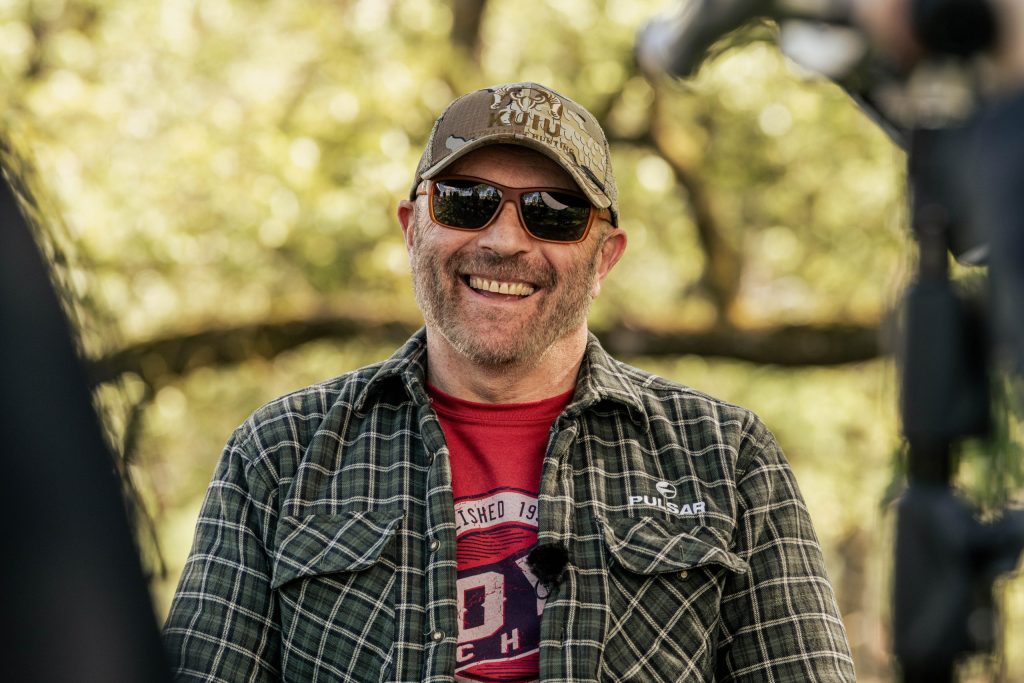
Meet our trusted Pulsar Ambassadors: Riccardo Tamburini from Italy and Kevin Murphy from the UK. Both have witnessed a dramatic transition from traditional hunting practices to those driven by modern technological advancements.
-

- Riccardo Tamburini
-
- Kevin Murphy

The challenge of low-light hunting
Before thermal devices were even a topic of discussion, the rhythm of both wildlife and the hunter was dictated by natural light. Critical moments – just before twilight – offer low visibility, yet this is often when nocturnal and crepuscular animals, such as red deer, roe deer, and wild boar, quietly emerge to feed. This gives the hunter a fleeting opportunity to demonstrate precision and speed.
As Riccardo describes, “You have little time to place a good shot, but if you are not able to leave a downed animal close to the point of impact, you have to start a tough search to find the carcass. Often, you need a special dog, but it’s available only the next day. In summer, this delay can be a major problem.”
Kevin echoes this struggle, recalling that hunting in unfavorable light without a technological advantage was an almost impossible task. “Use of lamps was really the only thing I had used, and although this can be effective even now, thermal really did change everything and took away that doubt that I had as a hunter: Is there something here? Is it safe? Often, I wouldn’t take a shot due to that uncertainty,” he says.
Use of lamps was really the only thing I had used, and although this can be effective even now, thermal really did change everything and took away that doubt that I had as a hunter: Is there something here? Is it safe? Often, I wouldn’t take a shot due to that uncertainty.
Kevin Murphy

The thermal revelation: an “Aha!” moment
The moment of clarity – the thermal “Aha!” moment – is when a distant, blurred shadow transforms into an animal with a distinctive shape and heat signature.
While Kevin was already familiar with night vision after a couple of years of hunting, Riccardo came to thermal technology after more than 30 years of experience. He remembers an old and affordable Pulsar Axion XM30S monocular that turned his understanding of hunting on its head. “I felt like a kid with a new toy. A new world opened to my eyes: the dark world. It was amazing to see the tips of the ears of a roe deer in the tall grass!” he shares.
Riccardo notes it took several tests to use the device to its full potential. This didn’t just change his hunting game – it shifted his perception of the practice. “People often think that using a thermal unit, a hunter will be able to understand which animal is watching from very, very far. It’s not true. You can understand what you are watching, but only thanks to your knowledge, because you will see only some lights in the dark without getting any other info. Hunting is also research, and a lot of hours are spent glassing the environment around you.”
Hunting is also research, and a lot of hours are spent glassing the environment around you.
Riccardo Tamburini

Fieldcraft vs. technology: earning confidence
Kevin, on the other hand, felt a brief initial hesitation, wondering how much this technology would fundamentally change the hunt. “It almost felt like I was cheating! I knew this would change everything for me,” he recalls. And he was right. After a while, he felt undeniable confidence in both diurnal (daytime) and nocturnal hunting: “The main thing it did for me was show me that I can use thermal day or night.”
Similar to Riccardo, Kevin considers thermal a highly adaptable tool that adds to a hunter’s skills but requires the same responsibility and knowledge. He enjoys variety in his outings and still relies heavily on his core skills: “I try to use traditional binoculars as much as I can still. Even though thermal is a huge part of hunting for me now, fieldcraft is still a key skill to have and practice as a hunter.”

Advice for thermal newcomers
With hunting being a huge part of their lives, both Ambassadors view it as a passion that requires an unavoidable responsibility toward nature and the community.
Offering advice to newcomers, Kevin stresses the need for careful consideration: “First, think about what and where you hunt. You need to research the right device for you,” he advises. This means considering your typical hunting range, the quarry, the required sensor quality, and your budget. “Thermal optics can be expensive, but you rarely need the top-of-the-line sensor. Often, a cheaper, more affordable model will be more than enough.” For example, he suggests the Axion XQ19 Compact monocular. “For most situations, this will be more than enough to locate that heat source and confirm what you’re looking at.”
Thermal optics can be expensive, but you rarely need the top-of-the-line sensor. Often, a cheaper, more affordable model will be more than enough.
Kevin Murphy

“The second thing,” he continues, “is to take your time to learn how different animals move, behave, and what they look like through thermal imaging. This will be much better for you in the long run when it comes to identifying your target instead of making a mistake due to being new to thermal.”
Riccardo adds another crucial piece of advice, saying one should not spend too much time with their eye glued to the thermal device’s eyepiece. “Eye strain could be annoying,” he explains, “especially with certain settings or color palettes. I know people are always super excited about what they can see in the dark during their first use, but you always have to focus on the potential problems we may have when looking at a digital display for a long time.”
The journey from doubt to clarity is more than just a device; it’s about refining your connection to the field. By integrating thermal technology with time-honored fieldcraft, you’re not cutting corners – you’re simply enhancing your ability to act responsibly and with certainty.