
Estimated read time: 7 min.
Getting the resolution wrong on a thermal device is an expensive lesson. Too low, and you are squinting at blurry heat signatures when you need a clear target ID. Too high, and you spent a premium on performance that your typical hunting range will never unlock.
Sensor resolution shapes everything, from image sharpness to how far digital zoom remains useful — but it only tells part of the story. The right choice comes down to where you hunt, what you hunt, and how far your shots typically travel.
This guide walks through each resolution tier, the conditions under which each performs, and the honest trade-offs between them — so the decision makes itself.
Quick answer
There is no universal best resolution, but there is a best resolution for your situation:
- 384 x 288 performs well in woodland and close to medium range scenarios, typically up to around 200 m.
- 640 x 480 is the stronger choice for open ground, longer distances, and situations where positive animal identification is critical.
- 1024 and above is reserved for professional-grade use, where maximum image detail at extreme range is a non-negotiable requirement.
For most hunters, the choice comes down to 384 or 640. Distance and terrain are the deciding factors.
How much does thermal resolution matter?
Every pixel on a thermal sensor records a temperature value. More pixels mean more data points, and more data points mean a more defined image. At 100 meters, the difference between a 256 x 192 sensor and a 640 x 480 sensor is modest. At 300 meters, it becomes the difference between a readable animal silhouette and an unidentifiable warm shape.
Sensor resolution comparison: 384×288 vs 640×480. Higher resolution reveals more of the scene.
However, resolution does not work on its own. Pixel pitch, the physical size of each pixel measured in micrometers, determines how much infrared energy each pixel can absorb. A larger pixel collects more energy and tends to perform better in low-contrast conditions, such as fog or humid air. A smaller pixel packs more detail into the same sensor area and sharpens edges at a distance.
NETD, the sensor’s thermal sensitivity measured in millikelvin, controls how well the device separates an animal from its background when temperature differences are small.
Resolution sets the ceiling on image detail. NETD and pixel pitch determine how well the device reaches that ceiling in real hunting conditions. For a thorough breakdown of how all three interact, Pulsar’s thermal sensor guide is worth reading before you buy. And for a hands-on insight, we turn to a well-seasoned hunter, Riccardo Tamburini:
What is the best? Larger resolution and smaller pixel pitch or the other way around? The answer is always deeply linked to the distance of observation I need. I’m a 360° hunter, so I need a device that can cover the widest range of scenarios I could have. Generally speaking, I prefer having a good resolution, with a higher pixel pitch: the bigger dimension helps me to get more info about the target in front of me within 200 m, because the animals I’m observing are closer and I need the possibility to get more details; and this is the most frequent scenario. At long range, more than 300 meters, the situation becomes different: a 12 micron helps me to have an image less pixelated when increasing the base mag; a mid-size sensor will work perfectly, but only if the base magnification is 3x or more. This will affect the FOV, so it’s important to consider this, too.
What thermal resolution do you need for hunting?
A practical framework helps here. Think in three tiers based on where most of your shots land:
- 384 and below cover short- to medium-range hunting.
- 384 to 640 handle the majority of general hunting scenarios.
- 640 and above are for long-range detection and positive identification at a distance.
| Resolution | Pixels | Best for | Typical detection range | Example use |
| 256 x 192 | ~50K | Entry-level, close-range spotting | Up to 400 m | Budget pest control, dense woodland |
| 384 x 288 | ~110K | Mid-range hunting, game recovery | 500 to 1,000 m | Coyote or varmint at 100 to 300 m |
| 640 x 512 | ~328K | Versatile long-range | 1,000 to 2,000 m | Deer or fox in open fields |
| 1280 x 1024 | ~1.3M | Premium, extreme detail | 2,000 m and beyond | Precision identification at full zoom |
Detection ranges based on Pulsar product specifications for a target sized 1.8×0.5 m.
These ranges give a baseline. Your actual needs depend on terrain, target species, and how often you genuinely engage at each distance. Most hunters overestimate how far they regularly shoot. That being said, if the budget allows, Riccardo recommends getting the best option possible:
The best choice is always a big resolution sensor because it can cover a bigger number of scenarios. The image will be the best available on the market, allowing me to get a good image even when increasing the base magnification a lot. The problem could be the price, so if someone is looking for the best quality/cost ratio sensor, I always suggest 384×288: The Pulsar last generation devices have an incredible quality, much better than the units released on the market a couple of years ago.
Understanding thermal resolution levels for hunting (256 to 1280+)
Not all thermal sensors are built to the same standard, and the gap between tiers is significant. Here is what each level actually delivers in a hunting context.
Low resolution: 256 x 192 and 320 x 240
Entry-level sensors at this tier detect heat and movement at close range, typically within 200 meters. Image detail is limited, and digital zoom quickly produces visible pixelation.
For hunters working in tight cover with predictable short-range engagements, these devices offer a low-cost entry point. Positive identification of smaller animals or at longer distances will be difficult.
Standard resolution: 384 x 288
This tier covers the widest range of general hunting use cases. Animal outlines are clear at practical distances, species differentiation is reliable within 200 meters, and modest digital zoom remains usable.
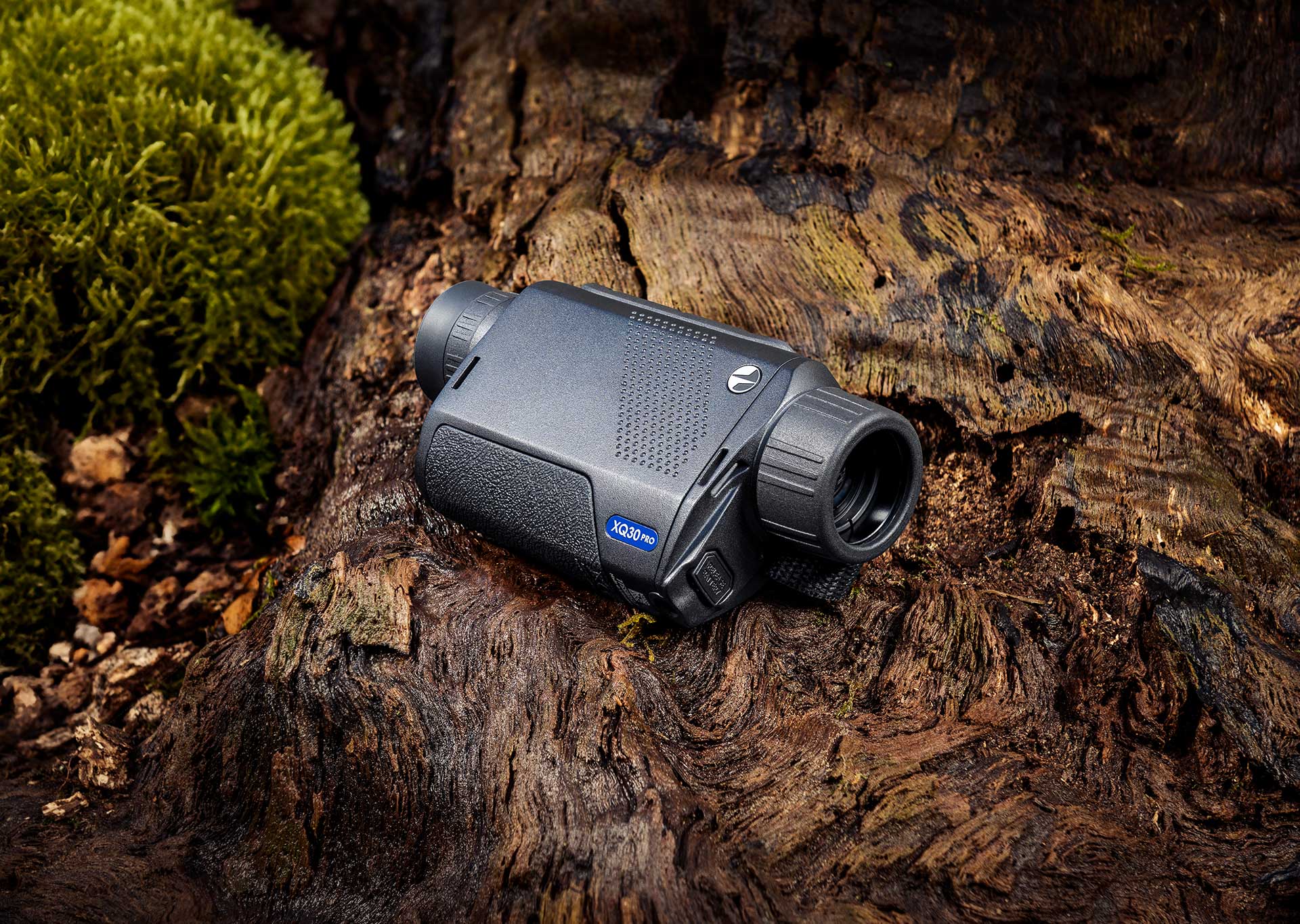
The Pulsar Trail 3 LRF XQ30 and Pulsar Axion XQ30 Pro are well-known examples at this resolution. Both are compact, field-proven, and appropriate for hunters who move on foot through mixed or forested terrain.
High resolution: 640 x 480
At 640, images hold detail at greater distances and remain clear at higher zoom levels without degrading into noise. Body shape, fur texture, and posture become visible in ways that influence shot decisions.
The Pulsar Thermion 2 LRF XP60, Trail 3 LRF XR50, and Pulsar Telos LRF XP50 sit in this tier and deliver reliable target identification well past 200 meters under favorable conditions.
That being said, Riccardo recommends looking beyond resolution itself:
The pixel works like a box: the bigger the box, the higher the number of things you can put inside; a 17 micron pixel pitch allows storing more info compared with a 12, so it’s better at short and mid distances. This option offers the possibility to range inside a lot of scenarios. A 384×288 with a high base mag will perform very well at short and mid distance, and a 640×480 with a lower base mag will work very well at any distance, with a bigger FOV and the possibility to have a good look at the area in front while focusing on a precise heat signature. It seems a paradox, but knowing how zooming works could help a user in the choice, because a 384 with a base mag of 3x could have a better image quality than a 640 with a 1.5x base mag zoomed at 3x. So, it becomes very important to consider the observation distance a user usually finds during the nights spent in the field.
Ultra-high resolution: 1024 and above
The Pulsar Thermion 2 LRF XL60 uses a 1024 x 768 HD sensor, making it the choice for hunters who need maximum clarity at extreme range. The Pulsar Merger LRF XT50 thermal binoculars go further with a 1280 x 1024 sensor, the highest resolution available in a civilian hunting device from Pulsar, delivering exceptional detail across extended observation sessions.
High-resolution sensor image showing enhanced detail
Thermal resolution vs. image display: what’s the difference?
Two numbers appear on almost every thermal device spec sheet: sensor resolution and display resolution. Confusing one for the other leads to poor buying decisions.
Sensor resolution is the number of pixels on the microbolometer, the component that captures thermal data. This figure sets the upper limit on image detail. Display resolution is the number of pixels on the screen that present that data to your eye. A 384 x 288 sensor can be paired with an AMOLED display at 1024 x 768, but the display cannot manufacture detail that the sensor never recorded.
Image processing adds another layer. Pulsar’s proprietary algorithms enhance edge definition and micro-contrast in real time, improving how sensor data is rendered on screen. This is a meaningful performance advantage. A well-processed 384 sensor will produce better results than an unoptimized 640 sensor in many conditions. Even so, the resolution ceiling belongs to the sensor, not the display or the software.
When you see a high display resolution listed alongside a modest sensor resolution, understand what that means in practice. The screen is doing its job well. The sensor is still the limiting factor at a distance.
However, it’s important to remember that overprocessing can also raise some issues. Here’s what Riccardo warns against:
Latency is one of the worst enemies a user can find in a thermal scope. The paradox is that it’s very easy to measure, even before purchasing a thermal unit directly in a shop, but many hunters don’t know this issue. Some devices in the market are up to 0.6 sec of latency. It seems like a short time, but it can make the difference between a perfectly placed shot and a dramatic failure; the best example of that is the head shot: many hunters often try it, but the head of the animal is the most moving part of the body, and it’s very difficult to predict its movement, so a small delay will always guarantee a bad shot. How is latency born? Because some producers bluff about the values of declared NETD. This is an important feature, but it can be measured at the sensor or at the instrument. The value measured at the sensor is the pure value, which expresses the goodness of the sensor itself. The value measured at the instrument can be counterfeit data, received by heavily manipulating the software that converts the thermal radiation into an image. To do that, the software needs time, and this time is the latency between what happens in the reality and what a user sees through the display. All Pulsar devices have zero latency.
384 vs. 640 thermal resolution for hunting: which one is better?
Most buying decisions come down to this comparison, and neither option wins outright.
In the image detail, the gap between 384 and 640 grows with distance. Within 150 meters, both sensors produce clear, usable images of medium to large game. Beyond 200 meters, 640 retains meaningful detail that 384 begins to lose. At 400 meters in open terrain, 640 gives you a readable body shape and approximate species confirmation. A 384 sensor, at the same distance, gives you a heat signature with far less information attached.
In real hunting conditions, the detection distance comparison is not purely about resolution. A 384 sensor with a large objective lens, strong NETD, and a 17 µm pixel pitch may detect targets farther than a smaller 640 device with weaker sensitivity. The Pulsar Trail 3 LRF XQ30 demonstrates this well: its 384 x 288 sensor with a solid thermal sensitivity serves forest hunters reliably at typical engagement ranges.
On value versus performance, 384 remains the better match for hunters whose shots stay within 200 meters and whose terrain limits sightlines naturally. Paying for 640 performance in dense forest yields marginal returns. Paying for 640 performance on open moorland or farmland is money well spent.
When high resolution (640 and above) is necessary
Open field hunting removes the natural range limitations that make 384 sufficient in forest environments. When you are scanning hundreds of meters across agricultural land or open hillside, you need to identify what you are looking at before committing to a shot. A 640 sensor provides the detail to distinguish deer from livestock, or a fox from a dog, at distances where a 384 image has already become ambiguous.
Long-range spotting beyond 200 meters also consistently favors 640. The Pulsar Telos LRF XP50, with its 640 x 480 sensor at 17 µm, is widely used for this purpose. At 4x digital zoom, it retains usable image quality where lower-resolution devices would produce pixelated, uninformative frames.
For hunters who operate at extreme distances or require absolute certainty before the shot, a 1024 x 768 sensor removes the remaining doubt that even a strong 640 device cannot fully eliminate. The Pulsar Thermion 2 LRF XL60 is the practical example: at distances beyond 500 meters, its HD sensor retains enough image detail to assess body posture, confirm species, and judge shot placement with confidence. This level of clarity is not necessary for most hunting situations, but when the terrain is vast, the target is distant, and the margin for error is zero, 1024 is the resolution that earns its price.
Longer-range thermal imaging comparison with Picture-in-Picture zoom: 640×480 vs 1024×768.
Identifying animals before shooting is both a legal obligation in many jurisdictions and a basic requirement of ethical hunting. In low-contrast conditions, such as damp mornings or overcast nights, a higher-resolution sensor paired with a low sNETD rating provides more visual data to work with when the image is struggling with poor thermal contrast.
Uncertainty at the moment of the shot is not an acceptable outcome. Resolution reduces that uncertainty at the distances that matter most. Here’re Riccardo’s thoughts on HD sensors:
Increasing the resolution from 640 to 1024 is very important, although many users think that this is only a way used by companies to make more money from a sale. It’s not true because an HD sensor always allows us to get everything in a heat signature, even what we don’t need. It’s clear that anyone can place a good shot with a 388 or 640 up to 200 m, a good nighttime distance, but having 2.5 times more pixels than a 640 will guarantee the same precision at more than 200 m. At 300-400 m, a 640 doesn’t work because of the lack of contour details. When you digitally zoom on a 640 sensor, you are simply stretching a limited number of pixels, which quickly leads to a blurry, pixelated image. Having more pixels will give you a better image at long distances.
Another consideration is the wider FOV, helpful in any conditions: from thick woods to an open area; an HD sensor allows for easier pairing of the higher resolution with a bigger focal length, resulting in a wider FOV. The moral of this story is only one: Do you need to get the smallest detail when watching any species at any distance, having the chance to evaluate everything? Go to a 1024. If you work in the woods or from a stand, many situations can be covered from a 640.
How hunting environment affects your resolution choice
Forest versus open terrain is the most fundamental variable. Dense woodland compresses sightlines, makes movement the primary detection cue, and favors a wide field of view over fine detail. Open terrain reverses all of that. Long sightlines, predictable animal positions, and the need for species confirmation at distance make resolution a primary concern.
Weather conditions interact with resolution in ways that surprise some hunters. In fog, rain, or heavy humidity, thermal contrast between an animal and its surroundings drops significantly. Under these conditions, NETD sensitivity becomes the dominant performance factor. A 384 sensor with strong NETD sensitivity can outperform a 640 sensor with poor sensitivity in wet weather. This is why resolution should never be evaluated in isolation.
Animal size also influences the resolution you need. Small, fast animals like rabbits and foxes at medium range benefit from higher resolution to maintain readable outlines as distance increases. Larger animals, such as red deer and wild boar, are detectable at lower resolutions over the same distances. If small game is part of your hunting calendar, factor that into the resolution decision. Riccardo shares his choice:
I’m a 360° hunter but also a wildlife operator; I’m constantly involved in pest control action against a lot of IAS (Invasive Alien Species): from the small Pallas squirrel to a medium-size nutria up to other invasive species like the big wild boar. We are talking about different species with different habits that live in different environments: to cover all the situations, reducing the risk of failure, my choice was a Thermion 2 LRF XL60 with its 1024 size sensor since its release to the market. Thanks to its incredible image quality, I’m able to understand whether the squirrel I’m watching during the night, a 250-gram animal, is a Pallas one or a local red (protected), while staying super precise in any weather condition. During pest control action or during hunting, it’s a real shame to shoot a pregnant or lactating female: the best result is to get a piglet or two. In this way, the female will bring away the herd from the crop for weeks, avoiding the devastation. And the possibility of getting the long nipples of a lactating female through thermal is imperative to not make mistakes during identification.
Resolution vs. zoom: what hunters need to know
Digital zoom enlarges the existing pixel data on a sensor. It does not add information that was not already there. The practical consequence is that sensor resolution sets the useful zoom ceiling.
On a 256 x 192 or even 384 x 288 sensor, 2x digital zoom remains workable for most hunting purposes. Push to 4x, and the image starts to break down. Animal outlines become coarser, and identification at distance gets harder rather than easier.
On a 640 x 480 sensor, that same 4x zoom still produces a structured, readable image. Body shape, movement, and approximate species remain visible at magnification levels where a 384 sensor has already lost the detail you need.
For hunters running 1024 x 768 and higher resolution sensors, such as the Pulsar Thermion 2 LRF XL60, high digital zoom levels remain genuinely informative well beyond the range where lower-resolution devices become unreliable. The higher the starting resolution, the more zoom you can apply before the image stops telling you anything useful.
Resolution impact on zoomed thermal image detail: 384, 640, and 1024 sensors.
If your hunting style involves scanning at maximum range and zooming in on potential targets before moving closer, resolution is a core requirement. Here’s a tip from Riccardo:
Knowing how the zoom works can drive towards the perfect purchase. Passing from 1.5x to 3x is achieved by enlarging the image seen on the display twice. Depending on the number of pixels of the sensor, this means having a pixelated image starting from a certain point. If you see this, the effect can be explained with a formula: apparent sensor = (real sensor/current mag) x base mag. A 1024 px sensor with a base mag of 1.75x will return an image at 3x like an apparent sensor of 597x448px. A 640px with a 2x base mag will return an image like a sensor of 426x320px. Knowing this, knowing the distance of observation, and knowing the formula will give you all the instruments to make the best choice.
Read more: Pixel pitch explained: 12 µm vs. 17 µm
What resolution alone doesn’t tell you
A 640 sensor with poor NETD sensitivity will underperform a 384 sensor with excellent sensitivity in cold, foggy, or humid conditions. The higher pixel count cannot compensate for poor contrast. In challenging weather, the device that separates an animal from its thermal background wins, regardless of resolution tier.
Pulsar publishes both NETD and sNETD values for its devices. NETD is the raw sensor sensitivity supplied by the sensor manufacturer Lynred. sNETD is the system NETD, measured across the complete device, including optics, electronics, and image processing. This is the number that reflects real field performance. The Pulsar Thermion 2 LRF XP60, rated below 18 mK sNETD, delivers field-level sensitivity that a resolution figure alone cannot convey.
Lens aperture, display type, and image processing round out the picture. A fast F1.0 lens gathers more infrared radiation, improving performance in low-contrast conditions regardless of sensor resolution. AMOLED displays render thermal gradients with more nuance.
A well-engineered lower-resolution device routinely outperforms a higher-resolution device where the full system has not been matched to the sensor.
Read more: NETD, sNETD, and beyond: everything you need to know
Common mistakes hunters make when choosing resolution
- Overestimating shooting range. Most hunters engage game within 150 to 200 meters far more often than they realize. Honest reflection on actual hunting distances before buying prevents overspending on resolution that the terrain never requires.
- Ignoring the hunting environment. Dense cover limits range in ways that make high resolution redundant. Match the device to how you actually hunt, not to the maximum number on the spec sheet.
- Choosing specifications over real use. Numbers on paper are easy to compare. Performance in a cold, wet field at dawn is harder to predict from a spec sheet alone. The combination of resolution, sNETD, lens size, and ergonomics determines the device you will reach for on every hunt. Evaluating resolution in isolation misses most of what determines a good thermal device.
Quick guide: best thermal resolution for your hunting style
No single resolution fits every hunter. The table below matches each hunting style to the resolution tier that best serves it, with a Pulsar model as a reference point for each scenario.
| Hunting style | Terrain | Recommended resolution | Pulsar model example |
| Forest stalking | Dense cover, short range | 384 x 288 | Pulsar Trail 3 LRF XQ30 |
| Mixed terrain scouting | Variable, medium range | 384 x 288 or 640 x 480 | Pulsar Axion XQ30 Pro / Axion XG35 |
| Open field hunting | Plains, farmland | 640 x 480 | Pulsar Thermion 2 LRF XP60 |
| Long-range spotting | Open terrain, 400 m+ | 640 x 480 | Pulsar Telos LRF XP50 |
| Precision long-range | Extreme range | 1024 x 768 | Pulsar Thermion 2 LRF XL60 |
| Dual-eye observation | Mixed, extended sessions | 1280 x 1024 | Pulsar Merger LRF XT50 |
Conclusion
Matching thermal sensor resolution to your hunting style is a question of honesty. What distances do you realistically shoot at? What terrain do you hunt in most of the time? How much do you rely on positive identification before taking the shot?
For close-to-medium-range woodland hunters, a 384 x 288 sensor with strong thermal sensitivity covers everything needed at a practical price. For hunters who regularly scan open ground or engage targets beyond 200 meters, 640 x 480 is the working standard. For precision work at extreme distances where no detail can be sacrificed, 1024 and above provides the ceiling.
Resolution is the foundation. The full system built around it is what performs in the field. Pulsar designs every device as an integrated unit, matching sensor, optics, and processing so that each resolution tier reaches its full potential in the conditions it was built for.
FAQ
Is 384 thermal enough for hunting?
For the majority of hunting scenarios, especially in woodland or at ranges under 200 meters, yes. A 384 x 288 sensor provides clear detection and reliable species identification at practical distances. Hunters targeting medium to large game in forested terrain will find it more than adequate.
Do I need 640 resolution for hunting?
Not in every situation, but in specific ones it makes a real difference. Open terrain, distances beyond 200 meters, heavy reliance on digital zoom, or the need to confirm species before shooting are all scenarios where 640 x 480 outperforms 384 x 288, as you will notice in the field.
What thermal resolution is best for long-range hunting?
For shots beyond 300 to 400 meters, 640 x 480 is the practical minimum. Beyond 500 meters in demanding conditions, a 1024 x 768 sensor such as that found in the Pulsar Thermion 2 LRF XL60 is the appropriate choice.
What is the best thermal resolution for deer hunting?
In mixed terrain, 640 x 480 is the recommended standard. Deer are typically hunted at distances where the additional detail from a 640 sensor supports confident species identification and shot-placement assessment. In purely forest conditions at shorter range, a high-quality 384 x 288 device is a capable and cost-effective option.
Does higher resolution help identify animals better?
Yes, particularly at distance and under digital zoom. More pixel data per unit of field of view produces sharper outlines and more readable body detail. The advantage is most noticeable beyond 200 meters and when zoom levels exceed 2x. At very close range, the practical difference between 384 and 640 is minimal.
About expert

Co-Author:
Riccardo Tamburini
Riccardo Tamburini is a lifelong outdoorsman, hunter, fisherman, and professional wildlife photographer and filmmaker.
With over 35 years of experience across plains and mountains in Italy and abroad, he combines field expertise with a mechanical engineering background to explain the technology behind rifles, optics, and digital devices.
Before purchasing any night or thermal vision device, please make sure you adhere to the local legislation and only use it when it is allowed. Our ambassadors come from various countries and travel a lot, which allows them to test different devices. We do not encourage or support the illegal use of our devices in any events. If you wish to learn more about export and sales restriction policy, please visit the following link: Export and Sales Restriction Policy.