
Expert Contributor:
Riccardo Tamburini, Dimitri Hullebroek
Estimated read time: 7 min.
No hunt is ever the same. Spending years in the field offers both heroic successes and less-than-successful outings. Yet, each trip provides an invaluable lesson – a test on the patience, discipline, and adaptability that the field demands of every hunter.
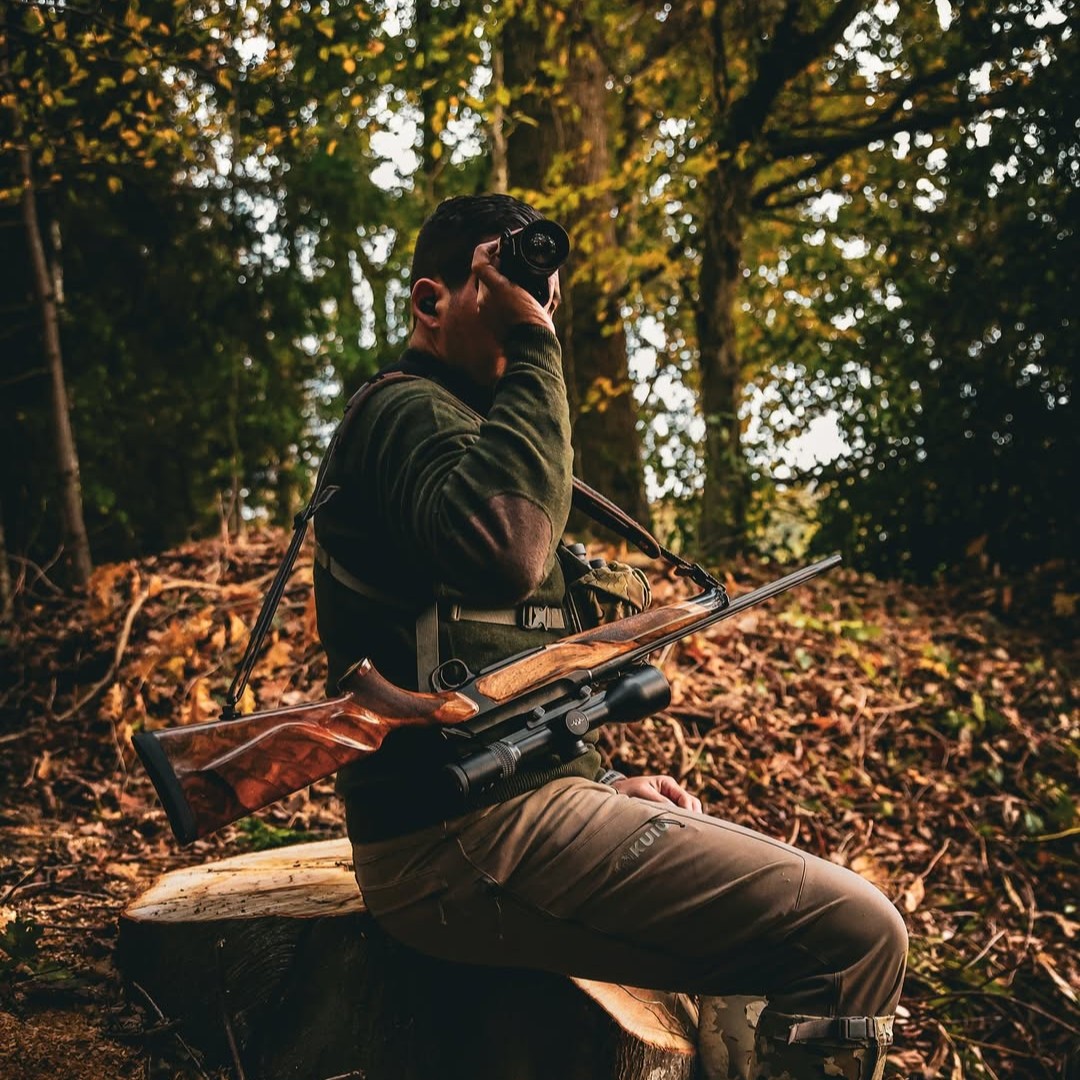
Pulsar Ambassadors – Riccardo Tamburini from Italy and Dimitri Hullebroek from Belgium – know these challenges intimately. With refreshing optimism, they share the triumphs and missteps of their hunting stories that will surely resonate with anyone who has ever stepped into the field.
-

- Riccardo Tamburini

-
- Dimitri Hullebroek

The toughest targets: wild boar vs. fallow deer
Thinking back on their lifelong hunts, the hunters name very different animals as the ones requiring the most knowledge and skill. For Riccardo, the ultimate challenge is the wild boar – a clever species that takes time to outsmart, especially the big old males. “The big tusker – the wild boar with a lot of ‘spring seasons’ of life behind, as we say in Italy – is like a ghost. He prefers living alone or together with another big male called ‘squire’, who is often sacrificed in a risky situation for him. He’s super careful, has an incredible nose, and can understand if there is something different in the ‘usual’ environment, despite his poor sight,” he explains.
Riccardo also adds that the so-called ghost hunting significantly changed with the introduction of feeding points, introduced by the government as a way to manage the wild boar population outbreak. “The wild boar’s weakest point is food. If you can prepare a good feeding point in the right place, you’ll be halfway to the goal, because you’ll familiarize the animal to come there every day, often at the same time.”
Riccardo recalls that hunting a wild boar at night near the feeding point, where the animal feels most secure and adapted, used to be the most frustrating experience. Even with a first-generation night vision device (cathode-tube technology), the result was always uncertain. “The skilled old male would quickly vanish after I switched on the illuminator, before I could pull the trigger. It’s super frustrating: hours and days spent hoping for a chance can be quickly ruined by a clever opponent.”
The skilled old male would quickly vanish after I switched on the illuminator, before I could pull the trigger. It’s super frustrating: hours and days spent hoping for a chance can be quickly ruined by a clever opponent.
Riccardo Tamburini
Meanwhile, Dimitri names the fallow deer as the hardest species to stalk, as they tend to live in herds. He explains that “Staying in a herd makes it hard to get close enough to have a good shot, and the fact that they are in large groups makes it a challenge to isolate one. You don’t want to end up shooting one and wounding surrounding animals,” he explains.
The non-linear path to the perfect shot
Hunting is seldom a linear process. Before the perfect shot, many steps must be taken, including reading the land, observing behavioral patterns, and finding a suitable approach.
Drawing on years of experience, Riccardo suggests a proactive approach to wild boar hunting: preparing a place where they come to you. But this is not a quick fix, as it must be done gradually, months before the actual hunt. “You must work slowly to avoid alarming the wild boar, which would cause it to escape. Rapid changes are the worst mistakes you can make.” He advises thoroughly exploring the surrounding area first, looking for animal signs and paths, noting that the presence of water close to the chosen point is a plus. The feeding point itself must be prepared in a calm, covered, and secure place for the animals. Furthermore, covers and natural obstacles must be considered, as they can affect the shot by making it impossible to establish a clear and safe line of fire.
The ability to adapt to the unique rules of wildlife makes a successful hunter. As Dimitri points out, although you cannot change or delete the obstacles on the terrain, you can learn how to overcome them. “The only thing you can live by is knowing your terrain, always being cautious, and thinking through when you are taking a shot. There is always another hunt, but you can never undo wrong decisions.”
The only thing you can live by is knowing your terrain, always being cautious, and thinking through when you are taking a shot. There is always another hunt, but you can never undo wrong decisions.
Dimitri Hullebroek

Skill vs. scope: the 50/50 rule
Besides the difficulties in tracking intelligent and constantly moving targets, unpredictable weather conditions pose another obstacle that can be overcome with patience and the right technology. According to Dimitri, the fog that covers the land in the mornings brings the most uncertainty. He credits many of his successful hunts to the use of thermal optics. “You must rely on very clear images to identify animal species and scan the surrounding areas to be sure of a safe shot.”
Riccardo agrees, noting that for him, a thermal riflescope, like the first-generation Thermion, was the final piece of the puzzle. He gives another important insight, arguing that while high-quality thermal optics accounts for 50% of the job, the other half is always the hunter’s skillset. As he puts it: it’s the patience that kills, not the rifle.
“People think that simply having a thermal riflescope assures them an easy shot at any animal. They often believe it’s unethical to reduce the challenge to a simple tool only helpful to dummies, dismissing skills gained over years of sacrifice. I disagree: if you don’t consider all the other necessary steps taken to attract a specific animal, you won’t get any result. You’ll only have the chance to get a wild boar – just one of many.”
People often believe it’s unethical to reduce the challenge to a simple tool only helpful to dummies, dismissing skills gained over years of sacrifice. I disagree: if you don’t consider all the other necessary steps taken to attract a specific animal, you won’t get any result. You’ll only have the chance to get a wild boar – just one of many.
Riccardo Tamburini

Tomorrow is another day
In reality, even the most experienced hunters can’t expect every day to be a success. Riccardo shares his personal recent example: “The other day I spent 10 hours on a hunting stand in the woods looking for that precise animal, starting from 7.30 a.m. until 5.30 p.m. The temperature dropped from 2°C to some degrees below zero (I don’t even want to know how many); completely still, like a stale fish. I had my loyal Thermion 2 LRF XL60 with me, but nothing happened, and I wasn’t able to get the result I wished.”
He admits that there are external elements you cannot manage, but patience is manageable. If he had been strong enough to beat the cold that day, maybe he would have gotten the boar he was looking for.
As both hunters agree, the process of hunting is just as important as the results. Being mindful of the responsibility and ethics in the decision-making, while adapting to harsh conditions with an open mind and serenity, is one of the greatest skills to have as a hunter. As Dimitri concludes: “Be aware of your privilege to harvest from nature and enjoy all your hunts, even if that means observing without taking a shot. Tomorrow is another day and another opportunity…”