
Expert Contributor:
Riccardo Tamburini
Estimated read time: 7 min.
Modern professional hunting isn’t solely about harvesting game; it’s a tightly regulated practice essential for sustainable wildlife management and maintaining ecosystem balance. Even with advanced technology, the modern hunter must be a greater wildlife expert than ever before. The cornerstone of this work is deep expertise: the ability to understand varying animal behaviors, recognize unique age and sex-revealing features, and interpret complex social dynamics within the herd. This commitment to observation proves that a true hunter is always attentive to the unique rhythm of wildlife.
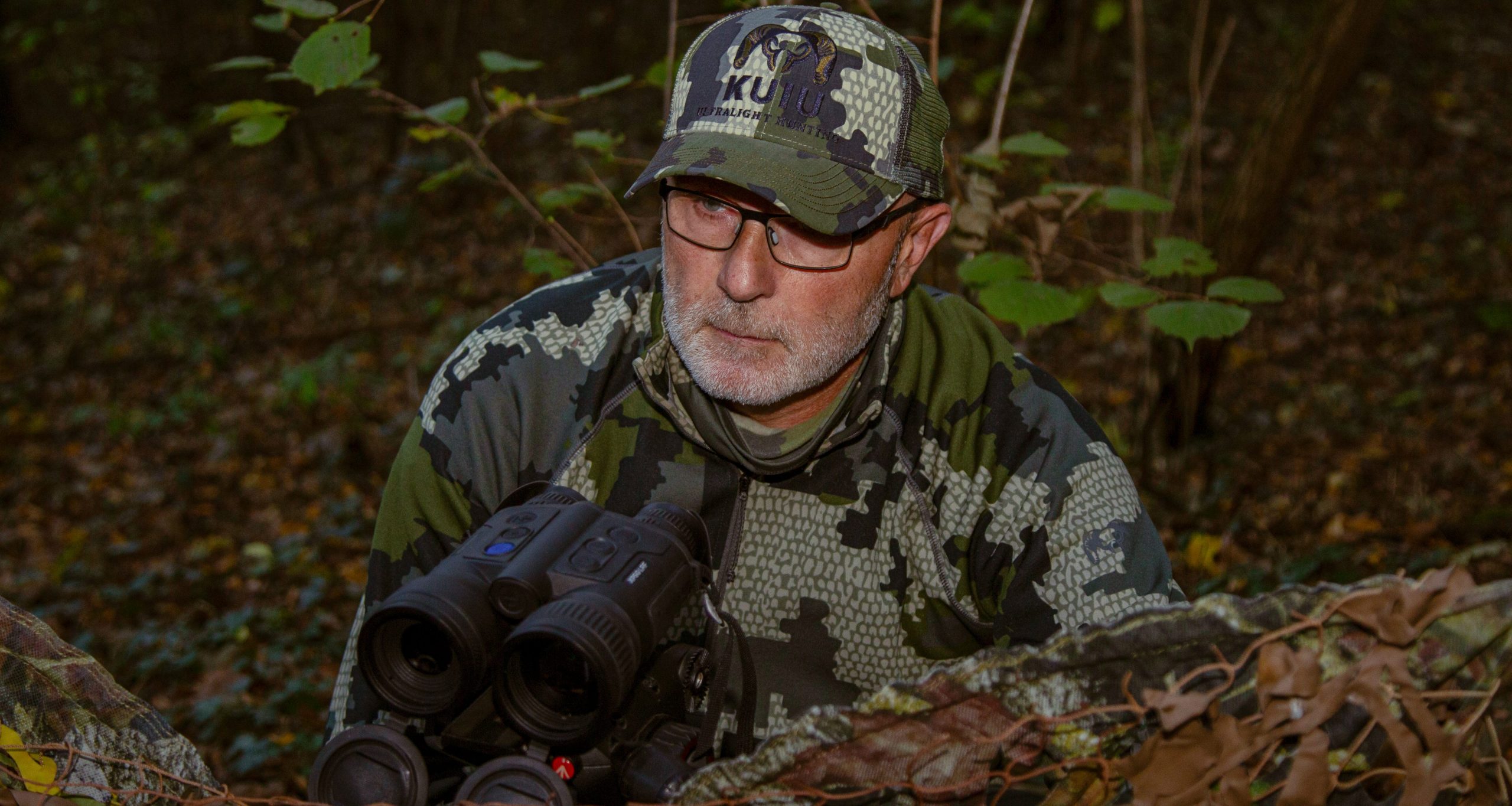
Pulsar’s trusted ambassador Riccardo Tamburini from Italy is a great example of a hunter whose long-standing expertise in patient wildlife observation serves as a strong ground for his knowledge in the field. In this article, Riccardo shares the importance of the precise identification of animals and how this can be done in unfavorable conditions, using both technology and hunter skills.
The mandate of ethical identification
Ethical hunting mandates a hunter to possess a level of ecological literacy akin to a field biologist. Instead of blind shooting, they must understand why they are targeting a specific animal, read their behavioral motivation in the land, and ensure the quickest, most humane harvest possible.
Today, a hunter has to follow precise rules to cull a game species. When the government releases tags, each is often restricted to a specific animal based on sex and age class. As Riccardo says, “To be sure that the animal corresponds to the tag, you should watch its teeth, but it’s impossible to do that before culling it. For this reason, you have to evaluate all the possible indicators: movements, size, behavior, presence of antlers or horns, their dimensions, fur, genitals, or the status of nipples, because some local laws prevent the hunter from culling a pregnant or lactating female.“
Living in the most congested region in Italy, Riccardo admits that identifying the animals during the day is not always possible with the naked eye. Since many game species are most active during the night, his only chance to see the animals in the open field is after sunset. Thermal optics empower the hunter’s knowledge in assessing the field.
“A high-end device allows the hunter to get the smallest detail in a lot of scenarios; Pulsar is the sole company that offers nine different color palettes, three algorithm settings according to the weather conditions, and 20 levels of contrast and brightness. Playing with them, it’s possible to get any info about an animal, even from afar.”
You have to evaluate all the possible indicators: movements, size, behavior, presence of antlers or horns, their dimensions, fur, genitals, or the status of nipples.
Riccardo Tamburini

Reading physiology and behavior
Observing a herd of specific animal species from a great distance, it might be almost impossible to confirm an animal’s age, size, and health. However, a skilled hunter is capable of identifying the gender of an animal even by watching its movement and behavior. Riccardo explains that the body structure of a roebuck is heavier, more wedge-shaped, and with longer fur. A female, on the contrary, is more rounded.
Riccardo adds that the interaction could be very different between sex and class age: “A dominant male will be like the neighborhood bully, always fighting for the harem or the territory, while the young often don’t take the challenge. The adult female is always the herd leader: all the others will follow her. She’s also more careful and will run away at the minimum risk.”
The animal’s age can also be determined by its appearance and anatomy. For example, “An old stag often has a more massive body and always holds its neck at a 45° angle to the body, as if the antlers are too heavy. In comparison, a young stag holds its neck erect at a 90° angle. Females are smaller and their lines are gentler. A mature female will have a rounded belly, indicating she has already delivered offspring, whereas a Class 1 female will have a flat belly, a shorter face, and will be smaller than an adult.“
But then again, not everything is as simple as in the books. Riccardo likes to think of animals as humans – each authentic in their behavior, and the hunter’s task is to evaluate even the slightest physical and behavioral indicators.
A dominant male will be like the neighborhood bully, always fighting for the harem or the territory, while the young often don’t take the challenge. The adult female is always the herd leader: all the others will follow her. She’s also more careful and will run away at the minimum risk.
Riccardo Tamburini

Identification through adversity
As technological advancements illuminate the night for hunters and conservationists, the dilemma between night vision and thermal optics remains. Riccardo’s choices are supported by years of experience and field needs.
“Generally speaking, digital vision offers a greater amount of details to judge within 150-200 meters, but it suffers from rain, cold, humidity, fog, or snow. If the animal is partially covered, it’s not easy to detect or judge it. This is why I prefer to use thermal technology: I have less detail to get, but I can do it without considering weather conditions or seasons.“
Pulsar thermal technology adapts to various weather or terrain conditions – with extensive settings, the contrast can be adjusted to the given surroundings to detect and identify wildlife with precision and confidence. For example, when using the rainbow palette, temperature contrast can even hint at the animal’s state: an alarmed animal will appear in intense red tones, while a calm one remains yellow.
In that sense, the hunter’s skills remain of topical significance throughout the year. Riccardo admits that identifying animals during the night in winter and the beginning of spring is probably the hardest of all: “the males and the females stay all together, the long fur hides shapes, males don’t have antlers, and also the size of the young is quite similar to the adults.“

The modern hunter’s success is measured not by volume, but by the surgical precision of their choices. By integrating advanced thermal technology with deep physiological and behavioral knowledge, hunters can meet the strict mandates of sex and age quotas. This combination of skill and thermal effectiveness ensures that harvesting is highly selective, proving that responsible hunting is a sustainable, ethical, and indispensable component of wildlife conservation.