
Expert Contributor:
Julia Nowak
Estimated read time: 6 min.
Thermal palettes for hunting directly influence how quickly and accurately you detect and identify game in real field conditions. Many hunters treat color modes as a visual preference, but the right thermal palette can make the difference between fast detection and missed detail.
Understanding how contrast, terrain, and temperature interact with different color modes helps you adapt instantly to changing environments. In this guide, you will learn how thermal palettes work, when to use each mode, and how to choose the right color setting for your specific hunting scenario.
Quick answer
Thermal palettes for hunting are tools for contrast, not color preference. The goal is to clearly separate animals from the background in any condition.
White Hot and Black Hot are the most reliable choices for most scenarios because they provide clean contrast and solid detail for identification. High-contrast palettes support detection, while lower-contrast or alternative palettes can help confirm identification.
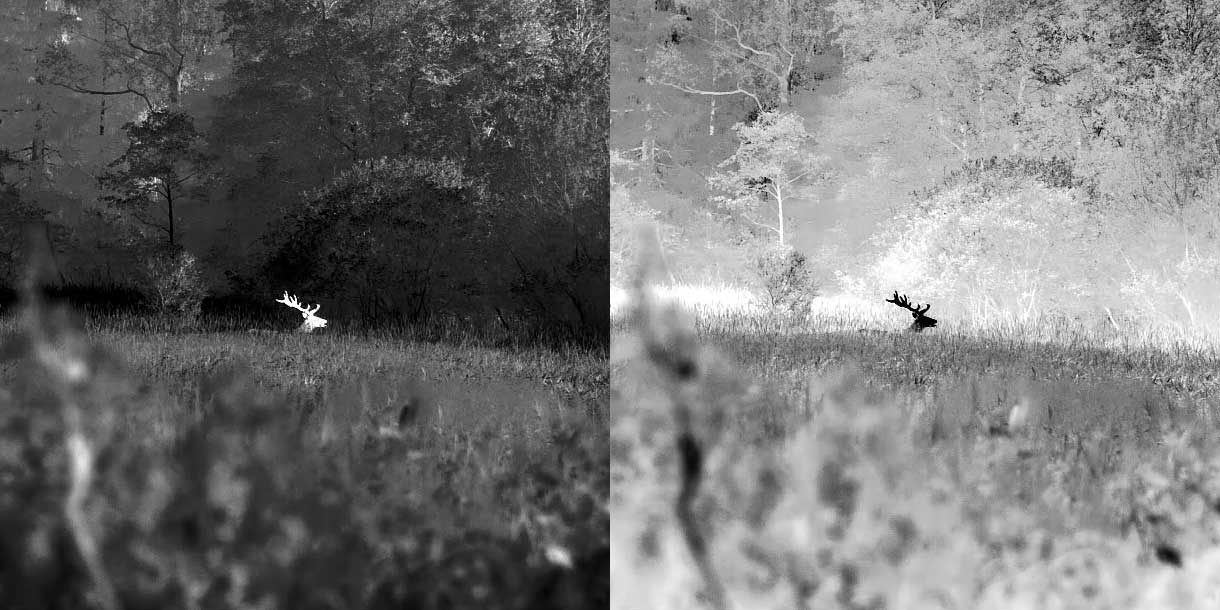
Environmental conditions such as temperature, vegetation, and humidity affect thermal contrast. Switching palettes when needed is not a mistake, but a tactical advantage.
What are thermal palettes and why do they matter for hunting?
Thermal palettes are color-mapping modes that translate heat differences detected by an infrared sensor into visible contrast on a display. In hunting, palette choice directly affects how clearly a heat signature separates from the surrounding terrain.
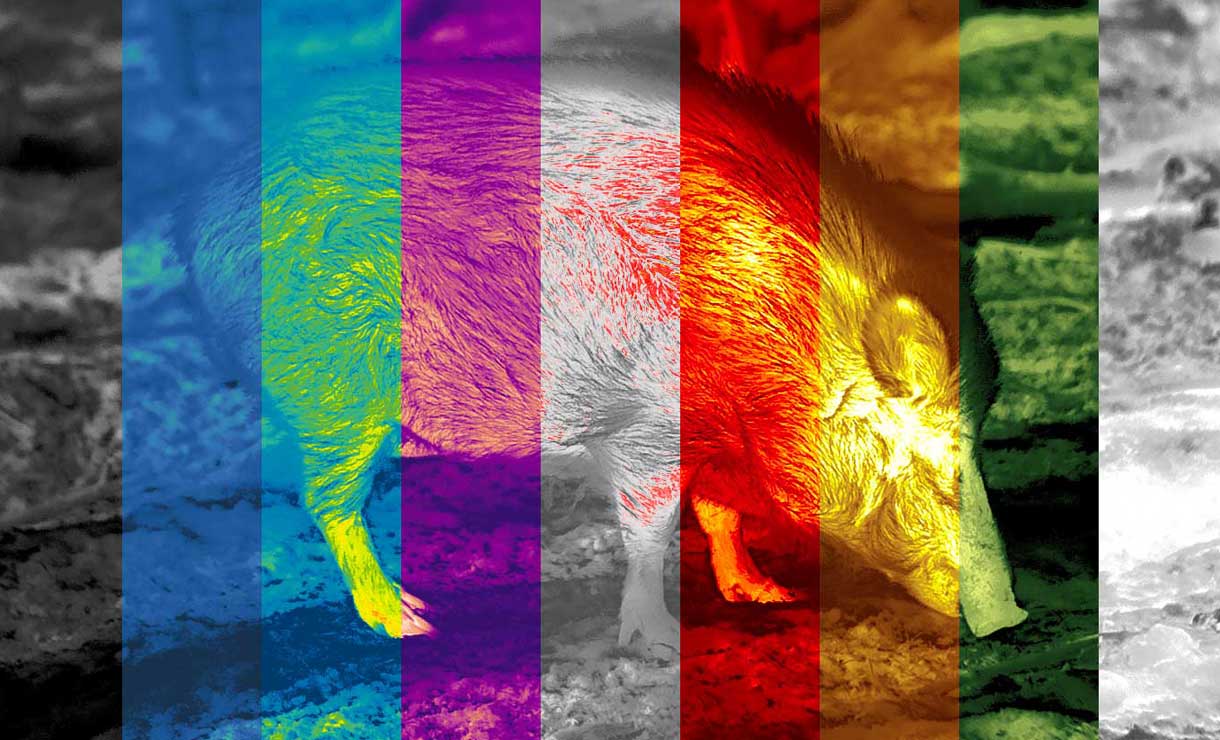
The availability of multiple color palettes is extremely helpful in thermal vision because it ensures the best possible visibility, according to individual eyesight and the type of terrain being observed.
The goal of a wide selection of color palettes is to guarantee contrast, faster detection, and reduced visual fatigue in any condition. Environment, timing, and season vary significantly, and the human eye, designed to see in daylight, must be supported to capture small details at night. Watching the same scenario through a thermal display during summer is completely different from observing it in winter. The same difference exists between sunrise and sunset.
When choosing a color palette, you should ask yourself specific questions:
- What am I looking for?
- Am I spotting animals at long range?
- Am I evaluating the shape of a stag’s antlers?
- Do I need to determine the sex or age class of a species?
- How long will the observation session last?
A single palette cannot answer all these needs. That is why technicians developed multiple color modes to provide the best compromise between visibility and safety in every condition. A wide selection of palettes allows the hunter to adapt rather than rely on a fixed visual solution.
That being said, after a while, you are sure to find a favorite. Here are the settings that Julia Nowak, an experienced hunter who uses thermal a lot, favors:
In general, I find the White Hot useful in most situations, and this is also my “starter” palette. Then of course, I play with brightness and contrast depending on conditions… or if it is not enough, change into another color palette.
My fav one for tough conditions is Black Hot though. Fog and rain? This means that I am immediately switching to Black Hot with high contrast.

Related: NETD, sNETD, and beyond: everything you need to know
Detection vs identification — why palette choice changes the outcome
Detection means spotting a heat source. Identification means confirming what that heat source actually is. Palette choice influences both stages.
Modern thermal devices offer image quality high enough to support many applications. Thermal vision helps hunters operate more precisely and safely at night. It also supports activities such as night navigation on water and wildlife observation. Law enforcement and rescue teams use thermal imaging to detect people, assess posture, and identify potential threats.
Different situations share the same sequence: first detection, then identification. Edge clarity must remain strong regardless of background clutter. Some palettes enhance fast scanning of large areas. Others improve fine detail recognition, such as distinguishing horns, equipment, or body posture.
Sometimes you need maximum information from a hot target. In other situations, you must evaluate cold details around it, such as antlers, branches, rocks, or other objects that may affect decision-making. A wide selection of color palettes allows the observer to choose whether to prioritize hot contrast or environmental detail.
Read more: Thermal sensor guide: What really defines thermal image quality
Common thermal palettes explained (Pros & practical use cases)
Color palettes serve different purposes and often depend on observation time and terrain conditions. Below is a breakdown of the most common ones.
White Hot – detail and precision
White Hot displays warmer objects as white against a darker background. It is one of the most intuitive and widely used palettes in thermal hunting.

When the priority is extracting maximum detail from an animal, White Hot is often the preferred choice. The hot body appears like a bright bulb in a dark room. This makes it easier for the human eye to focus on the smallest features of the target while minimizing distraction from the environment.
White hot is particularly effective for identification tasks such as:
- Confirming species
- Evaluating body size
- Assessing movement patterns
Black Hot – more background information
Black Hot displays warmer objects as dark against a lighter background. This inversion often improves perception of shape and environmental structure.

Thermal technology primarily emphasizes heat, so colder elements often appear dark and lack definition. By using Black Hot, the lighter background can enhance contrast around colder details. A typical example is antlers or horns. In black hot mode, the lighter background can help count points or evaluate height and shape more clearly.
Black Hot is often preferred when environmental awareness is just as important as target detection.
Red Hot – fast target acquisition
Red Hot is particularly effective for fast target acquisition when the environment has already released accumulated daytime heat. Ideal conditions include sunrise after a cold night, winter mornings, or sunset after a foggy or cloudy day. In these scenarios, residual heat in rocks, branches, or stumps can create false targets. Red Hot helps isolate the most relevant hot signatures more quickly.

This palette is suitable for long observation sessions and for situations that require fast acquisition of a hot target. The red highlight immediately draws attention to the hottest areas, supporting quick scanning without overwhelming the eye with brightness.
Multicolor palettes – situational tools
Multicolor palettes such as Rainbow or Ultramarine represent different temperature ranges with multiple colors. They visualize heat distribution rather than just hot-versus-cold contrast.

These palettes are useful for analyzing thermal structure inside a body. For example, they can help observe how fur insulates an animal or indicate changes in blood circulation related to stress, digestion, or alertness. In high-sensitivity thermal devices, it is sometimes possible to detect subtle variations such as the position of vitals due to active blood flow.
However, multicolor palettes can increase visual noise and may slow down detection if overused. They are best applied for short analytical checks rather than continuous scanning. Here’s how Julia uses them:
I like to turn on Rainbow sometimes, if I have an animal at a closer distance, and analyse the differences in heat on different body parts. But this is not something you do often during dynamic hunting situations.
How Pulsar implements thermal palettes in real hunting conditions
In addition to the main color palettes, there are variations that act as intermediate options between high contrast and reduced eye fatigue.
Sepia and Violet stand between White Hot and Red Hot. They offer a compromise between detail visibility and visual comfort, making them suitable for medium-length observation sessions.

Green-based palettes are often associated with analog night vision and a high level of perceived detail. Eye fatigue is slightly higher than with red-dominant palettes, but green still supports extended observation when properly adjusted.

Red Monochrome highlights the warmest parts of the image while maintaining a darker background. It reduces glare and visual strain.

Ergonomics play a critical role in palette selection. During night observation, it may be necessary to switch palettes briefly to evaluate a specific detail. Some palettes increase eye fatigue but reveal additional information. In these cases, the interface must allow fast and simple switching, even when wearing gloves. Excessive movement should be avoided because animals can detect even small motions in low light.
How hunting environment should influence palette choice
Forest vs open field
Dense forest environments reduce visibility due to vegetation density and background clutter. In forests, high-contrast palettes such as White Hot or Black Hot usually perform best because they clearly separate the animal’s heat signature from branches and trunks. The priority in this scenario is fast detection within short to medium distances.
In open fields, especially during census or trophy evaluation, identification becomes more important than pure detection. When evaluating sex, age class, or antler quality at 150–200 meters, adjusting contrast and brightness becomes essential. Lowering contrast to around 4/20 and setting brightness between 8 and 10/20 can flatten the background and make antlers easier to distinguish against a lighter scene.
Cold nights vs warm weather
Ambient temperature directly affects thermal contrast. During cold nights, animals stand out clearly because their body heat strongly contrasts with the environment. In these conditions, most standard palettes perform well.
In warm weather, especially at sunrise after a hot day, the environment retains heat. Rocks, stumps, and branches may appear as false targets. In these cases, careful adjustment of contrast and brightness, combined with an appropriate palette such as Red Monochrome or Black Hot, helps reduce background clutter and improve target discrimination.
Seasonal changes also alter how the same environment appears through a thermal display. A summer forest at sunset can look completely different from the same forest in winter at dawn. Having multiple palettes and a wide range of contrast and brightness levels significantly increases adaptability.
Should you switch palettes while hunting?
Switching palettes is a tactical decision, not a mistake. It allows re-evaluation of a target under different contrast conditions.
Personally, when I know the strengths and weaknesses of each palette, I tend to use one primary palette during a session, depending on my objective. I switch only when I need additional information, particularly about cold elements such as horns or antlers.

Black Hot can make the background very clear, which helps evaluate cold structures but increases eye fatigue during long sessions. For extended observation, I often return to White Hot, which provides a darker background and bright hot targets, reducing strain while maintaining clarity.
The key is not constant switching, but purposeful switching when more information is required. As Julia puts it:
I think that if we are getting ourself such a powerful tool, we should be using everything that it offers to improve our experiences. You do not buy a Ferrari to just keep it in the garage and take the bus instead, right?
But I agree with Riccardo, we should learn about how the different tools work – color palettes, in this case – and adapt them to our needs at specific moments. Switch them, use them! But do it wisely, otherwise you will confuse your brain and eyes instead of helping yourself.
Common mistakes hunters make with thermal palettes
One of the most common mistakes is always using the same color palette, often the one most popular on social media, such as White Hot. Familiarity does not always equal effectiveness.
Palettes such as White, Red, Green, and Violet share similar principles but differ in the level of detail perceived and the degree of eye fatigue they cause. Ignoring these differences limits performance.
Another frequent mistake is underestimating the impact of contrast and brightness settings. A 20-level scale offers wide flexibility and can dramatically change the overall image. Proper adjustment can eliminate false targets, enhance edge clarity, and significantly improve both detection and identification.
Final advice — there is no “best” thermal palette
There is no universally best thermal palette. Personal visual perception plays an important role, and preferences vary from one hunter to another.
The most effective approach is understanding the general characteristics of each palette and then selecting the one that matches your eyes, your environment, and your hunting objective.
The best hunters do not rely on a single color mode. They understand when to adapt.
FAQ
Which thermal palette is best for hunting?
There is no single best palette. White hot and black hot are the most versatile and reliable for most conditions, but the optimal choice depends on environment, temperature, and observation goal.
Is White Hot or Black Hot better for thermal hunting?
White Hot is often better for detailed identification and reduced distraction from the background. Black Hot can improve perception of shape and cold structures such as antlers. The choice depends on the specific task.
Do thermal color palettes affect accuracy?
Thermal palettes do not change the mechanical accuracy of a scope. However, they influence detection and identification clarity, which can indirectly affect decision-making before taking a shot.
Why do hunters prefer Black Hot thermal?
Many hunters prefer Black Hot because it provides a lighter background and strong shape contrast. It can make environmental details and cold structures easier to evaluate.
Should I use color palettes on thermal scopes?
Yes. Color palettes are tools that improve contrast in different conditions. Using multiple palettes strategically increases adaptability and situational awareness.
Can thermal palettes cause misidentification?
Yes, if used incorrectly. Overusing high-contrast or multicolor palettes in warm environments can increase visual noise and create false targets. Proper adjustment of palette, contrast, and brightness reduces this risk.
About the experts

Co-Author:
Riccardo Tamburini
Riccardo Tamburini is a lifelong outdoorsman, hunter, fisherman, and professional wildlife photographer and filmmaker.
With over 35 years of experience across plains and mountains in Italy and abroad, he combines field expertise with a mechanical engineering background to explain the technology behind rifles, optics, and digital devices.

Expert Contributor:
Julia Nowak
Julia Nowak was born and raised in a hunting family in Poland and now lives — and continues to hunt — in Sweden. She holds a degree in sustainable forest and game management, bringing both tradition and scientific knowledge to her pursuits.
For Julia, hunting is not just a hobby; it’s a way of life. She also runs the YouTube channel Hunting O’Clock, where she shares her experiences and insights from the field.
Before purchasing any night or thermal vision device, please make sure you adhere to the local legislation and only use it when it is allowed. Our ambassadors come from various countries and travel a lot, which allows them to test different devices. We do not encourage or support the illegal use of our devices in any events. If you wish to learn more about export and sales restriction policy, please visit the following link: Export and Sales Restriction Policy.