
Expert Contributor:
Erik Bjaelkvall
Estimated read time: 6 min.
The Telos line just got its most capable model yet. The TELOS LRF XT50 pairs a 1280×1024 HD thermal sensor with a 1200 m speedy integrated laser rangefinder. Add a stunning 17.5° field of view, the widest in the Telos family, allowing you to clear more ground per sweep and hold detail on a target further out.
This review covers what those numbers mean in practice, where the XT50 improves on the previous Telos generation, and who it’s actually built for.
Key takeaways
- HD 1280×1024 sensor: delivers the sharpest image and the widest field of view (17.5°) in the Telos lineup.
- Integrated laser rangefinder: now reaches 1200 m, up from 1000 m on the previous Telos LRF, with faster locking on target.
- Electronic image stabilization: keeps the image usable at higher magnification, where hand shake otherwise becomes the limiting factor.
- Built for long sessions: one-handed ergonomics, textured focus and zoom grips for cold hands and gloves, IPX7 weatherproofing.
- Flagship pricing and size: rewards experienced thermal users who scan large areas; it’s more device than a first-time buyer typically needs.
Quick Overview of TELOS LRF XT50
- Who it’s for: Experienced thermal users, professional hunters, forestry and land management, search & rescue, and wildlife observers who scan large areas and need confident long-range identification and speedy distance measurement.
- Main features: 1280×1024 HD thermal sensor, AMOLED 1920×1080 display, 1200 m laser rangefinder, 17.5° field of view, electronic image stabilization, 128 GB internal memory, Stream Vision 2 connectivity.
- Buy it if: You want the highest image detail and widest field of view in the Telos range, you rely on distance measurement for shot placement, and you’re covering ground fast enough that a wider sweep genuinely saves time.
- Considerations: Flagship price, larger and heavier than entry-level thermal units, digital-only zoom, and a learning curve around amplification settings and the ballistic calculator.
- Bottom line: The most capable Telos to date, and priced accordingly. Worth it if you’ll actually use what the sensor and rangefinder give you.
- Price point: Premium
➡️Explore Pulsar Telos XT50 model
➡️Find an Authorized Pulsar Dealer Near You
What is the TELOS LRF XT50?
The TELOS LRF XT50 is the flagship of Pulsar’s Telos series: a handheld thermal imaging monocular built around a 1280×1024 HD sensor with an integrated 1200 m laser rangefinder. It’s aimed at hunters and outdoor professionals who need to detect, identify, and range a target in a single, continuous motion, without switching devices or losing the animal while you fumble for a rangefinder.
What separates it from a general-purpose thermal spotter is the combination: sensor resolution that holds detail at distance, a field of view wide enough that scanning a treeline takes fewer passes, and a rangefinder fast enough to give you a number before the moment’s gone. Add electronic image stabilization for higher magnification work and a body designed around intuitive operation, and no single spec carries the XT50 on its own — what counts is how they work together in the field.
This is what sets the gold standard apart, most thermals show you heat signatures, the Telos LRF XT50 shows you the actual world in thermal, with real spatial relationships and depth.
— Erik Bjaelkvall
Benefits and considerations
Benefits
- HD 1280×1024 sensor holds detail on targets at distance, not just heat signatures.
- Widest field of view in the Telos line (17.5°) for faster area scanning.
- Laser rangefinder extended to 1200 m with faster lock times.
- Electronic image stabilization for stable viewing at higher magnification.
- Textured focus and zoom grips built for gloved, cold-weather use.
- 128 GB internal memory for extended recording.
- USB-C charging with wireless charging support.
- IPX7 weatherproofing and a compact body with a built-in tripod mount.
Considerations
- Flagship pricing: this is a top-tier investment, not an entry-level unit.
- Larger and heavier than entry-level compact thermal monoculars.
- Zoom is digital only: it enlarges pixels, it doesn’t resolve new detail.
- Getting the best image requires learning the amplification and contrast settings.
- Ballistic calculator is only as reliable as the data you input. Needs to be set up correctly.
Full technical specifications: TELOS LRF XT50
| Parameter | TELOS LRF XT50 |
|---|---|
| Thermal imaging sensor | 1280 × 1024 |
| Pixel pitch | 12 µm |
| System NETD | <20 mK |
| Display | AMOLED 1920 × 1080 |
| Magnification range | 2–16× |
| Field of view | 17,5° |
| Field of view @100 m | 30,7 m |
| Laser rangefinder measurement range | 1200 m |
| Detection range | 2300 m |
| Internal memory | 128 GB |
In-depth review of features and benefits
Image performance: what you actually see
The XT50’s 1280×1024 sensor is the highest resolution in the Telos lineup, paired with 12 µm pixels and an NETD rating that keeps the image clean in low-contrast conditions. NETD is the sensitivity figure. It sets how much fine thermal difference the sensor can pick up. The lower the number, the more subtle temperature variation it resolves, which is how you tell a sow from a boar at range instead of just picking up a vague warm shape.
Resolution and detection range go hand in hand. The XT50’s 2300 m detection range is measured against a standard 1.8 × 0.5 m target and describes the distance at which that target still lands on enough pixels to register as a heat signature. A higher-resolution sensor pushes that distance out and holds enough detail for you to identify the animal, not simply confirm that something is out there. For putting a name to what you are looking at, that counts for more than the raw detection number.

Wide field of view: scan more with every observation
At 17.5°, the XT50 has the widest field of view in the Telos range, translating to 30.7 m of coverage at 100 m. In practical terms, that means fewer sweeps to clear a treeline or a field edge, and an easier time picking up and following movement at the periphery rather than re-scanning to catch it. On large or open ground, field of view shapes how the unit feels to use as much as detection range does.
Laser rangefinder: know the distance with confidence
The integrated rangefinder now reaches 1200 m, up from 1000 m on the previous Telos LRF, with accuracy of ±1 m. The range bump matters less than the lock speed. A rangefinder that returns a number quickly means less time holding the reticle on an animal waiting for a reading, and more certainty that the number you get reflects the target you are on. Paired with a properly set up ballistic calculator, that turns a guess into a real firing solution. Just remember the calculator is only as good as the data you put into it.
Electronic image stabilization: smoother observation at higher magnification
Push past base magnification and the thing blurring the image is no longer the sensor. It is your own hands. Electronic image stabilization compensates for that, keeping the image steady enough to observe and place a shot at magnification where an unstabilized view would show your pulse. It will not replace a solid rest when you are tracking bigger movement. But for holding on a distant, stationary target, it opens up the top end of the zoom range.
Ergonomics and user interface: built around intuitive operation
At roughly 730 g with the battery seated, the XT50 is designed for intuitive operation over extended sessions. The updated focus and zoom wheels carry more texture than previous Telos models, a small change that pays off in cold-weather or gloved use, where a smooth ring is hard to turn with any precision. The body is also more compact than the previous generation’s rangefinder housing, and includes a built-in tripod mounting point for static observation.
Battery and cold-weather runtime
The XT50 runs on Pulsar’s LPS7i rechargeable battery pack, rated at approximately 8 hours, an improvement over the XL50’s 7-hour rating. Charging is via USB-C, with wireless charging also supported. The battery is field-replaceable, so a spare pack extends a session without needing to power down to swap.

Recording, streaming, and Stream Vision 2
With 128 GB of internal memory, the XT50 supports extended video recording and photo capture without needing to manage storage mid-session. It integrates with Pulsar’s Stream Vision 2 app for streaming, remote monitoring, and ballistics support, letting footage and data move off the device without a cable.
How the TELOS LRF XT50 handles in real hunting conditions
Ask hunters who’ve spent real time behind the XT50 in the field, and the same profile comes up: extensive glassing before any decision to move. According to Erik Bjaelkvall, a highly seasoned hunter and equipment reviewer, who tested the unit on live quarry, that’s exactly the hunter it’s built for:
If you’re the type of hunter who glasses extensively before moving, who needs to pick out individual animals at distance and read their behaviour before committing to a stalk, the XT50 is built for that. The thermal clarity and a superb LRF, everything integrated into a very portable and ergonomic package.
That profile covers more than one kind of stalk.
Extensive pre-stalk glassing where you need to pick out animals in complex terrain, the 1280 pixel resolution reveals detail that helps you plan approaches. Fox control observation at distance, wild boar spotting through patchy cover, anything where thermal depth and realism matter for reading behaviour,
Erik says. In each case, the extra resolution isn’t about confirming something is there, it’s about resolving enough detail to decide what to do about it.
Expert insights and field tests
Field testers who’ve put the XT50 through real sessions keep coming back to the same strength: clarity that holds up under pressure.
The thermal clarity on the Telos LRF XT50 is exceptional, revealing detail at range that makes spotting and identifying game straightforward in any lighting condition.
— Erik Bjaelkvall
It isn’t one standout spec doing the work, either.
Build quality, thermal contrast, image responsiveness, the Telos LRF XT50 doesn’t just excel at individual things, it sets the standard in every category.
— Erik Bjaelkvall
Comparison to alternatives: TELOS LRF XT50 vs TELOS LRF XL50
| Decision factor | TELOS LRF XT50 | TELOS LRF XL50 |
|---|---|---|
| Thermal sensor | 1280×1024 HD sensor | 1024×768 HD sensor |
| Image detail | Highest image detail available in the Telos lineup | Excellent image quality |
| Field of view | 17.5° (30.7 m @100 m) | 14° (24.6 m @100 m) |
| Detection range | 2300 m | 2300 m |
| Laser rangefinder | Integrated, 1200 m | Integrated, 1000 m |
| Best suited for | Hunters who prioritize maximum image quality and faster wide-area scanning | Hunters looking for an excellent all-round premium thermal monocular |
| Main advantage | Best thermal image quality and the widest field of view in the Telos family | Excellent balance of image quality and long-range performance |
| Choose this model if… | You want the latest and most advanced Telos model with maximum image detail, the widest field of view, and the highest overall thermal performance. | You want a premium HD thermal monocular with excellent long-range performance and outstanding all-round capability. |
Final thoughts: Is the TELOS LRF XT50 right for you?
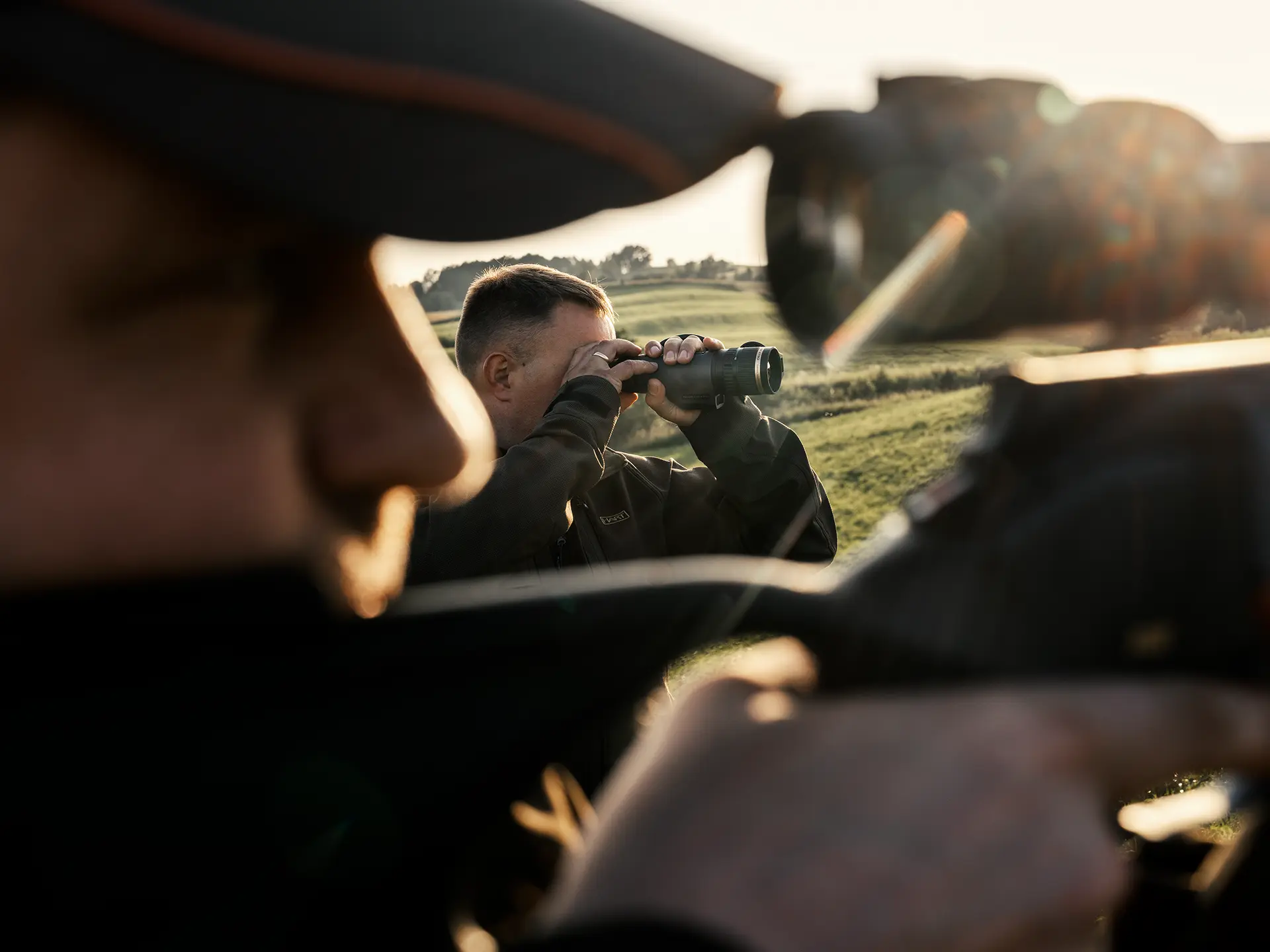
The TELOS LRF XT50 is built for a specific kind of hunter: one who spends real time glassing before committing to a stalk, and who needs that time to actually tell them something. The 1280×1024 sensor, 17.5° field of view, and 1200 m rangefinder work together rather than as a headline spec sheet, and that shows up most clearly in the situations Erik Bjaelkvall describes: fox control at range, boar spotting through cover, picking a single animal out of a group before deciding whether to move.
Anyone doing serious thermal glassing work where detail at range directly affects your decisions, this is the tool. The gold standard imaging means less second-guessing what you’re actually looking at.
— Erik Bjaelkvall
If that’s how you hunt, the XT50 earns its price. If you’re after a lighter, cheaper unit for occasional use, or you don’t spend long stretches glassing before moving, the investment is harder to justify, in which case the XL50 is worth a look first.
FAQs
What is the Pulsar TELOS LRF XT50?
A premium HD thermal imaging monocular with an integrated 1200 m laser rangefinder, designed for hunting, wildlife observation, forestry, and search & rescue.
What makes the TELOS LRF XT50 different from other Telos models?
The XT50 is the flagship model in the Telos lineup, featuring a 1280×1024 HD thermal sensor, a wider 17.5° field of view, electronic image stabilization, and premium image quality.
How far can the TELOS LRF XT50 detect animals?
The TELOS LRF XT50 offers a detection range of up to 2300 meters, allowing users to detect heat signatures at long distances in complete darkness.
Does the TELOS LRF XT50 include a laser rangefinder?
Yes. It features a fully integrated 1200-meter laser rangefinder with both single-shot and continuous scanning modes.
Is the TELOS LRF XT50 suitable for daytime use?
Yes. Thermal imaging works independently of ambient light, making the XT50 equally effective during the day, at dusk, and at night.
Is the battery replaceable?
Yes. The TELOS LRF XT50 uses Pulsar’s replaceable LPS7i rechargeable battery, allowing quick battery changes during extended field use.
Is the TELOS LRF XT50 waterproof?
Yes. The monocular is IPX7-rated, providing reliable protection against rain, snow, and temporary water immersion.
What comes in the box?
The package includes the TELOS LRF XT50 monocular, rechargeable LPS7i battery, charger, USB-C cable, carrying case, neck strap, cleaning cloth, and user documentation.
About the Experts

Co-Author:
Christian Rysgaard
Christian Rysgaard brings a lifetime of hunting experience, holding certifications as both a rifle and shotgun instructor, along with a long-standing passion for archery, ballistics, and night optics.
As a hunting journalist with a strong engineering background, he delivers technical articles and in-depth gear reviews for the European hunting market.

Expert Contributor:
Erik Bjaelkvall
Erik Bjaelkvall is a former Arctic Ranger, now a competitive practical shooter, seasoned hunter, and gear expert with decades of field experience.
Operating out of Sweden, Erik has extensively tested thermal imaging equipment across diverse environments – from open plains to rugged mountains, through snow, fog, and sun.
Before purchasing any night or thermal vision device, please make sure you adhere to the local legislation and only use it when it is allowed. Our ambassadors come from various countries and travel a lot, which allows them to test different devices. We do not encourage or support the illegal use of our devices in any events. If you wish to learn more about export and sales restriction policy, please visit the following link: Export and Sales Restriction Policy.