
Expert Contributor:
Erik Bjaelkvall, Riccardo Tamburini
Estimated read time: 6 min.
With the launch of the new TELOS LRF XT50, many hunters are asking whether it’s worth choosing over the proven TELOS LRF XL50.
While both premium thermal monoculars share the Pulsar Telos platform, an integrated laser rangefinder, and rugged design, the XT50 introduces a new HD thermal sensor, a wider field of view, a faster-locking rangefinder, and an enhanced viewing experience.
In this comparison, we’ll break down the key differences in image quality, performance, and real hunting use cases to help you choose the right model for your needs.
Quick overview
The TELOS LRF XT50 is the newest flagship in Pulsar’s Telos lineup, introducing a 1280×1024 HD thermal sensor, wider 17.5° field of view, and the highest level of image detail available in the series.
The TELOS LRF XL50 remains a premium thermal monocular, offering excellent long-range performance, integrated 1000 m laser rangefinder, and the same Telos platform trusted by hunters and professionals.
While both models share many premium features, this comparison focuses on the differences that matter most in the field — image quality, scanning efficiency, and overall viewing experience — to help you choose the right thermal monocular for your hunting style.
In short:
- Choose the TELOS LRF XT50 if you want the newest flagship with maximum image detail and the widest field of view.
- Choose the TELOS LRF XL50 if you want a premium all-round thermal monocular with excellent performance across a wide range of hunting scenarios.
Quick comparison
| Category | TELOS LRF XT50 | TELOS LRF XL50 |
| Positioning | New flagship model | Premium all-round thermal monocular |
| Thermal sensor | 1280×1024 HD | 1024×768 HD |
| Field of view | 17.5° (30.7 m @100 m) | 14° (24.6 m @100 m) |
| Detection range | 2300 m | 2300 m |
| Laser rangefinder | 1200 m | 1200 m |
| Best suited for | Hunters prioritizing maximum image detail and faster scanning | Hunters looking for excellent all-round performance |
| Main advantage | Highest image quality and the widest field of view in the Telos lineup | Excellent balance of image quality, detection range, and versatility |

(Telos LRF XT50 footage)
Discover the full TELOS thermal monocular lineup, compare models, and explore their key features and specifications.
Or, if you’re ready to purchase, find your nearest authorized Pulsar dealer.
What are the main differences between the TELOS LRF XT50 and XL50?
Although the TELOS LRF XT50 and TELOS LRF XL50 share the same upgradeable Telos platform and premium build quality, they are designed with different priorities in mind.
The XT50 introduces a 1280×1024 HD thermal sensor and a significantly wider 17.5° field of view, delivering more image detail and allowing users to scan larger areas more efficiently. The XL50, meanwhile, remains a premium all-round thermal monocular, offering excellent long-range performance and the same trusted Telos experience.
The biggest difference isn’t detection range — both models detect heat signatures up to 2300 m. The real difference is how much detail you see and how comfortably you can observe your surroundings.

Full specification comparison
| Parameter | TELOS LRF XT50 | TELOS LRF XL50 |
| Thermal sensor | 1280×1024, 12 µm | 1024×768, 12 µm |
| System NETD | <20 mK | <20 mK |
| Magnification | 2–16× | 2.5–20× |
| Field of view | 17.5° (30.7 m @100 m) | 14° (24.6 m @100 m) |
| Detection range | 2300 m | 2300 m |
| Laser rangefinder | 1200 m | 1200 m |
| Display | AMOLED 1920×1080 | AMOLED HD 1024×768 |
| Internal memory | 128 GB | 64 GB |
| Upgradeable platform | ✓ | ✓ |
Image quality and target identification
It’s tempting to assume the XT50’s higher-resolution sensor means you can identify an animal farther out than you could with the XL50, but that isn’t quite how it works out. The XT50 pairs its 1280×1024 sensor with a wider 17.5° field of view, and those extra pixels go into covering more ground rather than packing more detail onto a single target. Both models share the same 12 µm pixel pitch, sub-20 mK NETD rating, and 50 mm f/1.0 lens, so at a given distance, both put roughly the same number of pixels on an animal. On a single stationary target, recognition and identification happen at much the same range on either unit.
What the higher resolution and finer display change is the overall viewing experience, not any one target’s detail in isolation. As Riccardo Tamburini, a long-time hunter and an avid user of thermal devices, explains:
The first approach was literally incredible: what I saw on the display at 10 p.m. is what I normally see through a display of a thermal device during the day! All the smallest details are clearly visible: not only from a heat signature but also from all inanimate things in the environment: leaves, branches, rocks, grass; everything that is able to absorb heat during the day is visible on the display many hours after sunset.
That’s a genuine upgrade: more of the environment around a heat signature reads clearly, which makes it easier to place what you’re looking at in context. But if the question is whether the XT50 lets you put a name to an animal from farther away than the XL50 can manage, the honest answer is no, not on resolution alone. That advantage, where it exists, comes from field of view and display, covered next.
Erik Bjaelkvall, an experienced equipment tester and hunter, summarizes the quality with one bold statement:
The thermal clarity you get through this optic is what other manufacturers aspire to, this is the standard the rest of the market is measured against.

Field of view and scanning efficiency
The XT50’s 17.5° field of view covers 30.7 m at 100 m, against 24.6 m for the XL50’s 14°. That difference adds up over a session: clearing a treeline or a field edge takes fewer sweeps, and movement at the periphery is easier to catch without re-scanning back over ground you’ve already covered.
Where this matters most is open or mixed terrain, where you’re covering a wide area rather than watching one fixed point. In tight woodland or when you’re glassing a single treeline for a known animal, the difference between the two fields of view is far less noticeable, and the XL50’s narrower view is no real disadvantage.
Magnification and observation distance
Here the XL50 actually has the wider range: 2.5–20× against the XT50’s 2–16×. That’s the trade the XT50 makes for its wider field of view, a lower base magnification is what lets it fit more of the scene into the frame. Because both units put roughly the same number of pixels on a target at a given distance, the XL50’s higher top-end zoom doesn’t reveal any more detail, it just enlarges the same pixels further. Digital zoom works the same way on both: it magnifies what the sensor already captured, it doesn’t resolve anything new.
So the deciding factor isn’t which unit zooms further, it’s what you’re doing with that zoom. If most of your time is spent scanning wide ground at a working distance, the XT50’s lower base magnification and wider field get you there faster. If you regularly want to sit on a single distant point and study it, the XL50’s higher top-end zoom gives you a bigger picture to look at, even though the underlying detail on that target is the same either way.
Display and viewing experience
The XT50 pairs its sensor with a Full HD 1920×1080 AMOLED display, up from the XL50’s 1024×768 AMOLED panel. Since the display is the last step between the sensor and your eye, a higher-resolution panel lets the XT50’s wider view come through sharper, rather than being smoothed out on the way to the screen.
Over a long glassing session, that shows up as less eye strain from squinting at soft edges, and a sharper, more natural-looking image rather than one that visibly reads as a heat map.
Detection range and laser rangefinder
Detection range is identical on both models: 2300 m against a standard 1.8 × 0.5 m target. It’s worth sitting with that for a moment, because it’s the clearest proof of the point running through this whole comparison, identical detection range and near-identical pixels on target don’t add up to an identical viewing experience overall.
The rangefinder is one place the two models genuinely differ. The XT50 reaches 1200 m, up from 1000 m on the XL50, and it locks onto a target noticeably faster, which matters more in the field than the extra range does. The housing is different too: the XT50’s rangefinder unit is more compact than the XL50’s, and it includes a built-in tripod mounting point, where the XL50 needs a separate tripod adapter for static observation.
Other shared features
Beyond the sensor, optics, and rangefinder, the XT50 and XL50 are built on the same foundation. Both use Pulsar’s Telos platform, the same replaceable LPS7i battery, electronic image stabilization at higher magnification, IPX7 waterproofing, and Stream Vision 2 connectivity for streaming and remote viewing.
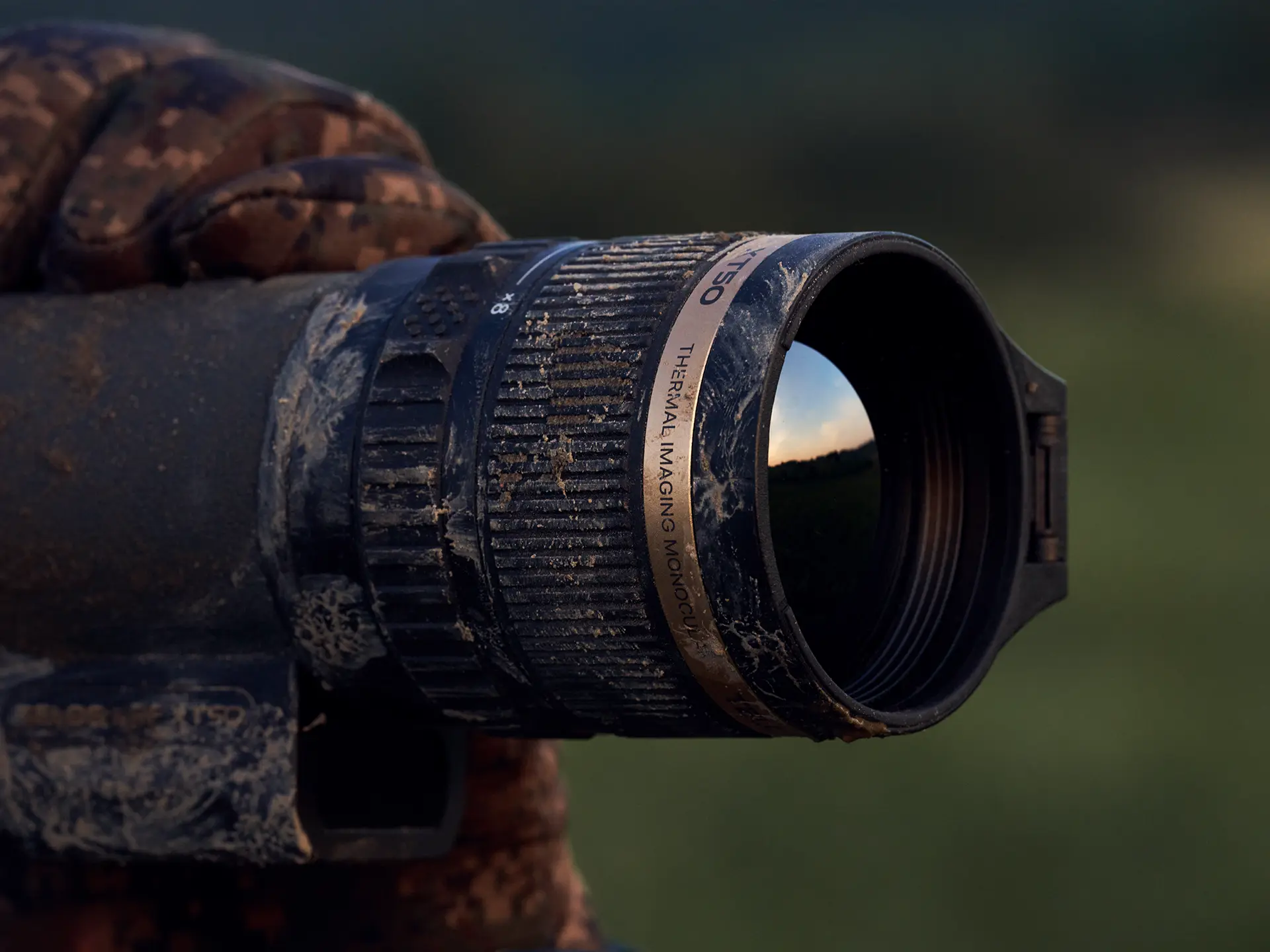
One control detail worth calling out: the focus and zoom wheels have noticeably more texture on the XT50 than on the XL50. It’s a small change, but it matters more than it sounds — in the cold, or with gloves on, a smooth ring is hard to turn with any precision, and the extra grip means you’re not fighting the control at four in the morning. The XT50 also wears gold accents to mark it out as the flagship, purely cosmetic, but it’s an easy way to tell the two models apart at a glance.
Riccardo Tamburini, who tested the XT50 in the field, points to the build quality carrying through the range: “new materials which assure more grip in any situation.
The core hardware experience, battery, stabilization, connectivity, and weatherproofing, is the same tool underneath either model.
Which thermal monocular should you choose?
Choose the TELOS LRF XT50 if you:
- Want the newest flagship in the Telos lineup.
- Prioritize the widest field of view, sharpest display, and fastest scanning across large areas.
- Frequently scan large areas and benefit from a wider field of view.
- Want the most advanced handheld thermal monocular Pulsar currently offers.
Choose the TELOS LRF XL50 if you:
- Want a premium all-round thermal monocular.
- Prefer a balance of image quality and long-range performance.
- Don’t need the highest-resolution thermal sensor.
- Want a proven platform for a wide range of hunting scenarios.
Which hunting style fits each model?
| Hunting Style | Recommended Model | Why |
| Woodland & mixed terrain | Both | Excellent thermal performance for everyday hunting. |
| Predator hunting | XT50 | Higher image detail helps identify smaller targets. |
| Long observation sessions | XT50 | Wider field of view improves scanning efficiency. |
| Wildlife observation | XT50 | Better detail for prolonged observation and identification. |
| General-purpose hunting | XL50 | Excellent balance of performance and versatility. |
Is the TELOS LRF XT50 worth the upgrade?
If you’re already using the TELOS LRF XL50, upgrading makes the most sense if image quality and wider field of view are your top priorities.
If you’re satisfied with your current image quality and your hunting style doesn’t require the additional detail offered by the XT50, the XL50 remains an outstanding premium thermal monocular.
Expert opinion
The 1280×1024 sensor combined with a 12 micron pixel pitch and a super low NETD is an explosive mix; in my opinion, it’s the best Pulsar device, talking about image quality. If you are an XL owner, getting the XT will be like getting a completely new thermal unit.
— Riccardo Tamburini
The golden ring isn’t decoration, it’s a symbol. Pulsar just set the benchmark for what high-end thermal imaging and laser range finding should include and deliver.
— Erik Bjaelkvall
Conclusion
The TELOS LRF XT50 and TELOS LRF XL50 are both premium thermal monoculars built on the same Telos platform, but they serve slightly different priorities.
Choose the XT50 if your goal is the highest level of image quality, wider-area scanning, and the newest flagship technology.
Choose the XL50 if you’re looking for an outstanding all-round performer that continues to deliver excellent thermal performance across a wide variety of hunting scenarios.
Ready to buy? Find your nearest authorized Pulsar dealer.
FAQs
What is the main difference between the TELOS LRF XT50 and XL50?
The biggest differences are the thermal sensor resolution and field of view. The XT50 features a 1280×1024 HD sensor and a wider 17.5° field of view, providing more image detail and faster scanning. The XL50 uses a 1024×768 HD sensor with a 14° field of view, making it an excellent premium all-round thermal monocular.
Which model has better image quality?
The TELOS LRF XT50 delivers the highest image quality in the Telos lineup thanks to its higher-resolution thermal sensor and Full HD AMOLED display.
Do both models have the same detection range?
Yes. Both the TELOS LRF XT50 and TELOS LRF XL50 offer a detection range of up to 2300 m. Their laser rangefinders differ, however: 1200 m on the XT50 versus 1000 m on the XL50, and the XT50 locks onto a target faster.
Which model is better for scanning large areas?
The TELOS LRF XT50 is better suited for scanning large areas thanks to its 17.5° field of view, allowing users to observe more terrain with every scan.
Is the TELOS LRF XT50 worth upgrading to?
If image quality, wider field of view, and the latest thermal technology are your priorities, the XT50 is a worthwhile upgrade. If you’re satisfied with your XL50’s performance, it remains an excellent premium thermal monocular.
Which model is better for hunting?
Both are excellent hunting monoculars. The XT50 is best for hunters prioritizing maximum image detail and observation efficiency, while the XL50 is ideal for those looking for premium all-round performance across a wide range of hunting scenarios.
About the experts

Expert Contributor:
Erik Bjaelkvall
Erik Bjaelkvall is a former Arctic Ranger, now a competitive practical shooter, seasoned hunter, and gear expert with decades of field experience.
Operating out of Sweden, Erik has extensively tested thermal imaging equipment across diverse environments – from open plains to rugged mountains, through snow, fog, and sun.

Expert Contributor:
Riccardo Tamburini
Riccardo Tamburini is a lifelong outdoorsman, hunter, fisherman, and professional wildlife photographer and filmmaker.
With over 35 years of experience across plains and mountains in Italy and abroad, he combines field expertise with a mechanical engineering background to explain the technology behind rifles, optics, and digital devices.
Before purchasing any night or thermal vision device, please make sure you adhere to the local legislation and only use it when it is allowed. Our ambassadors come from various countries and travel a lot, which allows them to test different devices. We do not encourage or support the illegal use of our devices in any events. If you wish to learn more about export and sales restriction policy, please visit the following link: Export and Sales Restriction Policy.