
Estimated read time: 7 min.
Coyote hunting gear loadouts can make or break your hunt. It determines whether you detect the animal early, identify it correctly, and take an ethical shot. The right predator hunting equipment — from rifles and optics to calling devices and stability systems — shapes success long before a trigger is pressed.
This expert gear checklist breaks down essential tools for day and night hunts, explains the role of each category, and helps you build a coyote hunting gear list that matches your terrain and experience level.
Quick answer
Essential coyote predator hunting gear
Necessary coyote hunting gear includes a flat-shooting predator rifle, detection optics for scanning, thermal or night vision devices for night hunts, a predator calling system, a stable shooting support, and legal/safety equipment suited to your state’s regulations.
Core gear checklist:
- Predator rifle & suitable caliber – Flat-shooting cartridge like .223 Remington or .22-250 for typical 100–300 yard engagements.
- Detection optics (daytime) – Quality binoculars or spotting optics for long-range scanning.
- Thermal or night vision optics (night hunting) – A thermal monocular for detection and a dedicated optic for identification and engagement.
- Predator calling device – Electronic caller or mouth call for projecting distress sounds; make sure the device you use is legal in your state.
- Shooting support system – Bipod, tripod, or shooting sticks for stability.
- Rangefinder & environmental tools – Laser rangefinder and wind indicator.
- Legal & safety equipment – Gear compliant with local night hunting regulations – always check before you go out for a hunt.
What equipment is absolutely essential for coyote
predator hunting?
Coyote predator hunting gear falls into five universal categories: firearm setup, detection tools, sound tools, stability systems, and environmental gear. Every successful loadout respects the hierarchy of detection → identification → engagement.
First, equip yourself with gear that suits your experience level. Learn how to use your tools before you hunt. Without reliable detection tools, opportunities can be missed, and improper identification, ethical shots become questionable. Your equipment checklist must support all three phases.
Read more: How to hunt coyotes at night
What core gear do all coyote hunters need regardless of time of day?
Certain equipment remains essential whether hunting under a midday sun or in total darkness. Dress for the weather and what the weather may bring. These tools form the foundation of any serious coyote hunting gear list.
Which rifle and caliber are most suitable for coyotes?
The most suitable rifle calibers for coyotes are flat-shooting cartridges such as .223 Remington and .22-250 Remington. These calibers offer manageable recoil, effective ranges beyond 300 yards, and sufficient terminal performance for ethical predator control.
A predator rifle should provide:
- Consistent accuracy inside 300 yards
- Controlled recoil for fast follow-up shots
- Compatibility with modern optic systems
Ethical hunting should lean towards the right caliber for the animal you are hunting; a .30-06 is overkill for a coyote or any other similar rounds. On the technical side, overpowered calibers increase recoil and reduce practical shot control. Balanced performance matters more than raw velocity.
What type of optic is required for detection, identification, and engagement?
Coyote hunting requires separate optic roles for detection, identification, and engagement. A single optic rarely performs all three functions efficiently. Scanning with a dedicated rifle optic is generally viewed as unsafe, and having a separate optic for scanning is strongly recommended.

- Detection optics: Wide field of view for scanning terrain.
- Identification optics: Clear image resolution to confirm species.
- Engagement optics: Precise aiming system for ethical shots.
Magnification between 3x and 12x covers most daytime engagements. Excessive magnification narrows the field of view and slows target acquisition, or causes you to miss your target entirely.
What calling equipment is used in predator hunting?
Predator calling equipment includes electronic callers, mouth calls, and remote-operated systems that project distress sounds to attract coyotes.
Electronic predator calls allow:
- Remote sound placement away from the shooter
- Adjustable volume and sound variety
- Consistent distress sequences

Mouth calls remain lightweight and reliable, but they can lead the coyote directly to your position. Improper positioning based on wind direction and where your scent will be carried can blow your position. The same applies for placement of a remote electronic caller.
Both systems serve the same purpose: draw coyotes into effective range.
What shooting support equipment improves accuracy?
Shooting sticks, bipods, and tripods improve shot stability and reduce movement during engagement. Stability systems increase hit probability, especially for long-range shots or uneven terrain.
Tripods provide maximum steadiness during night hunting with thermal riflescopes. Bipods offer lighter-weight solutions for mobile daytime stands. Choose what works best for you.
What gear is needed specifically for daytime coyote hunting?
Daytime coyote hunting emphasizes visual concealment, optical clarity, and wind awareness. Visibility replaces thermal detection, so optical performance matters more than sensor sensitivity.
What optics work best for spotting coyotes during the day?
High-quality binoculars with balanced magnification and optical clarity work best for daytime spotting. Magnifications between 8x and 12x allow scanning without excessive image shake.

Spotting scopes assist detection while covering large open terrain. Optical clarity and edge-to-edge sharpness help distinguish coyotes from livestock, deer, foxes, and domestic dogs at a distance.
Read more: Best multispectral binoculars for day and night hunting
What camouflage and wind-control gear helps during day hunts?
Camouflage patterns that match the terrain can reduce visual detection by approaching coyotes, but their primary defence is through their superior scent. Wind indicators and scent-control accessories are essential to get the drop on a coyote.
Wind direction influences approach patterns. A simple wind indicator provides immediate feedback without complex tools.
What gear is required for night coyote hunting?
Night coyote hunting requires specialized optics capable of detecting heat signatures or amplifying ambient light. Darkness changes the detection phase completely.
Thermal optics dominate predator hunting at night because they detect heat rather than visible light, whereas night vision can be adversely affected by weather conditions and moonless nights.
Why are thermal optics commonly used for night predator detection?
Thermal optics identify heat signatures in complete darkness, through light brush, and across open ground. Detection range often exceeds 1,200–2,000+ meters, depending on device class.
Category comparison overview
| Category | Primary function | Detection range | Best use case |
|---|---|---|---|
| Thermal riflescope | Precision aiming | Up to ~2,000+ m | Long-range engagement |
| Thermal monocular | Handheld scanning | ~1,200–1,800 m | Rapid field scanning |
| Thermal binoculars | Wide FOV observation | Up to ~2,000+ m | Extended monitoring |
| Night vision devices | Ambient light amplification | Limited by light / IR | Where thermal is restricted |
| Multispectral optics | Thermal + digital imaging | Up to ~2,000+ m | Day & night identification |
Thermal monoculars and binoculars handle detection. Riflescopes handle engagement. Separating those roles increases efficiency.
Pulsar devices for predator hunting at night
| Device | Type | Key strengths | Best use case |
|---|---|---|---|
| Axion XG35 Compact | Thermal monocular | Pocketable design; <20 mK thermal sensor | Quick scanning |
| Oryx LRF XG35 | Thermal monocular | Mid-size body; <20 mK sensor; 1100-yd laser rangefinder | Quick scanning and distance ranging |
| Merger LRF XT50 | Thermal binoculars | Wide field of view; built-in LRF; long detection range | Large-area observation |
| Talion XQ38 | Thermal riflescope | Lightweight design; fast startup | Fast predator calling stands |
| Thermion 2 LRF XG60 | Thermal riflescope | Long-range precision; traditional scope form factor | Extended-distance identification |
| Trail 3 LRF XQ50 / XR50 | Rail-mounted thermal riflescope | Integrated laser rangefinder; ballistic support | Mixed-terrain predator control |
| Symbion LRF DXR50 / DXT50 | Multispectral binoculars | Thermal + digital image fusion | 24/7 observation |
Devices with NETD <20 mK or <25 mK improve heat contrast in cold weather and subtle terrain conditions.
Read more: Best thermal scope for coyote hunting
When should you use night vision instead of thermal?
Night vision should be used when thermal optics are restricted by regulation or when ambient light conditions allow effective image amplification. Night vision relies on IR illumination or moonlight rather than heat detection.
Thermal excels in complete darkness and cluttered terrain. Night vision performs adequately in open fields with moderate ambient light.
Read more: Night vision vs thermal: Which to choose?
What legal and safety equipment should be considered for night hunts?
Night hunting requires compliance with state regulations governing optic type, identification standards, and firearm legality. Proper target identification is mandatory before engagement.
Equipment should comply with local night-hunting regulations and safe shooting practices.
For night hunting techniques and field strategies, see: How to hunt coyotes at night.
Read more: Night hunting laws: Legal and ethical use of thermal devices
What additional accessories increase success in predator hunting?
Additional predator hunting equipment enhances precision and environmental awareness without replacing core tools. Make sure you don’t bring anything unnecessary, more weight can slow you down, and anything noisy can blow your hide site.
Do you need a rangefinder or wind meter for coyotes?
A laser rangefinder improves distance estimation and shot accuracy, especially beyond 200 yards. Wind meters assist when shooting across open terrain where crosswinds affect bullet drift.
Accurate range estimation reduces guesswork and improves ethical engagement.
What clothing and weather gear should predator hunters consider?
Insulated layers, cold-weather gloves, scent control, and noise-reduction fabrics improve endurance and reduce movement noise. Weather-appropriate gear prevents fatigue during extended sits.
Comfort supports patience. Patience increases opportunity.
How do you build the right coyote hunting gear setup for your environment?
Coyote hunting gear should match terrain, line of sight, and typical engagement distances. Open country demands a longer detection range. Wooded areas emphasize shorter engagement and maneuverability.
How does terrain affect your gear selection?
Open terrain increases detection distance and often favors thermal binoculars or long-range riflescopes. Wooded areas reduce line of sight and shift emphasis toward faster scanning and lighter setups.
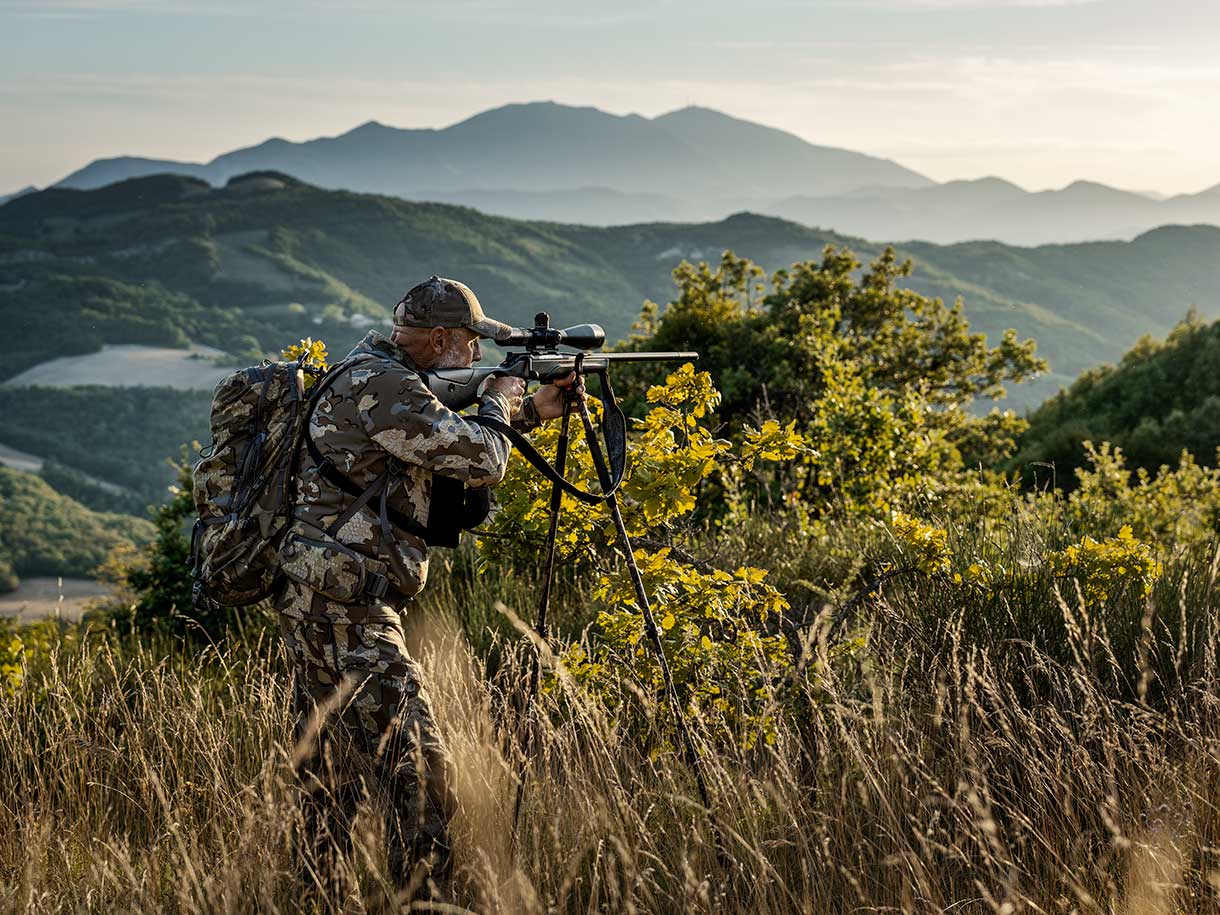
Detection distance, and what you are comfortable with via shot placement should dictate optic selection.
What does a beginner vs advanced predator hunting loadout look like?
A beginner loadout includes:
- .223 Remington rifle
- Quality daytime optic
- Electronic caller
- Shooting sticks
- Basic binoculars
An advanced loadout adds:
- Dedicated thermal monocular
- Thermal riflescope with integrated LRF
- Ballistic support features
- Modular tripod system
Advanced optic systems prioritize detection first, engagement second. Keep in mind, you don’t need the most advanced gear to get the job done, but it can help ease the burden of your hunt.
What are the most common gear mistakes in coyote predator hunting?
Common gear mistakes include optic mismatch, poor detection hierarchy, and environmental misalignment.
Frequent errors:
- Choosing excessive magnification
- Overinvesting in engagement optics before detection tools
- Ignoring wind and terrain conditions
Detection tools determine opportunity. Engagement optics only matter after detection. Experience gets you the opportunity to take the shot.
Final thoughts
Coyote predator-hunting gear determines success long before a shot opportunity arises. Detection, identification, and engagement must work together within your environment.
Build your coyote hunting gear list around terrain, light conditions, and realistic engagement distances. Prioritize detection tools first. Add engagement optics second.
Choose equipment that solves real-world problems — not marketing claims — and your setup will reflect experience where it counts.
Frequently asked questions about coyote hunting gear
Do you need thermal optics for night coyote hunting?
Thermal optics are not legally required everywhere or always necessary, but they significantly improve heat-based detection and target identification in complete darkness. They outperform night vision in most low-light predator scenarios.
What is the most important piece of predator hunting gear?
The most important predator hunting gear is reliable detection optics. Without early detection, rifle performance and calling strategy become irrelevant.
Is night vision or thermal better for coyotes?
Thermal is generally better for coyotes because it detects heat signatures in total darkness and cluttered terrain. Night vision depends on ambient light and IR illumination.
What gear is required to hunt coyotes legally at night?
Legal night-hunting gear depends on state regulations, but typically includes compliant optics, proper firearm configuration, and verified target identification.
How much magnification do you need for coyote hunting?
Most coyote hunting scenarios require magnification between 3x and 12x. Excessive magnification reduces the field of view and slows engagement.
Further reading:
About the expert

Co-Author:
Joshua Skovlund
Joshua Skovlund has covered stories for Task & Purpose, Outdoor Life, and Coffee or Die Magazine. He has photographed and filmed multinational military exercises and hunting trips in austere environments around the world, with his first archery kill in Kona, Hawaii.
Joshua grew up in South Dakota, learning how to scout and hunt deer, turkey, pheasant, and waterfowl. He currently scouts and hunts black bears, turkeys, and deer, while taking every opportunity to go to the range and further hone his pistol and rifle shooting skills.
Before purchasing any night or thermal vision device, please make sure you adhere to the local legislation and only use it when it is allowed. Our ambassadors come from various countries and travel a lot, which allows them to test different devices. We do not encourage or support the illegal use of our devices in any events. If you wish to learn more about export and sales restriction policy, please visit the following link: Export and Sales Restriction Policy.