
Expert Contributor:
Riccardo Tamburini, Ben Blood
Estimated read time: 7 min.
Hunting coyotes at night is one of the most effective ways to control a wary predator—but only if you do it right. When darkness, wind, and pressure work against you, the right setup, tactics, and thermal optics make all the difference.
From choosing the best stand locations to calling strategies and precise shot placement, this guide breaks down how experienced hunters consistently succeed after dark.
Whether you hunt open farmland or mixed terrain, you’ll learn how to detect coyotes faster, confirm identification confidently, and take ethical shots using proven night hunting methods.
QUICK ANSWER
To hunt coyotes at night successfully, focus on discipline, wind control, and constant scanning. Coyotes use darkness and scent to expose mistakes fast, so your setup matters more than speed.
Core night hunting principles:
- Set up with the wind quartering into your face to control the downwind approach
- Scan continuously with a handheld thermal before calling or moving
- Keep movement minimal and let silence work between calling sequences
- Confirm identification before shooting and stay within your proven night range
Calling and shot execution:
- Start calling at low volume and increase only if nothing responds
- Expect coyotes to circle downwind before committing
- Use a stable shooting position and be ready for a fast follow-up shot
Watch: Expert Cory Chilton demonstrates how patience, sound volume adjustment, and reading coyote body language turn a quiet night into a successful harvest.
Recommended Pulsar optics:
- For open farmland and prairie hunting, Thermion 2 LRF XL60 or XG60 provide long-range clarity with built-in laser ranging.
- For mixed terrain and varied distances, Thermion 2 LRF XP60 offers a balanced combination of sensitivity, field of view, and magnification.
- For hunters who prioritize a more compact, rail-mounted setup for mixed terrain and professional predator control, the latest Pulsar Trail 3 LRF thermal riflescope delivers precision ranging, integrated ballistic support, and reliable performance in challenging night conditions.

Why nighttime hunting works for coyotes
Coyotes shift to a more nocturnal lifestyle in areas where people are active; in rural or pressured areas, their movement peaks around dusk and again after midnight. That is when thermal optics perform best. In open fields and pasture edges, heat signatures stand out, and long shots are easier to range and hold.
There is one more thing to note: and that’s moon. Here’s how it affects coyote behavior, according to a highly experienced hunter and wildlife expert Riccardo Tamburini:
During a full moon, coyotes are more active but also feel more exposed in open areas; full moon nights might lead to more nocturnal activity, potentially reducing daytime movements; but the hunter will be more visible and the coyotes could feel less secure and are less likely to move across open ground, so stay under cover and leave the car far from your hunting area.
What gear do you need for hunting coyotes at night?
Successful night hunts begin with efficient scanning and precision shooting. Pair a handheld thermal for detection with a riflescope for identification and an integrated laser rangefinder to cut down time for longer shots.
Thermal imaging vs. Night vision
The debate over whether to use thermal or night vision for hunting coyotes in the twilight hours is a common topic. The simple answer is they aren’t the same. Thermal detects heat with no ambient light, cutting through darkness, light fog, and light brush. Night vision amplifies light and can be excellent in areas where thermal scopes and glass are illegal, but it relies on moonlight or IR.
Read more: Thermal imaging vs night vision for hunting
Pulsar Devices the experts can rely on
The Thermion 2 LRF XL60 (HD 1024×768 sensor, 60 mm lens, 2.5–20×) is the best for long-range ID and holds. The Thermion 2 LRF XG60 (640×480, 60 mm, 4–32×) provides extra base magnification for small targets, making it ideal for short to intermediate ranges. The Thermion 2 LRF XP60 boasts exceptional thermal sensitivity, striking a balance between resolution, field of view, and magnification, making it an ideal choice for mixed terrain and a prime option for challenging conditions.
For hunters who prefer a more compact, rail-mounted setup, especially in forested areas, rolling terrain, or professional predator control scenarios, the latest Pulsar Trail 3 LRF thermal riflescopes provide a highly efficient alternative. Built as rugged monoblock units with integrated laser rangefinding and ballistic support, Trail 3 LRF scopes are designed for fast handling and reliable performance in real-world conditions.
- Trail 3 LRF XQ50 excels in fog, humidity, and low-contrast environments, making it ideal for short- to mid-range night hunting in mixed or wooded terrain.
- Trail 3 LRF XR50 is optimized for longer distances, delivering crisp target detail and confident shot placement across open fields and wider landscapes.
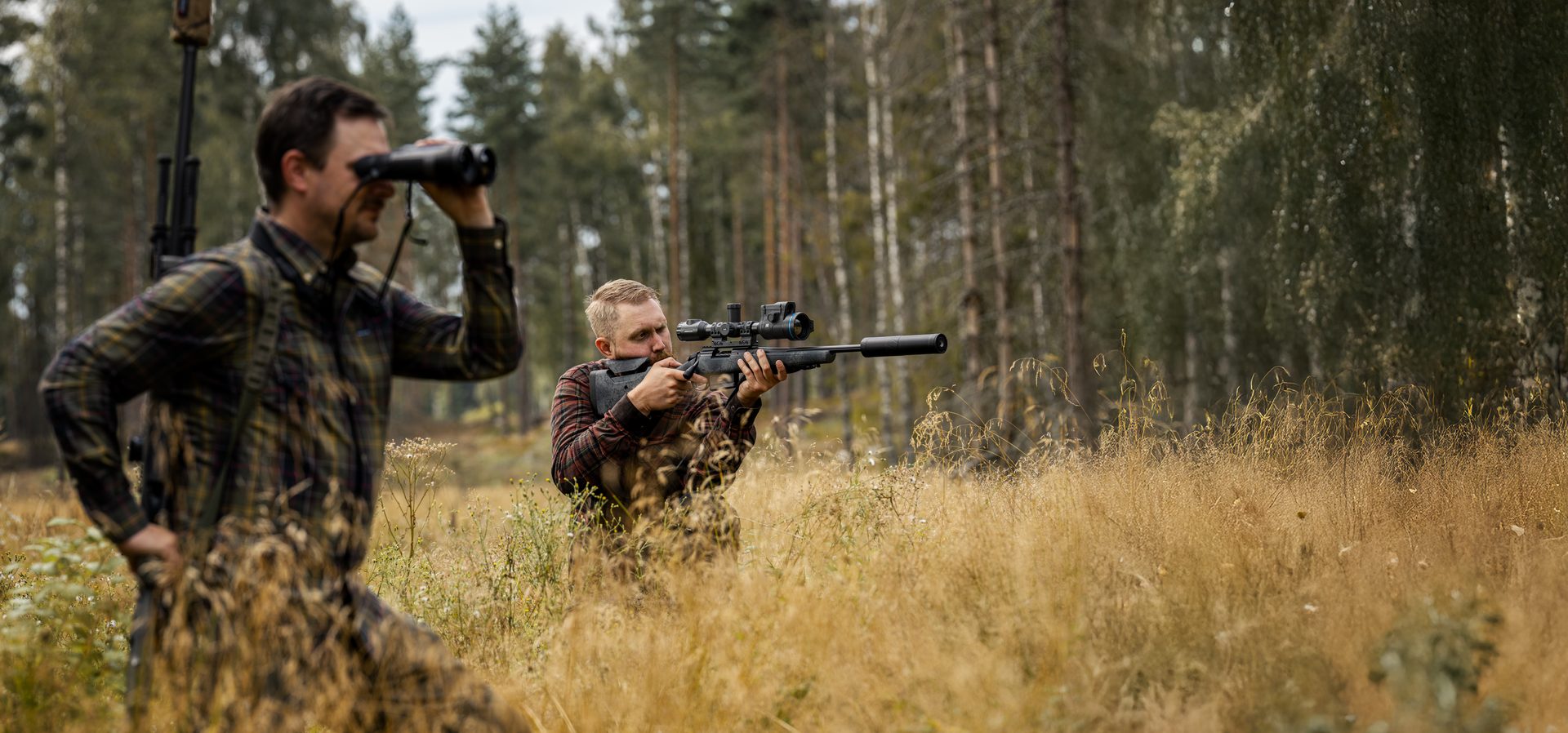
For scanning and range finding, use a compact monocular such as the Axion 2 LRF XQ35 Pro for fast handheld scanning and instant range checks before you shoulder the rifle. Hunters who want a premium handheld option for scanning larger areas and more detailed observation can step up to the TELOS LRF XT50, Pulsar’s newest flagship thermal monocular. Its 1280×1024 HD sensor and wide 17.5° field of view combine high image detail with broad situational awareness, while the integrated 1200 m laser rangefinder supports fast distance assessment. For long sits and big pastures, Merger LRF XP50 binoculars reduce eye strain and provide comfortable two-eye observation.
For hunters operating across changing light conditions — from early evening setups through full darkness and into extended night scans — the latest Pulsar Symbion multispectral binoculars add an extra layer of situational awareness. Coyotes often pause at field edges or use open ground and shadow to conceal movement, making confident identification just as important as detection. By combining thermal detection with digital imaging, Symbion supports 24/7 day-and-night observation, allowing hunters to confirm heat signatures alongside visual detail and make informed decisions before committing to a shot.
That’s not the only aspect to consider. A stable tripod or shooting sticks, spare APS batteries, and a quiet e-caller remote are essential to every night hunt.
Tripods reduce scope wobble at higher base magnifications. Spare batteries keep you in the field when temps dip. A chest rig or bino harness keeps the monocular handy without swinging.
One of the key reasons our expert Riccardo chooses Pulsar for reliable shots? Latency:
In my opinion, when hunting coyotes, the latency of a thermal scope becomes one of the most important aspects to consider. As we know, Pulsar scopes have zero latency because they declare both the real sensor NETD and the system NETD. When the software manipulation is too intense, often latency can be introduced in digital vision because the time needed to process the thermal signal. And 0.5 seconds can make the difference between a precise shot and a missed target, considering that coyotes move not alone and also, often a second and third running shot is possible.
Comparison table: thermal optics for coyote hunting at night
Choosing the right optics is crucial for successful nocturnal coyote hunting. Coyotes are wary, fast, and often cross open ground between cover. Reliable long-range detection, wide-area scanning, and precise aiming in complete darkness are essential.
| Category / Use case | Thermal riflescope | Thermal monocular | Thermal binoculars | Night vision devices | Multispectral optics |
|---|---|---|---|---|---|
| Primary function | Precision aiming with a rifle | Handheld scanning of fields/treelines | Wide FOV for extended observation | Low-light amplification where thermal isn’t legal | Day-and-night detection and identification |
| Detection range | Up to ~2,000+ m | ~1,200–2,300 m | Up to ~2,000+ m | Limited—depends on moon/IR | Up to ~2,000+ m (thermal) |
| Performance in total darkness | Excellent | Excellent | Excellent | Limited—needs ambient/IR | Excellent |
| Accuracy & identification | Highest precision for ethical shots | Great for detection | Excellent ID/tracking at distance | Lower—harder to confirm species | High-confidence ID using thermal + digital |
| Mobility and weight | Medium | Very light/portable | Heavier | Light | Medium |
| Best use case | Long-range shots when coyotes commit | Rapid scanning, then transition to rifle | Monitoring big country/calling setups | Can provide a range up to ~1,000 m, limited by weather, terrain, lighting | 24/7 day-and-night observation across changing light |
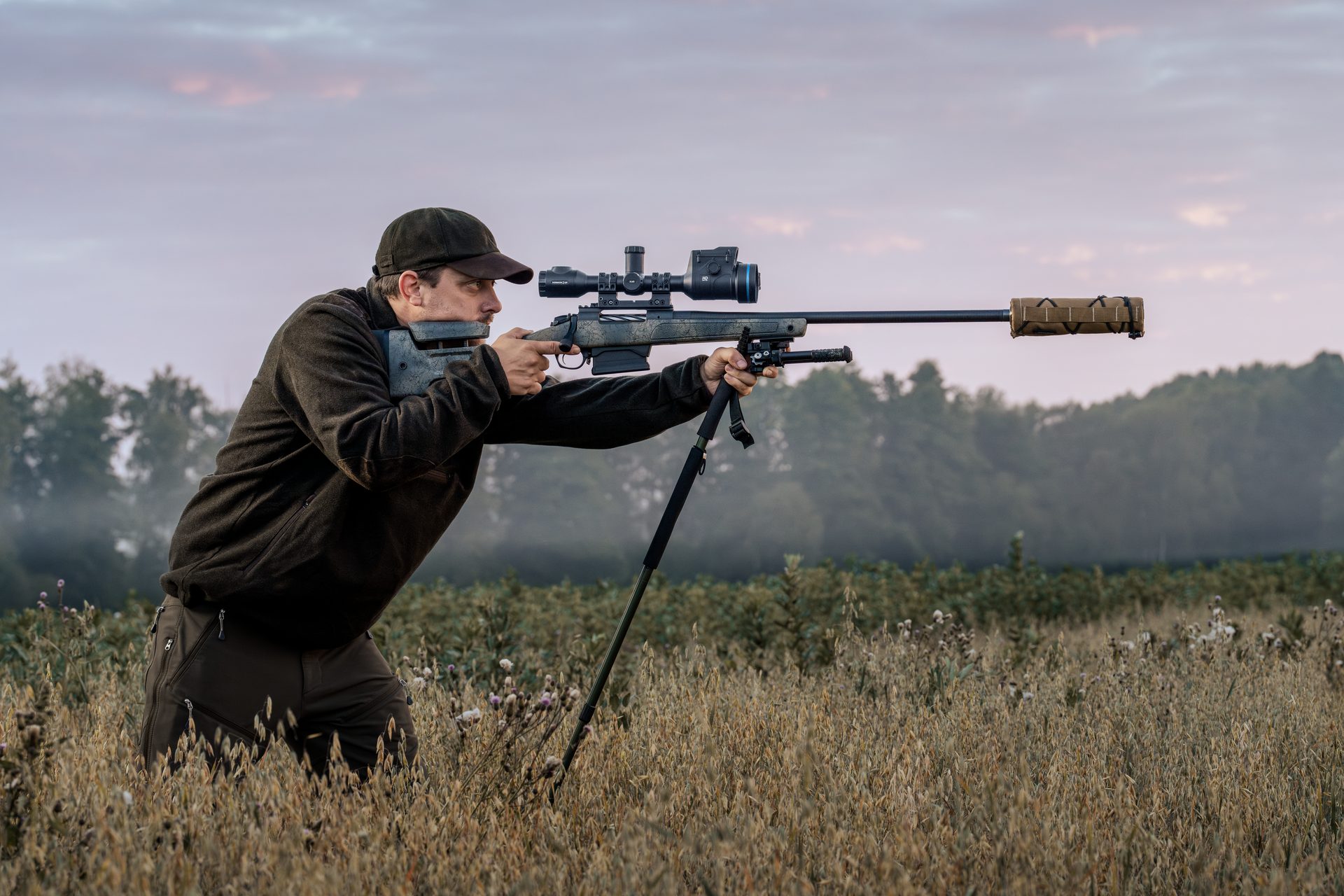
Pulsar devices for coyote hunting at night
Coyote hunting rewards devices with long detection range, crisp target ID, and dependable ergonomics. These options cover scanning, observation, and precision shots.
| Device | Type | Key strengths for coyote hunting | Best use case |
|---|---|---|---|
| Axion 2 LRF XQ35 Pro | Thermal monocular | Pocketable scanner with integrated LRF and strong thermal sensitivity | Quick, mobile scanning and ranging before transitioning to the rifle |
| TELOS LRF XT50 | Premium thermal monocular with LRF | 1280×1024 HD sensor, wide 17.5° FOV, 2× base magnification, and integrated 1200 m LRF | Premium wide-area scanning and detailed observation across open fields, treelines, and mixed terrain |
| Merger LRF XP50 | Thermal binoculars with LRF | Wide FOV, long detection range, built-in LRF, and comfortable two-eye viewing | Extended observation across large fields and longer calling stands |
| Talion XQ38 | Thermal riflescope | Lightweight, fast startup, and solid mid-range performance | Fast-paced calling stands and short- to mid-range shots |
| Thermion 2 LRF XG60 | Thermal riflescope with LRF | Traditional scope feel, high base magnification, long-range precision, and integrated ranging | Longer-range shots where precise observation and ranging matter |
| Trail 3 LRF XQ50 / XR50 | Rail-mounted thermal riflescope with LRF | Compact monoblock design, integrated LRF and ballistic support, fast handling | Professional predator control across mixed terrain, forest edges, rolling farmland, and challenging conditions |
| Symbion LRF DXR50 / DXT50 | Multispectral binoculars with LRF | Thermal detection combined with digital imaging for additional visual information across changing light | 24/7 observation when both thermal detection and visual confirmation are important |
Riccardo also has some practical tips regarding setting up your rifle:
Coyotes offer a small silhouette so it’s better to wait they got close to you. .223 is famous for the small drop of the bullet and for not being sensitive to the wind, although some new calibers, such as 6 ARC (for those who love to go hunting with an AR platform rifle), performs even better than .223.
In my opinion, a 100 mt zeroing is a good compromise between the features of these calibers and the hunting conditions. Talking about reticles, in varmint hunting I prefer to use the M58I, M56FI or X51FI, which show a direct distance compensation (dots on reticle cross) when the target is farther than zeroing distance.
Read more: Best Pulsar thermal scope for coyote hunting
Scouting and setup: how experts choose the right spot
Successful night stands start before the sun sets. Glass likely travel corridors and plan entry paths that keep your scent disguised or moving in the opposite direction of the coyotes you’re hunting.
Wind can be a problem or your best friend for stand selection. Set up cross-wind or wind-in-face so your scent cone drifts into “dead space” coyotes won’t cut through. Expect coyotes to circle downwind in the last 100–200 yards; place a partner or decoy there and watch the edges.
Set up on a slight elevation with a clean, safe backstop that lets you see over dips and identify heat signatures sooner. Avoid skylining; use fencerow shadows, round bales, or low brush to break your outline without obstructing the muzzle.
Read more: How to choose the right thermal scope for your hunting style

Calling coyotes at night: what actually works?
Sound choice and cadence matter more than volume. Start subtle, then escalate only if nothing is moving. Begin with vole/rodent squeaks or soft rabbit distress for two minutes, then pause. If nothing shows in five minutes, hit a cottontail or jackrabbit call. Mid-hunt, pup distress, or howls can trigger a commitment from coyotes hanging at 300+ yards.
Ben Blood says:
My preferred calling sequence is to start with a rabbit sound at a relatively low volume. Very couple of minutes that passes without the sight of an approaching coyote I bump the volume up until I have reached maximum volume. This is of course using an electronic caller. Usually I play the same rabbit sound for 10-15 minutes. Sometimes I will play a couple different rabbit sounds in that 15-20 minute timeframe. One that has a higher pitched followed by a sound with a lower pitch and always looking for sounds with as much emotion in them as possible. Sometimes I start with bird distress as a high pitch sound. A lot of coyote hunters say that is too long to play the same sound but in my area I have seen many appear in that 15-20 minute mark. It begs the question was the animal there listening the whole time or was it roaming the area and finally got into hearing distance at that point in the stand. Probably never know for sure but that’s what has worked for me. If I am in a spot where I really believe there is a coyote and he is reluctant to approach my ambush I will then howl and play some territorial dominance sounds to try to entice a response. This has worked well for me too.
Most night responses happen in 10–18 minutes. After the initial look, reduce the volume and let the coyotes work. Avoid constant sound—silence makes them hunt your position.
Coyote activity vs. time of night
This snapshot shows typical activity windows seen by Pulsar field testers. Use it to time call intensity and magnification changes across the night.
| Time period | Coyote activity level | Recommended tactic | Pulsar feature to use |
|---|---|---|---|
| Dusk (6–9 pm) | Moderate | Scout & soft-call | Wide FOV (Merger), low base magnification |
| 9 pm–1 am | High | Active calling + watch downwind | LRF for ranging, PiP for ID |
| 1–3 am | Peak | Sit tight near cover edges | PiP + higher magnification |
| 3–6 am | Declining | Scan slowly, reduce calling | Long battery mode, User Mode profiles |
Spotting and shooting: timing is everything
Thermal makes detection easy; ethical ID and steady holds still decide the outcome. Look for coyote-typical gait (light, head-low lope), tail carried level, and a smaller chest than a domestic dog. Use Picture-in-Picture to zoom in on the head and confirm ear shape before you touch the trigger.
Where to aim is a common question for beginners. Broadside shoulder shots are the most reliable. Keep shots inside your proven group at that magnification—many hunters cap at 250–300 yards at night. Experience, conditions, wind, and magnification drive the limit. When the wind or angle is wrong, let them walk. Ethics beat footage, every time.

What legal and ethical issues should you consider?
Regulations on thermal, artificial light, and electronic calls vary widely by state and even county. Some states allow thermal for predators with restrictions; others ban artificial light or night vision. Check your state regs and any local firearm-discharge ordinances.
Always confirm with your wildlife agency and landowner rules before a night hunt. For example, Kansas allows coyote night hunting but prohibits the use of artificial light and optics that project or amplify light. Whereas in Montana, you can use artificial light and light-amplifying devices, just not on public lands.
Always check your state and local restrictions on night hunting before you set out for the night. That includes season dates, acquiring tags and permission to hunt the land, and whether you can use thermal or night vision scopes or glass for that hunt.
When it comes to coyote hunting, it’s also worth remembering your why. Here’s Riccardo’s:
Managing coyote population helps to have healthy stocks of whitetail deer. A recent study demonstrated that during breeding season, a sole coyote is able to get up to 19 whitetail deer fawns. Considering that a deer gives birth to one or two fawn and the coyote – up to nine pups, it’s quite clear that the two situations are not balanced and they have to be managed by hunters.
Read More: Night Hunting Laws
Pulsar pro tips: mistakes to avoid in the field
Experience turns into numbers when you repeat what works and cut what doesn’t. Overcalling in high wind, rushing the set after a noisy approach, and running excessive magnification that narrows the FOV are some of the biggest mistakes. Slow down, scan first with the monocular, and only zoom when you are ready to shoot.
Case study: A successful night hunt breakdown
Ben Blood says:
First thing I always like to point out is I believe there is a difference between calling a coyote into a set and calling a coyote out into the open where you can get a shot. Most people blend the two thinking as long as I can get a shot at the animal then I have called it in. But for me I can tell the difference between an animal whose curiosity has been sparked versus one who is totally fooled and completely committed to my ambush. I personally prefer and seek out the later and with that I think my approach to calling is sometimes a little different.
Coyotes need calories and are very opportunistic when it comes to food. They are the top of the food chain around my part of the world and this have no fear or sense of concern approaching a prey sound unless they have been educated to a potential danger in the past. Even then depending on severity of the hunger they can be pursuaded. Take the depth of winter when hunting for food is more difficult and more calories are required an educated coyote can be fooled much easier than when hunting is easy and less calories are required. With this in mind I find starting with some kind of prey sound is best for a calling sequence. A lot of coyote hunters say to start with a howl but I have rarely seen a coyote coming bolting in to very close range with a howl where I have many times to a prey sound such as a rabbit or hare. Coyote vocals like howls, fights and puppy sounds usually work better in the summer months I have found. During this time they are very territorial and defensive of their young.
Just last night I made a coyote stand shortly after dark. I parked my truck on the edge of a freshly picked corn field near a hard wood timber with a section of set aside grass bordering. All great coyote terrain. I made my way to the high spot in the field where I could observe all three terrain changes. Placing the call up wind approximately 40 yards away. I started the stand with a low volume higher pitched rabbit call. And increased the volume every couple minutes. After about 10 minutes I switched sounds to a deeper pitched rabbit sound. A jack rabbit to be exact. None in this specific region I should note. This particular sound has a lot of emotion in it and has been a very successful sound over the years. In less than two minutes a coyote appeared from the grass field and bounded into the picked corn. Heading for the wind I prepared to have to stop him and make the shot. Before he could get to the wind he made the final commitment and turned heading straight towards my sound. As he entered inside my range less than 75 yards and less than 30 from my call he paused to take a better look at what was making the sound. At this time I took the frontal shot hitting the animal in the neck just below his head anchoring him instantly. The weather he has been warm. Mid 80’s F during the day and mid 60’s F at night. The wind was very minimal from the North. I have been using the Talion XG35 recently in White Hot. I like using dimmer settings as to not affect my normal eyes night vision.
Final thoughts
Successful night coyote hunting comes down to discipline and repeatable fundamentals. Plan every stand around the wind, scan constantly with a handheld thermal, confirm identification before shooting, and only take shots you can place with confidence. Coyotes punish rushed setups and sloppy movement, but they reward hunters who slow down, stay patient, and let the hunt come together.
The right optics reinforce those fundamentals. For open country and longer shots, Thermion 2 LRF XL60, XG60, and XP60 provide the clarity, ranging, and precision needed from prairie to pasture. In mixed terrain, forest edges, or professional predator control scenarios where compact handling and fast decision-making matter, the Trail 3 LRF thermal riflescopes offer a reliable, rail-mounted alternative with integrated ranging and ballistic support. For detection and observation, Axion 2 LRF and Merger LRF tools keep you ahead of approaching coyotes, while Pulsar Symbion multispectral binoculars add confidence across changing light conditions.
Build simple routines, log your stands, learn from each setup—and night hunting coyotes will stop feeling unpredictable and start producing consistent results.
FAQs About Hunting Coyotes at Night
What legal restrictions should I check before hunting after dark?
Confirm your state’s rules on night hunting, thermal/night vision, artificial light, electronic calls, and local discharge ordinances. Some states allow hunting predators at night with limits; others don’t. Always verify before you go.
How can thermal scopes improve my success rate?
Thermal detects heat in total darkness, making it easier to spot and identify coyotes at safe shooting ranges. Built-in LRF, PiP, and stable base magnification improve shot placement and ethics.
When is the best time of night to hunt coyotes?
Activity often spikes between 9 pm and 3 am, with regional variation. Start sets around dusk, but plan your longest sits for the midnight window.
What are the most effective tools for night hunting safely?
A thermal monocular for scanning, a riflescope with PiP and LRF for precise holds, a stable tripod, and spare batteries. Add a partner to watch downwind when possible.
What Pulsar device is best to hunt coyotes at night?
For long-range shots in open country, choose the Thermion 2 LRF XL60 or XG60; for mixed terrain, consider the XP60. For handheld scanning, the Axion 2 LRF XQ35 Pro prioritizes compactness and fast deployment, while the TELOS LRF XT50 is the premium choice for hunters who want wide-area scanning, HD thermal detail, and integrated ranging. For extended two-eye observation, choose the Merger LRF XP50. For changing light conditions, Pulsar Symbion multispectral binoculars combine thermal detection with digital imaging for 24/7 observation.
Can thermal imaging see through brush?
Thermal detects heat; it does not see “through” solid objects. Twigs and grass can obscure or distort a heat signature, so re-angle for a clear lane before shooting.
About the experts

Co-Author:
Joshua Skovlund
Joshua Skovlund has covered stories for Task & Purpose, Outdoor Life, and Coffee or Die Magazine. He has photographed and filmed multinational military exercises and hunting trips in austere environments around the world, with his first archery kill in Kona, Hawaii.
Joshua grew up in South Dakota, learning how to scout and hunt deer, turkey, pheasant, and waterfowl. He currently scouts and hunts black bears, turkeys, and deer, while taking every opportunity to go to the range and further hone his pistol and rifle shooting skills.

Expert Contributor:
Ben Blood
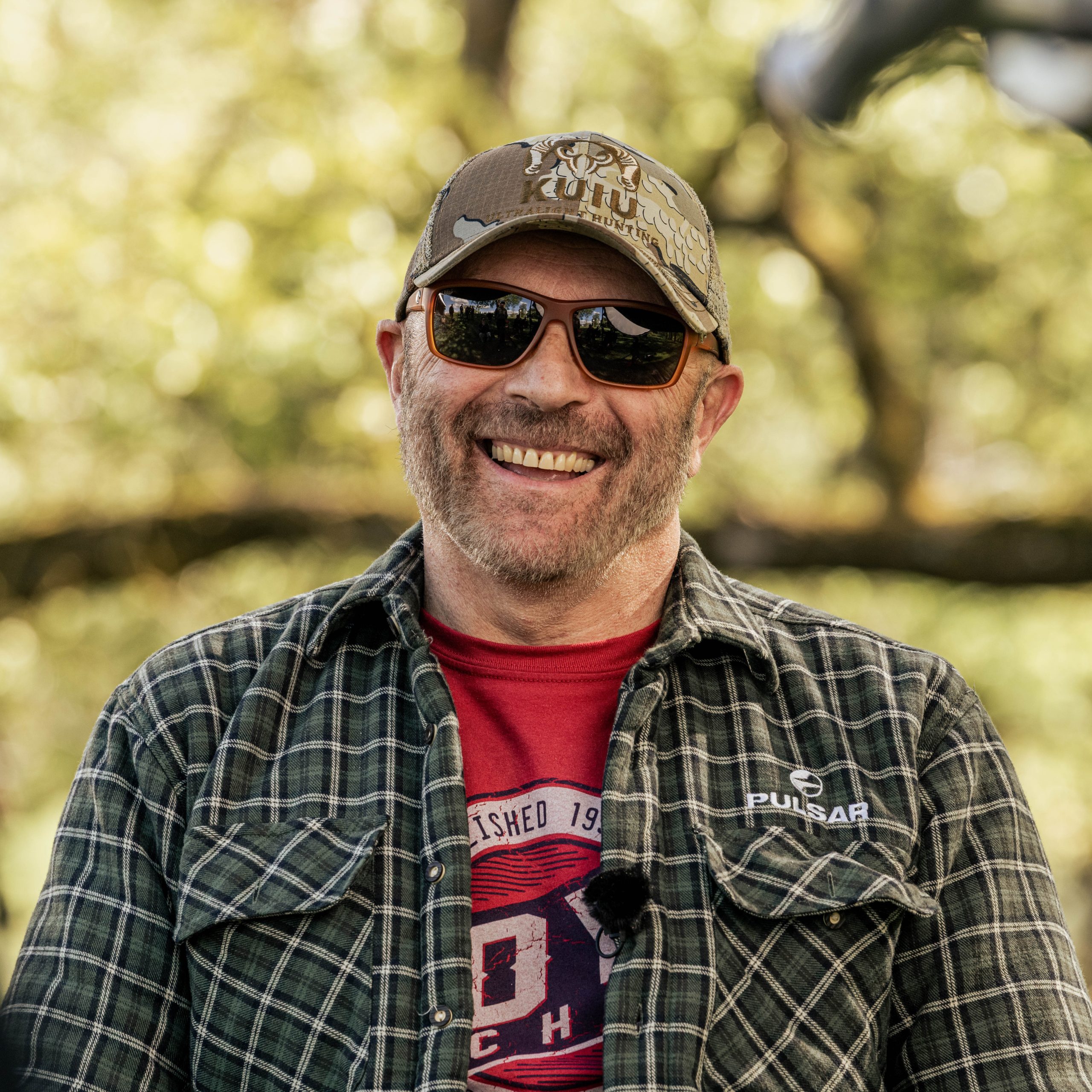
Ben Blood is recognized as one of the leading US authorities on coyote hunting. With decades of practical experience, his expertise offers invaluable insights into both the strategy and science behind effective hunting.
Expert Contributor:
Riccardo Tamburini
Riccardo Tamburini is a lifelong outdoorsman, hunter, fisherman, and professional wildlife photographer and filmmaker.
With over 35 years of experience across plains and mountains in Italy and abroad, he combines field expertise with a mechanical engineering background to explain the technology behind rifles, optics, and digital devices.
Before purchasing any night or thermal vision device, please make sure you adhere to the local legislation and only use it when it is allowed. Our ambassadors come from various countries and travel a lot, which allows them to test different devices. We do not encourage or support the illegal use of our devices in any events. If you wish to learn more about export and sales restriction policy, please visit the following link: Export and Sales Restriction Policy.