
Estimated read time: 5 min.
How far can a thermal scope see is one of the most pressing questions in hunting. Advertised detection ranges look impressive, but spotting a heat signature at long distance doesn’t mean you can identify your target or take a responsible shot.
In real hunting conditions, thermal imaging performance depends on more than specs. Sensor resolution, lens size, environmental conditions, and target type all shape what you actually see in the field.
This guide explains the critical difference between detection, recognition, and identification, and shows what thermal range really looks like when it matters — when you’re making decisions in the dark.
Quick answer
A thermal scope can detect heat signatures from 700 to over 2,500 meters, depending on sensor resolution and lens size. However, detection range is not the same as usable range: most hunters can only identify targets at 100–400 meters, where details like species, size, and orientation become clear. Detection shows a heat source; identification enables a safe, ethical shooting decision.
Key takeaways
- Understand the difference: Detection shows heat, identification confirms a target for an ethical shot.
- Expect realistic ranges: Most hunters identify targets at 100–400 meters, not at advertised max distances.
- Prioritize sensor and lens: 640×480 sensors and larger lenses dramatically improve usable range.
- Factor in conditions: Humidity, fog, and warm nights reduce thermal contrast and effective distance.
- Focus on technique: Settings, elevation, and slow scanning can extend real-world performance.
What is the difference between detection, recognition, and identification?
Detection is spotting heat, recognition is understanding the target type, and identification is confirming exactly what it is for a safe shot.
Detection range explained (seeing heat signatures)
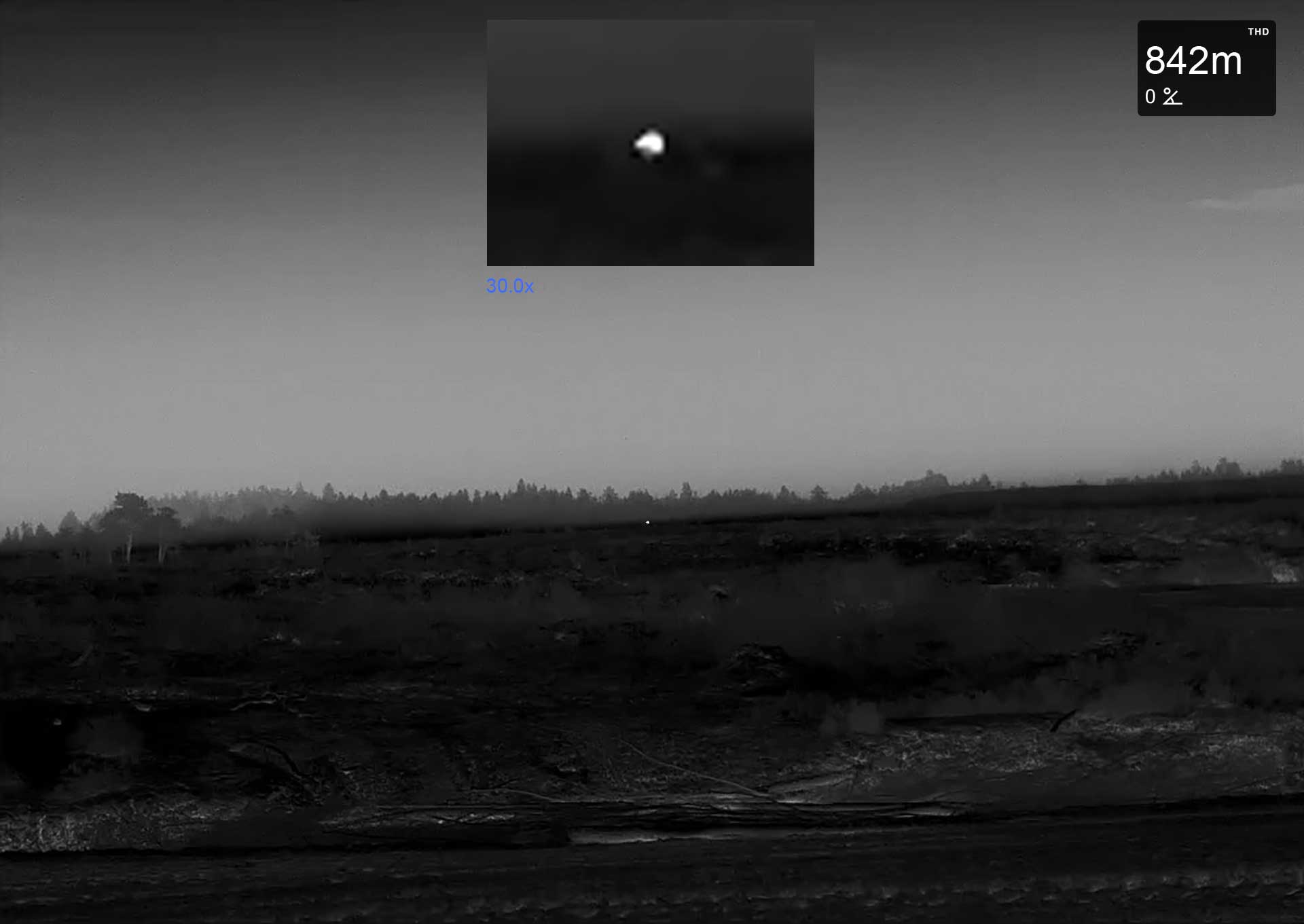
Detection means your thermal scope registers infrared radiation as a heat signature. It shows a warm object against a cooler background.
Detection is just your scope telling you something warm is out there: a blob of heat against a cooler background. At that stage, you know almost nothing useful.
This matters because detection alone doesn’t support decision-making. A heat source could be anything — animal, human, or background interference.
Field warning: Many hunters overestimate detection range. Seeing a heat blob at 1,500 meters does not mean you can act on it.
Recognition range explained (understanding the target type)
Recognition means interpreting shape, silhouette, and movement patterns.
Recognition is when you start reading the shape: four legs, the silhouette of a deer versus a wild boar’s low-slung bulk, the way something moves. At this stage, classification becomes possible, but not certainty.
Recognition helps narrow possibilities but still carries risk. Movement patterns can mislead, especially in dense terrain or poor contrast.

Identification range explained (making a shooting decision)
Identification means confirming species, size, orientation, and safety context.
Identification is the final confirmation. You can see enough detail to know species, size, and orientation, and you can make an ethical shot decision.
In practice, at identification range on a boar, I expect to see the shoulder mass, the distinct head profile, whether it’s a sow with piglets nearby, and a clear enough picture of the vitals to place a shot with confidence. On a deer, I want to see the neck-to-body ratio and be able to distinguish a doe from a young buck. If I can’t see those details, I’m at recognition range at best, and that’s not good enough to shoot.
Decision shortcut: If you cannot clearly see anatomical details, you are not at identification range. Do not shoot.

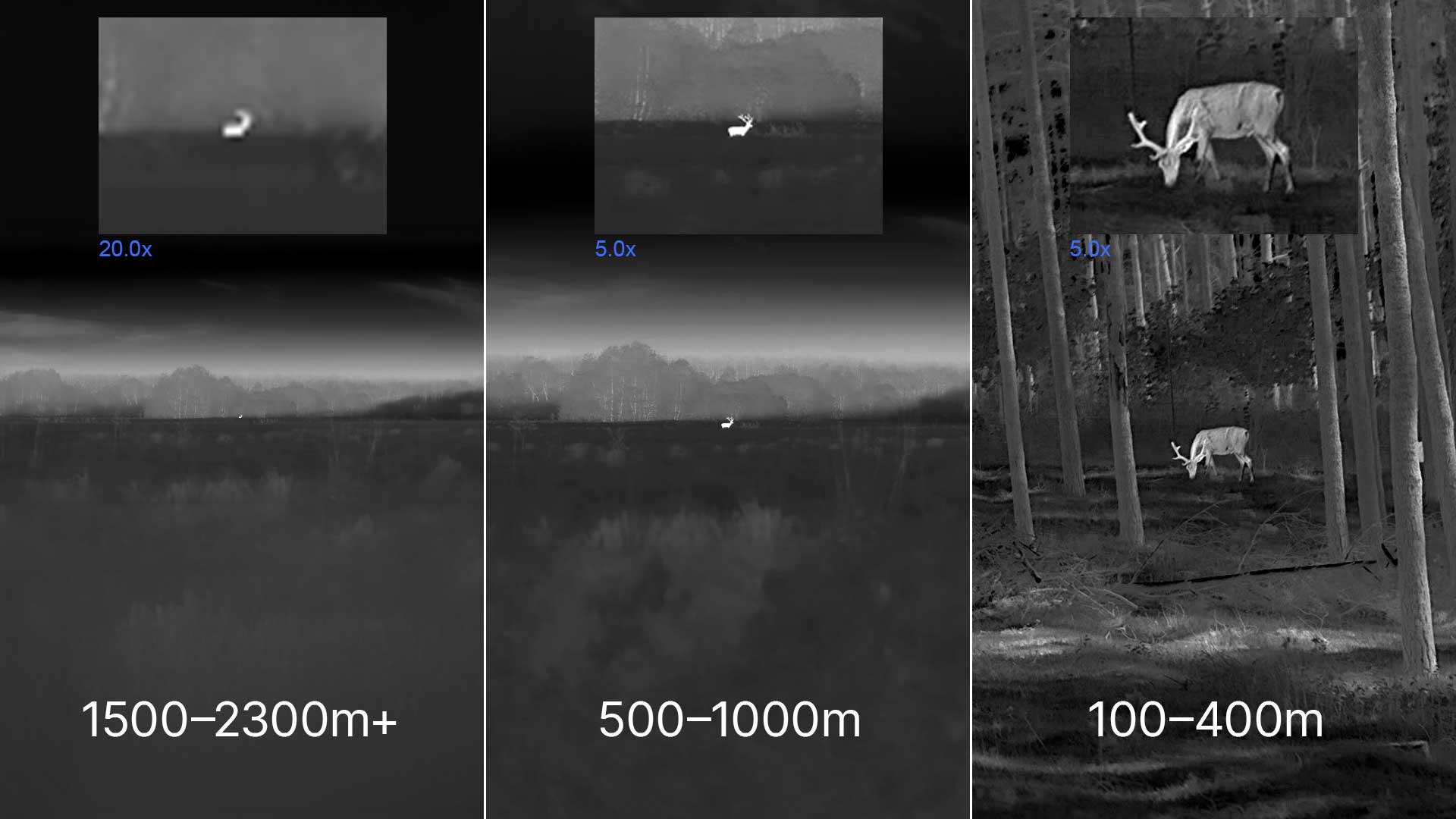
Quick range reality check: What those numbers actually look like in the field
- Detection range (1,500–2,300+ m): spotting heat only
- Recognition range (500–1,000 m): distinguishing object type
- Identification range (100–400 m): confirming target details
What factors affect how far a thermal scope can see?
Thermal scope range is determined by sensor quality, optics, environmental conditions, and temperature contrast.
Sensor resolution and pixel density
Sensor resolution defines image clarity. A 640×480 sensor produces more detail than 384×288.
From my time behind various scopes, the single biggest variable is sensor resolution. A 640×480 sensor versus a 384×288 sensor is not a small step. It’s the difference between reading an animal at 300 meters and squinting at a heat blob.
This matters because higher resolution improves identification, not just detection.
Read more: Thermal sensor guide: What really defines thermal image quality
Lens size and optical magnification
Lens size determines how much thermal energy is captured. A 50 mm or 60 mm objective gathers significantly more thermal energy than a 35 mm, and that translates directly into detection range and image clarity at distance.
Related: Scope magnification guide for hunters
Environmental conditions and thermal noise
Environmental conditions directly impact thermal contrast.
High humidity, fog, and warm nights all compress your effective range because the temperature contrast between the target and the background collapses.
The coldest clear nights in Sweden give you the best thermal performance, the contrast is at its sharpest. Cold clear nights generally give the best thermal contrast, as the gap between a warm-blooded animal and the cooling background is at its widest.
A humid summer night is genuinely harder to work with than a crisp autumn one, even with identical equipment.
Read more: How weather impacts thermal imaging for hunting
Target size and heat signature strength
Target size influences detection and identification: a moose at 400 meters is a very different proposition from a hare at 150.
This matters because larger animals emit bigger heat signatures and are easier to interpret at distance.

Why manufacturer detection ranges can be misleading
Detection ranges are measured in ideal lab conditions and do not reflect real hunting environments.
The detection ranges you see on spec sheets are measured against a calibrated black-body target under controlled conditions. That’s essentially a perfectly hot object against a perfectly cold, uniform background. You will never hunt in those conditions.
A realistic rule of thumb is to take the stated detection range and divide it by roughly five to get a practical identification range for medium game. Relying purely on spec-sheet numbers can lead to poor field decisions.
Related: How to choose thermal riflescope for hunting
What is a realistic thermal scope range for hunting?
Most hunters operate within 100–300 meters, where identification is reliable and ethical.
For hunting purposes, most of my shots happen inside 200 meters and the identification decision is made somewhere between 100 and 300 meters depending on the scope.
Typical identification ranges by game size
- Small game (hare, fox): 80–150 meters
- Medium game (roe deer): 150–250 meters
- Large game (boar, moose): 250–350 meters
Beyond that, you’re recognizing, not identifying, and recognizing is not enough.
Related: Beginner night hunting guide (Pulsar experts tips)
How to maximize your thermal scope’s effective range
Proper settings, positioning, and scanning technique significantly improve usable range.
The biggest gains come from settings and positioning, not from buying more scope.
Start with your polarity: White Hot versus Black Hot, or if you have another favorite color. On cold clear nights, I often find Black Hot gives better contrast on game.
Gain should be turned down in high-contrast conditions; running gain too high adds noise and actually degrades the image at distance.
Contrast adjustment matters more than most people realize. Spend time learning where your scope performs best under different conditions before you need it in the dark.
Positionally, getting even a small amount of elevation opens up your effective range enormously because you’re looking across the thermal gradient rather than through ground clutter.
A meter or two of height, from a slightly elevated stand or a hillside, changes what you can detect and identify at distance.
And patience: thermal imaging rewards slow scanning. Moving your scope too quickly means heat signatures wash through the frame without your brain registering them.
Related: Thermal palettes explained: How hunters should choose the right color mode
Which Pulsar scopes deliver in real hunting scenarios?
High-end thermal scopes with larger lenses and integrated rangefinding deliver the most reliable identification performance in real conditions.
The Thermion 2 LRF XL60 is the top of the stack and it earns it. The 60mm lens and XL sensor give you a noticeably cleaner picture at distance than anything else in the lineup, and the integrated LRF removes the range guesswork entirely. If you hunt open terrain like fields, bogs, or mountain edges, this is the one you want. I’d choose it any time I expect to glass across large areas before closing the distance.

The new Trail 3 LRF is worth mentioning for driven hunts or any situation where you need a quick, accurate distance call. The LRF combined with a solid sensor makes it very practical when things happen fast.

Decision shortcut: If you hunt open terrain and need maximum identification distance, choose the Thermion 2 LRF XL60. If your hunting involves fast-moving scenarios, the Trail 3 LRF is the more practical tool.
Thermal scope vs night vision at distance
Thermal scopes outperform night vision at long range, while night vision provides finer detail at close range.
This isn’t a close contest at longer ranges. Thermal wins comprehensively.
Night vision depends on reflected light, which means it degrades fast in total darkness, under heavy canopy, or in any overcast condition with no moon.
At 200 meters on a dark night in Scandinavian forest, digital night vision is showing you shapes at best. A good thermal at the same distance gives you a clean heat signature, movement detail, and enough image quality to make a shot decision.
The one area where night vision still has an argument is very close range, particularly for reading fine detail like antler configuration or coat markings where you genuinely need reflected-light image quality.
But for the core task of finding game, tracking movement, and making an identification decision at hunting distances, thermal is in a different category entirely. It also doesn’t care about cloud cover, moon phase, or whether you’re in a clearing or under trees. It reads heat, and heat is always there.
Read more: Thermal vs night vision: Which to choose?
Final thoughts
Understanding how far a thermal scope can see isn’t about maximum detection. It’s about reliable identification.
When you shift focus from marketing numbers to real-world performance, your decisions become safer, more ethical, and more effective in the field.
FAQ
What is the maximum distance for thermal imaging?
Thermal scopes can detect heat signatures beyond 2,000 meters, but this only means spotting heat, not identifying a target.
What factors reduce thermal scope range in bad weather?
Fog, rain, humidity, and warm temperatures reduce thermal contrast, making targets harder to distinguish.
What magnification is best for a 1000-yard shot?
High magnification helps with detection, but identification at 1,000 yards is rarely reliable with thermal imaging alone.
What is the difference between detection and identification range?
Detection shows a heat source. Identification confirms species, size, and shot placement details.
Can thermal scopes see through fog or rain?
Thermal can partially penetrate fog and rain, but performance drops significantly due to reduced contrast.
What is the best range for hunting with thermal optics?
Most ethical shots occur within 100–300 meters, where identification is clear.
How far can you identify a deer with a thermal scope?
Typically 150–250 meters, depending on equipment quality and environmental conditions.
About the Expert
Expert Contributor:
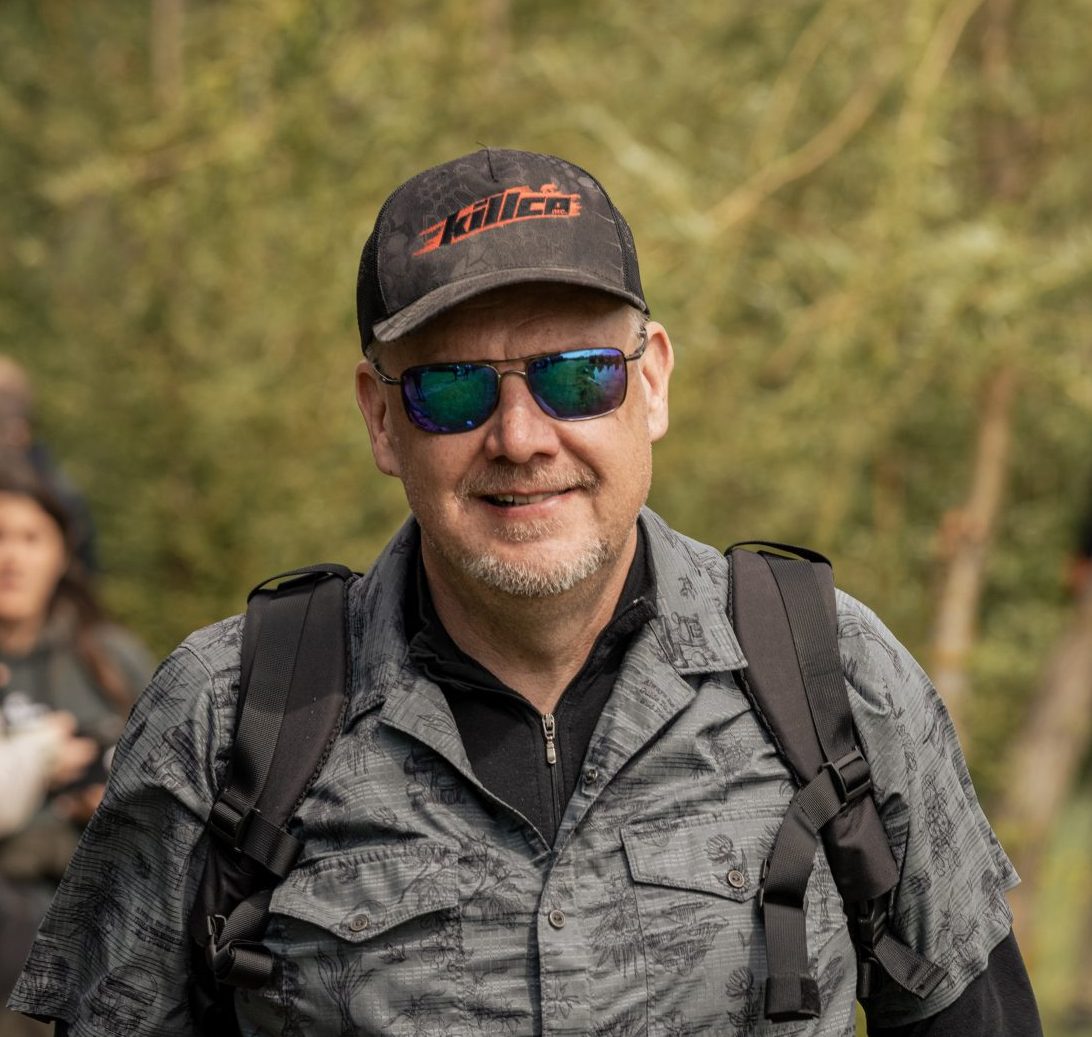
Erik Bjaelkvall
Erik Bjaelkvall is a former Arctic Ranger, now a competitive practical shooter, seasoned hunter, and gear expert with decades of field experience.
Operating out of Sweden, Erik has extensively tested thermal imaging equipment across diverse environments – from open plains to rugged mountains, through snow, fog, and sun.
Before purchasing any night or thermal vision device, please make sure you adhere to the local legislation and only use it when it is allowed. Our ambassadors come from various countries and travel a lot, which allows them to test different devices. We do not encourage or support the illegal use of our devices in any events. If you wish to learn more about export and sales restriction policy, please visit the following link: Export and Sales Restriction Policy.