
Expert Contributor:
Henrik Sproedt
Estimated read time: 8 min.
Scope magnification explained: choosing the right zoom for hunting
Key takeaways
- Scope magnification or zoom refers to how many times closer the scope lets you see a target compared to the naked eye (e.g., 4× means four times closer).
- Fixed low, medium, and high magnification serve different hunting needs—from scanning woodland to long-range precision.
- Variable magnification scopes (e.g., 1.75–14×, 4–32×) offer versatility across different terrain and conditions.
- Know the difference: detection (spotting presence), recognition (distinguishing type), and identification (confirming species). Too much digital zoom can blur these stages—moderate magnification gives more reliable results.
- When discussing magnification, it’s essential to understand the difference between optical zoom (true lens magnification) and digital zoom (software enlargement). Most thermal optics (like handheld thermal monoculars, rifle scopes, and thermal binoculars) do not have true optical zoom in the way that daylight binoculars, rifle scopes or camera lenses have. Instead, they typically use digital zoom, which enlarges the image by cropping and interpolating pixels from the thermal sensor. This makes the image appear closer, but it usually reduces sharpness and detail, when using excessive digital zoom. So in short: most thermal optics rely on digital zoom, and traditional glass optics rely on optical zoom.
When hunters talk about rifle scopes, magnification often becomes the main topic. It’s tempting to think that the higher the zoom number, the easier the identification and shot will be. But in reality, magnification is a balancing act—too little, and you might struggle to see detail at distance; too much, and you lose field of view, stability, and image clarity.
For hunters using thermal scopes, this balance becomes even more critical. Unlike traditional glass optics, thermal devices rely on sensor resolution and digital processing. Cranking up the magnification can magnify heat signatures—but it can also introduce pixelation or blur, making target identification harder instead of easier.
The right magnification depends heavily on context:
- Terrain – Dense forests reward wide fields of view, while open plains or elevated vantage points may justify more zoom.
- Game behavior – Fast-moving boar call for quick acquisition at lower power, while distant red deer demand more magnification for confident identification.
- Visibility conditions – Daylight hunts, foggy mornings, and night-time thermal scans all place different demands on how you use magnification.
In this guide, we’ll not only explain the basics of magnification, but also show how to match magnification to your terrain and hunting style.
Knowing the most common pitfalls, how you can avoid them, and make magnification work for—not against—your hunt.
By the end, you’ll know not just what the numbers mean, but also how to choose zoom settings that deliver the best result for you in the field.
Freya’s Opinion:
There’s no magic number. What works in dense forest fails in the mountains. The best magnification is always the one that matches where you are and what you’re hunting.
One interesting side fact from Henrik Sproedt, hunter, hunting school owner and instructor:
From shooting education, we know that most people shoot tighter groups with a lower magnification. Mostly because higher magnification stresses the shooter as it also “magnifies” every tiny movement.

Fixed vs variable magnification
Most traditional riflescopes come in two styles: fixed and variable.
Fixed scopes (like a 2×, 4× or 6×) are simple, rugged, and consistent, but they lock you into one magnification level. While they work for specialized situations, they don’t offer the flexibility modern hunters need—especially when dealing with unpredictable terrain, game behavior, and light conditions.
That’s why Pulsar focuses exclusively on variable magnification in its thermal scopes. Variable optics let you scan wide at low magnification, then zoom in for identification or precise shot placement when distance requires it. For example, a 2-16× or 3-24× range covers nearly every hunting situation—from woodland stalking to open-field engagements.
The advantages of variable magnification include:
- Versatility: Adapt on the fly without changing gear or compromising your shot opportunities.
- Wide-to-narrow control: Use lower zoom for fast scanning, then dial in more magnification for detail.
- Thermal efficiency: Start with the base magnification (sharpest image), then apply digital zoom gradually when extra detail is needed for identification or shot placement.
- Better fit for mixed terrain: One scope can cover forest, farmland, and mountains without limitation.
In practice, this means a single Pulsar scope can serve you year-round, across multiple hunting styles and environments. Instead of choosing between low or high fixed magnification, variable zoom gives you both—making it a smarter, more future-proof choice.
The preference for digital zoom varies, though. For Henrik, it’s definitely not a key feature:
As long as there is no effective optical zoom in thermal scopes, I am no fan at all of digital zoom bigger than perhaps 2-3x the base magnification.
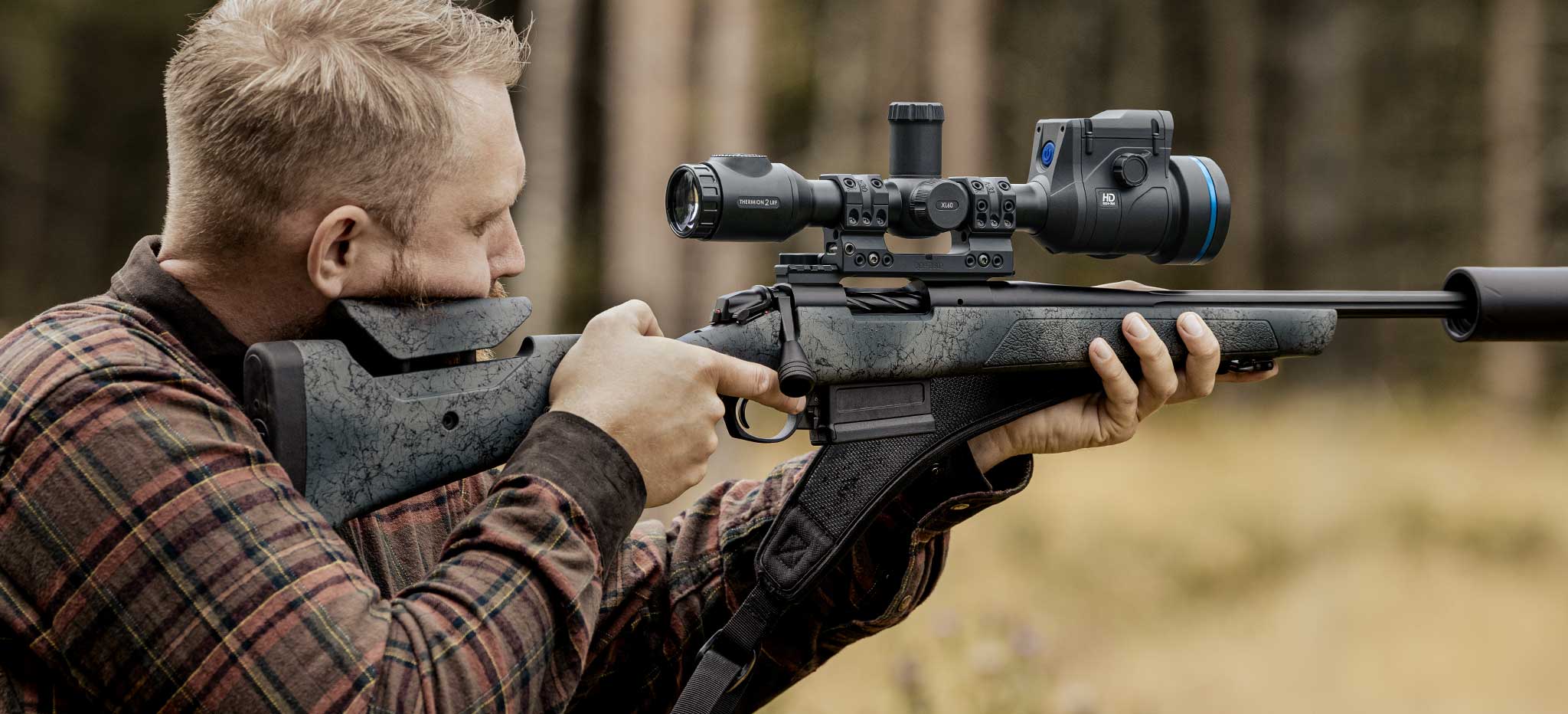
How magnification impacts hunting performance
Magnification isn’t just about how close you can see an animal—it directly affects how you move, aim, and make decisions in the field. Understanding the trade-offs between field of view, stability, and shooting comfort will help you avoid common mistakes and choose the right zoom for every scenario.
Field of view vs target detail
- Low magnification = better situational awareness. Great for scanning wide areas and following moving targets.
- High magnification = provides more detail. Helps confirm species or shot placement but narrows your field of view.
- In thermal scopes, high digital zoom can also soften or pixelate image quality.
Henrik notes this from the extensive practice he’s got with thermal devices:
Usually, high magnification turns everything into pixels and all smaller detail is lost. With most devices I tested, especially antlers, “kind of disappear” if you zoom in. However, it might work with pigs to some scale, when it is only about confirming gender, as genitals are well-blooded and provide a heat signature.
Let’s break it down
Every time you increase magnification, you shrink your field of view (FOV). At low settings, like 1.75-4×, you see more of the landscape at once, which is critical for scanning wide areas or tracking moving game. This is why hunters in dense forests or when stalking fast animals often favor lower magnification: it lets them maintain a high situational awareness and react quickly.
At higher settings, such as 10-32×, the opposite happens. You gain more detail on your target—seeing antler points or confirming species at distance—but you sacrifice situational awareness of what’s happening around the animal. In thermal scopes, this effect is even more pronounced because high digital magnification can also reduce image sharpness.
For most hunters, the sweet spot lies in being able to switch between wide FOV for detection and higher magnification for recognition and precision. That’s why variable scopes are so valuable in real-world hunting conditions.
Freya’s opinion:
I’ve learned that clarity and stability matter more than raw magnification. A sharp image at 8× beats a shaky, pixelated picture at 20× every time.
Stability and target acquisition
Magnification doesn’t just enlarge the target—it enlarges everything, including the effect of your hand movements and heartbeat. At 12× or higher magnification, even small movements can make the reticle wobble off target. This is why unsupported high-zoom shots can feel unstable and frustrating.
The more magnification you use, the more critical stability aids become: shooting sticks, bipods, tripods, or just resting against a tree will help you. Hunters in open fields may benefit from higher magnification for longer shots, but they should plan on using solid support. Conversely, in quick, off-hand shooting scenarios like a driven boar hunt, lower magnification (1.75-4×) provides faster target acquisition and smoother tracking.
Think of magnification as a tool that magnifies your stability, or lack of, just as much as your target. If the terrain or shooting style doesn’t allow for support, stay lower in magnification to keep your sight picture steady.
Freya’s Field Insight:
Once, I tried taking a 12× shot off-hand, and the reticle was dancing all over the place. I dropped down to 6×, and suddenly the sight picture steadied enough to take a clean shot. That moment taught me how higher zoom magnifies not just the target, but also your own movement.
Eye relief and shooting comfort
Higher magnification often means shorter eye relief—risking scope-bite, eye strain, or poor sight alignment. Choose scopes with consistent and safe eye relief across magnification levels.
Eye relief—the distance between your eye and the scope where the full image is visible—can shrink as magnification increases. Short eye relief means you need to be in a precise head position, which can be difficult in awkward field shots. In extreme cases with traditional scopes, short eye relief can lead to “scope bite” when the recoil drives the optic back.
With thermal scopes, the risk is less about recoil and more about eye strain and image loss. At higher magnifications, small shifts in head position can cause the display to darken or misalign, which slows down target engagement. Extended glassing sessions at high magnification can cause fatigue faster, especially during night hunting when your eyes are already working harder.
That’s why choosing a scope with consistent eye relief across its zoom range is essential. Pulsar models, for example, are designed to maintain comfortable eye relief whether you’re scanning at 3× or zooming in at 20×, ensuring reliability when it matters most.

Choosing the right magnification for your hunt
There is no single “perfect” magnification that works for every hunt. The ideal magnification level depends on where you are, what you’re hunting, and how you plan to take your shot.
To simplify the decision, it helps to break down magnification choices by terrain type, game size and behavior, and day vs. night thermal conditions. By thinking in terms of context rather than raw numbers, you’ll be able to select a scope—with a variable zoom range—that consistently supports your style of hunting.
Magnification by terrain type
Terrain is often the single biggest factor in deciding magnification. A dense forest limits visibility and rewards wide fields of view, while an open field or mountain ridge can justify dialing in higher magnification to spot distant game. Thinking about where you’ll be hunting most often ensures you don’t choose a scope that excels in one environment but feels awkward in another.
The landscape you hunt in shapes how much magnification you can actually use:
- Forest (2.5–10×): Wide FOV is more valuable than detail—lets you track fast, close game.
- Mixed terrain (1.75–14×): A flexible sweet spot; scan low, zoom in when conditions open up.
- Open fields (3–24×): Higher magnification extends range but demands a steady rest like sticks or bipod.
- Mountains (4–32×): Useful for spotting and ID across valleys, but narrow FOV means slower scanning.
Freya’s Field Insight:
I stalked through thick woodland at dusk. At 3× magnification, I could keep an eye on several animals moving at once. If I had been zoomed in too far, I would have lost track of the sounder completely.
Note that these tips are for your general awareness – personal preferences might differ. For example, Henrik Sproedt, the German hunter with 30+ years of experience, has a slightly different preference for magnification range:In the forest, I would definitely prefer 1.5x-8x or 10x. In the mountains, where shots beyond 200 m are common, I would wish for a higher base mag like 6x or 8x.
I usually prefer a 1.5-2x base mag for stalking, and neither during the day nor night do I need more than 18x. That doesn’t mean some specialist doesn’t need more, but most hunters I met shouldn’t use more than 12x, otherwise the only result is suffering and pain.
Magnification by game size and behavior
Different animals require tailored optical strategies. When selecting magnification levels for thermal optics, it’s not just about how close you can zoom in—it’s about how you balance detection range, field of view (FOV), and target behavior.
While magnification is important, it is often secondary to how the thermal scope performs in real hunting conditions, especially regarding situational awareness and tracking movement across terrain.
Below is a breakdown of optimal magnification considerations based on game size and hunting behavior:
- Boar & foxes: Prioritize a wide field of view for dynamic movement in dense terrain. This typically means using lower base magnification—around 1.75x—which allows better situational awareness.
- Roe & red deer: These species demand a balance of range and FOV. Aim for a detection range of 2000 meters or more, with a base magnification in the 2.5x to 3x range to support mid-to-long-range observation.
- Small game: Go for a Low Power Variable Optic (LPVO) or the closest possible thermal equivalent. The key is maintaining a broad FOV to track fast, erratic movement effectively.
Read More: Thermal scope buying guide

Magnification in night or thermal hunting
Night hunts and thermal optics introduce new challenges. At night, image clarity and contrast become more important than raw magnification, and thermal sensors can lose detail at very high digital zoom. Choosing the right magnification range is about balancing recognition confidence with situational awareness in low-light conditions.
Thermal scopes especially benefit from moderate settings:
- Stay in the 1.75–8× range: Preserves image sharpness and avoids pixelation from overusing digital zoom.
- Lower magnification = better contrast: Wide FOV makes scanning easier in darkness.
- Use high digital magnification with caution: Helpful for positive ID, but only just enough to avoid misidentification.
Freya’s Field Insight:
Calling foxes at night is always unpredictable. With my thermal scope set at 6×, I had just enough detail to identify the fox without losing the wider view of the field. Any higher on digital zoom, and the picture would probably have pixelated too much.
Read More: Thermal vs night vision for hunting
Smart zoom features in Pulsar scopes
Modern thermal scopes, like those in Pulsar’s lineup, go beyond simple magnification. They integrate smart zoom features that help hunters balance situational awareness with precision in the field. Options such as stepped or smooth digital zoom, Picture-in-Picture (PiP), and stable image processing let you adapt on the fly without sacrificing clarity. These features are especially valuable in unpredictable hunting scenarios.
- Stepped or smooth digital zoom for fine control.
- Picture-in-Picture mode (PiP) keeps a wide FOV while zooming in on the target.
- Consistent clarity across zoom ranges, maintaining target recognition even at mid-range digital zoom.

Common magnification mistakes (and how to avoid them)
Even experienced hunters can misuse magnification. Thermal scopes make it tempting to crank up the zoom, but that often leads to more problems than solutions. Here are the most common pitfalls and how to avoid them:
Overprioritizing high zoom
- Extreme zoom ranges like 20–30× aren’t field-appropriate.
- At very high zoom, field of view shrinks, and even small movements make aiming unstable.
- Most hunting shots are usually under 200 meters—so moderate zoom (4–14×) would be enough, if you don’t shoot at very long distances.
Ignoring terrain and shooting position
- Dense forest: low magnification and wide FOV are key.
- Open terrain: more zoom is possible, but only with support (sticks, bipod, tripod).
- Shortcut: always match magnification to how you’ll take the shot (off-hand, prone, from a stand).
Henrik’s note:
Always start small. Safety is paramount and requires full understanding and awareness of the situation and surroundings.
Confusing detection, recognition, identification
- Detection: spotting presence.
- Recognition: distinguishing type.
- Identification: confirming species/sex.
- Too much digital zoom can give false confidence—moderate zoom with a sharp image usually wins.
Overlooking weight and balance
- Higher magnification optics are often bigger and heavier.
- This can unbalance lightweight rifles and make them harder to carry or steady.
Field tip: avoid large, heavy scopes if you’re stalking or moving a lot.
Freya’s Opinion:
To carry a setup that feels front-heavy for a few kilometers of stalking is honestly exhausting. A lighter, well-balanced scope makes the rifle an extension of me—quick to shoulder, steady to aim, and far less tiring over a long day.
For Henrik, the situation is a bit more nuanced:
Again, this depends on your hunting situation and which trade-offs you might have to make. The total weight of the gun and scope affects not only your ability to carry but also to shoot. Dilemma: Light=easy to carry, but heavy=less recoil and better shooting.

Final recommendations – magnification that matches the mission
After weighing terrain, game type, and scope design, the best approach to magnification is about balance, not extremes. A scope that adapts to changing conditions—and keeps image clarity at the forefront—will serve you better than chasing the highest zoom numbers.
Choose versatile variable zoom
- Variable zoom (2–16× or 3–12×): Covers up to 90% of hunting styles.
- Match scope to rifle and style: Lighter setups work better for mobile hunters; higher magnification suits static shooting.
Prioritize clarity, not raw zoom
- Prioritize clarity over raw zoom—low sensor sensitivity (sNETD) and high resolution matter more than headline numbers.
Freya’s opinion:
For me, confidence in the field comes from knowing my setup fits the hunt. A well-matched magnification range means I can focus on the experience, not second-guess my scope.
Henrik’s two cents:
I agree and would even add that more important than magnification is ruggedness and reliability. I.e., trust in the gear’s reliability beats every gimmick. If my mag is too small, it only means I am too far away, so I have to stalk closer.
Explore further: Best thermal scope for coyote hunting
Magnification fit by hunting type (table)
Sometimes it helps to see the options side by side. The table below offers quick, practical magnification ranges for different hunting styles, making it easy to match zoom levels to your most common situations.
| Hunting Style | Hunting Distance | Suggested field of view | Suggested detection range | Suggested Magnification | Matching Pulsar device |
|---|---|---|---|---|---|
| Forest/woodland stalking | 100–200 m | No less than 10° | 1800 m | 1.75–14× | Talion XG35 |
| Mixed terrain roaming | 100–200 m | No less than 10° | 1800 m | 2–16× | Thermion 2 LRF XP50 PRO |
| Open fields | 50+ m | No less than 7.5–8° | 1800–2300 m | 3–24× | Thermion 2 LRF XP60 |
| Mountains | Can vary | No less than 5.5–6° | 2300–2800 m | 4–32× | Thermion 2 LRF XG60 |
Dive deeper: Choosing between Thermion and Talion
Explore Pulsar thermal scopes
Magnification is only part of the equation. Pulsar’s thermal scopes combine smart zoom features, strong sensor performance, and rugged builds to deliver reliable results in every environment. From close woodland stalks to open-field hunts, there’s a Pulsar optic designed to fit your mission.
Pulsar’s line combines trusted thermal performance, and clarity across varying conditions. Models like Thermion 2 LRF XL50 deliver advanced sensor tech (1.75× base magnification, high image quality, detection range up to 2,300 meters while balancing the magnification range from 1.75 to 14×. Picture-in-Picture in the Pulsar range of rifle scopes enhances situational awareness while giving the hunter precise aim capabilities.
Ready for more? Check our thermal rifle scopes
Ready for the next move? Find your closest Pulsar dealer
Frequently asked questions
Magnification can raise a lot of “what ifs.” Here are straightforward answers to some of the most common questions hunters ask when deciding on zoom levels and scope performance.
- What does 4× or 8× mean on a scope?
It magnifies the view that many times compared to naked eye (e.g., 4× means about 4 times closer). - Is higher magnification always better?
No—higher magnification narrows the field of view, amplifies hand movement shake, and may reduce clarity, especially at the highest magnification. - What zoom range do most hunters prefer?
Variable ranges like 2-16× or 3-12× offer the best balance of scanning and precision. - Does digital zoom lower image quality?
Yes—a high digital zoom enlarges pixels, decreasing image clarity; use only when needed. - What’s best for forest hunting?
Low to mid magnification (1.75–6×) with a wide FOV and possibly PiP for enhanced detail when taking the shot. - What is the difference between digital and optical zoom?
Optical zoom is through glass lenses and retains clarity; digital zoom enlarges the image and can degrade quality when using extreme magnifications. - Does digital zoom affect thermal scope battery life?
Digital zoom may increase processing load slightly, but battery impact is minimal compared to other features. - Is magnification the same in day and night scopes?
Optical magnification is consistent, but thermal digital and variable zoom behavior can differ depending on many variables (e.g. temparature, humidity, distance, object size).
About the Experts

Co-Author:
Freya Askjaer
Freya Askjaer is a Danish huntress living in Sicily, with over a decade of experience hunting across the world.
She has tested Pulsar optics in snow-covered mountains, thick brush, and desert-like areas through every season.

Expert Contributor:
Henrik Sproedt
With over 30 years of hunting experience, Henrik Sproedt has honed his skills in tracking, fieldcraft, and ethical hunting practices across diverse terrains.
His expertise goes beyond personal mastery – he also runs a dedicated hunting school, where he shares his extensive knowledge with new and seasoned hunters alike.
Before purchasing any night or thermal vision device, please make sure you adhere to the local legislation and only use it when it is allowed. Our ambassadors come from various countries and travel a lot, which allows them to test different devices. We do not encourage or support the illegal use of our devices in any events. If you wish to learn more about export and sales restriction policy, please visit the following link: Export and Sales Restriction Policy.