
Expert Contributor:
Erik Bjaelkvall
Estimated read time: 6 min.
Choosing between the Pulsar Thermion 3 LRF and Trail 3 LRF comes down to more than specifications. Both combine thermal imaging with an integrated laser rangefinder (LRF) and ballistic support, but they approach the hunting experience differently.
Thermion 3 LRF brings premium 60 mm optics and a classic 30 mm riflescope design, while Trail 3 LRF packages its capabilities into a compact rail-mounted monoblock housing. So which one better fits your rifle and hunting style? This comparison will provide you with the answer by breaking down the key differences, models, features, and real hunting use cases to help you choose.
Quick answer
Choose Thermion 3 LRF if you:
- want a premium full-range thermal riflescope,
- prefer the familiar mounting and handling of a classic 30 mm riflescope,
- want 60 mm optics and detection up to 2,950 m (3,226 yd),
- need reach or detail: up to 40× magnification on the XR60, or the highest-resolution sensor and the widest field of view (FOV) on the XT60,
- want the best long-range performance Pulsar offers and are ready to invest in a flagship.

Choose Trail 3 LRF if you:
- prefer a compact rail-mounted monoblock design,
- want an integrated 1,200 m (1,300 yd) rangefinder and ballistic support in a smaller, lighter platform,
- want the thermal sensitivity of the XQ50 or the higher resolution and reach of the XR50,
- prioritize a compact thermal riflescope for hunting and pest control,
- want a capable, compact thermal riflescope with a rangefinder at a more accessible price, and don’t need the top-tier optics and resolution.

Bottom line: Choose Thermion 3 LRF if premium imaging, full-range capability, and classic riflescope handling are your priorities. It’s a premium option, and it’s priced accordingly. Choose Trail 3 LRF if you prefer a more compact rail-mounted platform while retaining integrated ranging and ballistic tools at a more accessible price.
What they share: a 1,200 m (1,300 yd) laser rangefinder and ballistic calculation with a suggested point of aim (SPOA). Neither is a reason to pick one over the other.
Overview of Pulsar Thermion 3 and Trail 3
Pulsar Thermion 3
The Thermion 3 is Pulsar’s premium full-range thermal riflescope platform, available as the XR60 and XT60. Both models combine European-made thermal sensors with 60 mm optics, a 1,200 m (1,300 yd) integrated laser rangefinder, ballistic calculation with SPOA, classic 30 mm tube mounting, and 65 mm eye relief.
Here’s how Erik Bjaelkvall, a former Arctic Ranger turned competitive practical shooter, seasoned hunter, and gear expert from Sweden, describes the Thermion 3 LRF:
Put it on a traditional hunting rifle and most people won’t realize it’s a thermal. It looks like a classic riflescope and performs like the future.
The XR60 combines a 640 × 480 sensor with 4–40× magnification, while the XT60 uses a massive 1,280 × 1,024 sensor with 2–24× magnification and a significantly wider field of view: 14.6 degrees horizontally, against 7.3 degrees on the XR60. Both provide detection up to 2,950 m (3,226 yd).

Thermion 3 LRF makes the most sense for:
- full-range hunting across varied distances,
- hunters who prefer classic riflescope mounting,
- open and mixed terrain,
- users prioritizing premium image quality and integrated shooting tools.
Pulsar Trail 3
The Trail 3 lineup includes the XQ50 and XR50. Both use a compact rail-mounted monoblock housing and integrate a 1,200 m (1,300 yd) laser rangefinder and ballistic support.
The XQ50 uses a 384 × 288, 17 µm sensor and emphasizes thermal sensitivity, so out of the four, it’s your best bet for poor weather. Meanwhile the XR50 uses a 640 × 480, 12 µm sensor and extends detection to 2,300 m (2,500 yd).

Trail 3 LRF makes the most sense for:
- hunters prioritizing a compact riflescope format,
- hunting and pest-control setups where integrated ranging is important,
- users who prefer rail mounting,
- hunters who want reliable thermal sensitivity but don’t require top-tier resolution.
Thermion 3 LRF vs Trail 3 LRF: side-by-side model comparison
We’ll go into the overview of key differences soon, but if you’re a numbers person, the table below compares the key specs side-by-side.
| Thermion 3 LRF XR60 | Thermion 3 LRF XT60 | Trail 3 LRF XQ50 | Trail 3 LRF XR50 | |
| Sensor | 640 × 480, 12 µm | 1,280 × 1,024, 12 µm | 384 × 288, 17 µm | 640 × 480, 12 µm |
| System NETD | <18 mK | <20 mK | <15 mK | <18 mK |
| Magnification | 4–40× | 2–24× | 3.5–14× | 3–24× |
| Horizontal FOV, degrees | 7.3 | 14.6 | 7.5 | 8.8 |
| Detection range | 2,950 m (3,226 yd) | 2,950 m (3,226 yd) | 1,800 m (2,000 yd) | 2,300 m (2,500 yd) |
| LRF range | 1,200 m (1,300 yd) | 1,200 m (1,300 yd) | 1,200 m (1,300 yd) | 1,200 m (1,300 yd) |
| Display | 2,560 × 2,560 AMOLED | 2,560 × 2,560 AMOLED | 1,920 × 1,080 AMOLED | 1,920 × 1,080 AMOLED |
| Eye relief | 65 mm | 65 mm | 50 mm | 50 mm |
| Battery life, up to | 14 h | 8.5 h | 12 h | 11 h |
| Weight, kg | 1.3 | 1.3 | 0.7 | 0.7 |
| Internal memory | 128 GB | 128 GB | 64 GB | 64 GB |
| Mounting | 30 mm rings | 30 mm rings | Rail-mounted | Rail-mounted |
| Main strength | Highest magnification | Highest resolution and widest FOV | Thermal sensitivity | Higher resolution and reach |
What are the key differences between Thermion 3 and Trail 3?
Image quality and viewing experience
Thermion 3 moves into a higher imaging tier with 60 mm optics on both models and a 2,560 × 2,560 AMOLED display, against the 1,920 × 1,080 AMOLED display on Trail 3. The Thermion 3 LRF XT60 stands out with its 1,280 × 1,024 sensor and 14.6-degree horizontal field of view, giving both high image detail and the widest view of the four models. Its sensor is the highest-resolution one in the Pulsar lineup, so if you’re after maximum detail, this is the way to go.

Erik on the difference in the field:
In the field, the Thermion 3 gives a much wider view and more detail at the same time. Its horizontal field of view is 14.6°, compared with 8.8° on the Trail 3, which makes it easier to follow a moving group and pick the right animal.
The Thermion 3 LRF XR60 takes a different approach, pairing its 640 × 480 sensor with 4–40× magnification for the greatest reach of the four. Be careful with the top number, though: at maximum zoom the image can get pixelated. However, high base magnification does work great on more distant targets.
Trail 3 also comes in two configurations. The Trail 3 LRF XQ50 prioritizes thermal sensitivity with a system NETD below 15 mK, the lowest of the four, while the Trail 3 LRF XR50 combines a 640 × 480, 12 µm sensor with detection up to 2,300 m (2,500 yd). In other words, one is for poor weather, the other for greater distances.
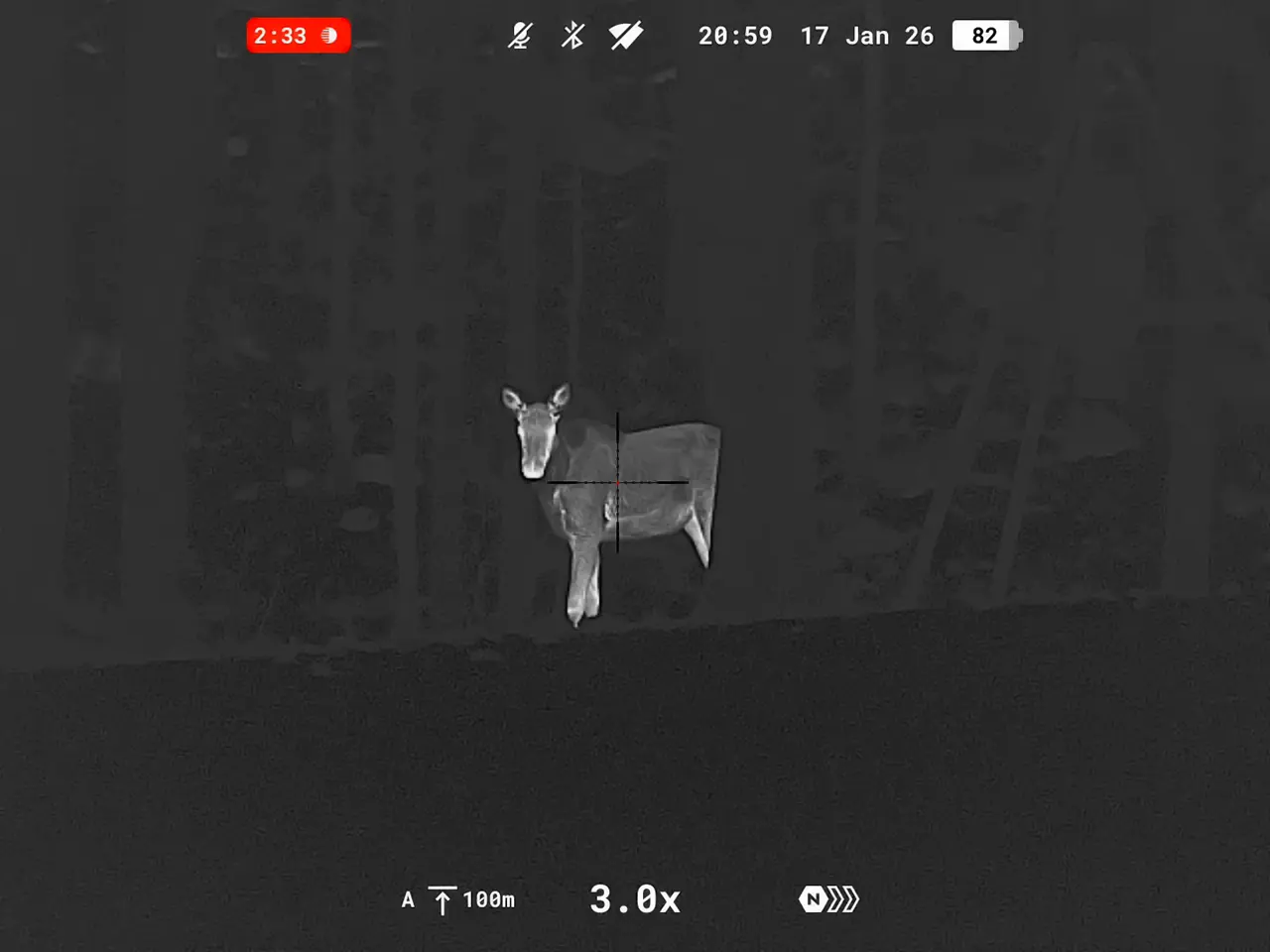 You will see that the Thermion 3 LRF XR60 and Trail 3 LRF XR50 share the same sensor resolution, pixel pitch, and system NETD (640 × 480, 12 µm, below 18 mK). However, their image is not identical, as they come with different optics, resulting in different reach and detailedness: the 60 mm lens of the XR60 does deliver a slightly more detailed image and a further reach.
Detection range and magnification
Both Thermion 3 models provide detection up to 2,950 m (3,226 yd), compared with 1,800 m (2,000 yd) for the Trail 3 LRF XQ50 and 2,300 m (2,500 yd) for the XR50. Now, that reach matters if your hunting distances are significant. Divide it by 10, and you’ll have a rough estimation of your identification range. The precise number will still, of course, depends on your target, conditions, and experience.
Magnification also separates the individual models. The Thermion 3 LRF XR60 reaches 40×, while the XT60 starts at 2×, supporting a much wider initial view. Both Trail 3 models come with similar base magnification (3× on XR50, 3.5× on XQ50), but their zooming capabilities differ a lot in real life. Despite being very sensitive, the XQ50 has a fairly small resolution, meaning you won’t be able to magnify the image multiple times while retaining the quality.
It’s important to remember that a higher detection range or magnification doesn’t automatically make one model right for every hunt. Field of view, type of terrain, and the rifle you use should also influence the decision.
Laser rangefinding and ballistics
This is an area where the two platforms have more in common. Both Thermion 3 and Trail 3 integrate a laser rangefinder measuring up to 1,200 m (1,300 yd) and support single-shot and continuous scanning measurements. The ballistic calculation with SPOA is available right on the riflescope’s screen after setting up the profile in the Stream Vision Ballistics app.
Classic 30 mm mounting vs rail-mounted
Design and mounting are two of the clearest practical differences.
Thermion 3 LRF uses a classic 30 mm tube, allowing installation with standard riflescope rings and adjustment of eye distance along the optical axis.

Trail 3 LRF uses a compact rail-mounted monoblock design. It’s a go-to choice for more compact rifles, AR platforms, and other modern solutions.
For hunters already accustomed to traditional daytime riflescopes, Thermion 3 provides the more familiar format. Trail 3 takes a more purpose-built thermal riflescope approach, and it is the more compact and lighter of the two.
Here’s how Erik sees each one on the rifle:
The Trail 3 might suit modern sporting rifles better, like the AR-15 and AR-10, where you have a Picatinny rail and want a compact sight. The Thermion 3 fits both modern and traditional hunting rifles. In 30 mm rings it sits low over the bore like any classic scope, so cheek weld and balance feel familiar. To the untrained eye, it’s hardly recognizable as a digital scope. Overall, I prefer the Thermion 3 and its controls, especially the new zoom wheel. One tip: with a 60 mm objective, make sure your rings give enough clearance over the barrel.
Controls and ergonomics
While strongly different in appearance, both Thermion 3 and Trail 3 riflescopes come with fairly similar controls. Both are ambidextrous and have circular encoders for navigation. Thermion 3, however, aims to mimic the experience of a daytime scope completely, so you’ll focus using a top-turret wheel accessible from either side, while zooming is done with a wheel on the eyepiece.
Trail 3 instead uses its compact monoblock layout with focusing wheels on each side, with the rest of the key controls designed close to the eyepiece.

Eye relief and comfort
Thermion 3 has 65 mm of eye relief, against 50 mm on Trail 3. More eye relief means more room between your eye and the eyepiece, which adds comfort on long sits, especially with bigger calibers. Plus, the bigger screen on the Thermion 3 means an overall better observation experience, as your eyes don’t tire as much, and you’ll be able to see the details better without squinting.
Battery life: the XR60 leads, the XT60 trails
The Thermion 3 LRF XR60 runs for up to 14 hours, the longest of the four models. The Trail 3 XQ50 and XR50 run for up to 12 and 11 hours. The XT60 runs for up to 8.5 hours, the shortest of the four. The difference comes mostly from sensor resolution: the higher it is, the more energy it takes to run the sensor and process the image.
The power setups differ too. Thermion 3 uses one internal battery and one external battery, so you can carry a charged spare and swap it in the field. Trail 3 has a single internal battery.
Erik, who has tested thermal gear from open plains to rugged mountains, on which one he would carry through a long night:
The Trail 3 might be a little lighter and more compact, but the benefits of the Thermion 3 make me choose it. On a long night, it’s not the weight that wears me down, it’s tired eyes and uncertainty. A clear HD image means less strain and fewer doubts about what I’m looking at, even in the last hour. The Thermion runs on an internal and an external battery, so I keep a spare external pack in my pocket and never worry about runtime. I’m also the kind of person who will always choose the best image quality over weight.
Pros and cons of Thermion 3 LRF vs Trail 3 LRF
| Model | Pros | Considerations |
| Thermion 3 LRF | 60 mm optics
Detection range up to 2,950 m (3,226 yd) 2,560 × 2,560 display Classic 30 mm mounting 1,200 m (1,300 yd) LRF and ballistic support 128 GB of memory, double the 64 GB on Trail 3 External battery you can swap in the field XR60: up to 40× magnification and up to 14 h of battery life 65 mm of eye relief XT60: highest-resolution sensor and widest field of view |
Premium positioning
Larger and heavier platform XT60 has the shortest battery life of the four models (up to 8.5 h) Premium price point |
| Trail 3 LRF | Compact, lighter monoblock design
1,200 m (1,300 yd) LRF and ballistic support Rail mounting Up to 12 h (XQ50) and 11 h (XR50) of battery life XQ50: lowest system NETD of the four models (<15 mK) XR50: 640 × 480 sensor with detection up to 2,300 m (2,500 yd) More accessible price |
Lower maximum detection range than Thermion 3
Different mounting format No 1,280 × 1,024 sensor option Lower-resolution display (1,920 × 1,080) 64 GB of memory and a single internal battery 50 mm of eye relief |
Which one should you choose based on your hunting style?

Choose Thermion 3 LRF if…
Choose Thermion 3 LRF if you want a premium full-range thermal riflescope that retains the mounting and feel of a classic riflescope. It is particularly relevant when you value:
- 60 mm optics and maximum detection capability
- classic 30 mm mounting and 65 mm of eye relief
- the highest magnification of the four models (XR60, up to 40×) and the longest battery life (up to 14 h)
- maximum image detail and the widest view (XT60)
- a platform designed to cover varied hunting distances
Choose Trail 3 LRF if…
Choose Trail 3 LRF if you prefer a more compact, rail-mounted thermal riflescope while still getting integrated ranging and ballistic tools. It makes particular sense when you value:
- compact, lighter monoblock construction
- an integrated 1,200 m (1,300 yd) LRF without moving to the Thermion format
- the thermal sensitivity of the XQ50 for difficult thermal conditions
- the resolution and detection capability of the XR50
- a purpose-built thermal riflescope layout
Erik on when the Trail 3 is the better pick:
Budget, and if my needs didn’t reach up to the Thermion 3’s HD capacity. If you mostly hunt at shorter forest distances, or want a compact sight for an AR-pattern rifle, the Trail 3 is a very capable choice. But once you’ve looked through 1,280 HD thermal in a riflescope, it’s hard to go back.
Thermion 3 LRF vs Trail 3 LRF in real hunting conditions
Both platforms cover hunting and pest-control applications, but their strengths appear differently depending on terrain and shooting style.
In open terrain and situations where maximum detection capability matters, Thermion 3’s 60 mm optics and 2,950 m (3,226 yd) detection range provide the stronger specification set.
For wide-area observation, the Thermion 3 LRF XT60’s 14.6-degree horizontal field of view stands out, while the Thermion 3 LRF XR60 provides the highest magnification of the four models.
Erik on which hunts call for which:
Both have good enough thermal capability for almost any hunt. But the Thermion 3, with its HD sensor and quick zoom and focus, is my choice. That’s especially true from a high seat over fields and clearings, where I need to identify at distance and choose the right animal in a group. I’d reach for the Trail 3 when I’m moving a lot, or when I want a compact sight for a modern rail-equipped rifle.
Trail 3’s compact rail-mounted format can make more sense when scope size and a purpose-built thermal layout are priorities.
For long nights in the field, the Thermion 3 LRF XR60’s runtime of up to 14 hours is the longest, and both Trail 3 models (up to 11 to 12 hours) outlast the Thermion 3 LRF XT60 (up to 8.5 hours).
Both platforms integrate ranging and ballistic tools, so the decision ultimately comes down to the viewing experience, mounting format, and level of thermal performance you need.
Conclusion: Thermion 3 LRF or Trail 3 LRF?
There is no universal winner between the Thermion 3 LRF and Trail 3 LRF, because they are designed around different priorities.
Choose Thermion 3 LRF if you want Pulsar’s premium full-range thermal riflescope experience: 60 mm optics, detection up to 2,950 m (3,226 yd), and classic 30 mm mounting. Within the lineup, choose the XR60 when reach and runtime are the priority, or the XT60 when maximum image detail and a wider field of view matter more, especially if price is not the issue.
Choose Trail 3 LRF if you prefer a compact rail-mounted platform while retaining an integrated 1,200 m (1,300 yd) LRF and ballistic support. The XQ50 is the thermal-sensitivity option, while the XR50 adds resolution and detection range, and both offer a very good price-to-quality ratio.
FAQs
What is the main difference between Thermion 3 LRF and Trail 3 LRF?
Thermion 3 LRF is a premium full-range platform built around 60 mm optics and classic 30 mm riflescope mounting, while Trail 3 LRF uses a compact rail-mounted monoblock design. Both offer integrated rangefinding and ballistic support.
Which has a longer detection range?
Both Thermion 3 LRF models provide detection up to 2,950 m (3,226 yd). Trail 3 LRF reaches 1,800 m (2,000 yd) with the XQ50 and 2,300 m (2,500 yd) with the XR50.
Which has the wider field of view?
The Thermion 3 LRF XT60 offers a horizontal field of view of 14.6 degrees, compared with 7.3 degrees for the XR60, 7.5 degrees for the Trail 3 LRF XQ50, and 8.8 degrees for the Trail 3 LRF XR50.
Do both have a laser rangefinder?
Yes. Thermion 3 LRF XR60 and XT60 and Trail 3 LRF XQ50 and XR50 all feature an integrated 1,200 m (1,300 yd) laser rangefinder.
Which has the longer battery life?
The Thermion 3 LRF XR60 runs for up to 14 hours, the longest of the four models. The Trail 3 LRF XQ50 and XR50 run for up to 12 and 11 hours, and the Thermion 3 LRF XT60 runs for up to 8.5 hours.
Which has more eye relief?
Thermion 3 LRF has 65 mm of eye relief on both models. Trail 3 LRF has 50 mm.
Which is better for hunters who prefer a classic riflescope?
Thermion 3 LRF is the natural choice, because its 30 mm tube is designed for standard riflescope ring mounting. Trail 3 uses a rail-mounted monoblock design.
Which Thermion 3 LRF model should I choose?
Choose the XR60 if higher 4–40× magnification is the priority. Choose the XT60 if you prioritize the 1,280 × 1,024 sensor, the lower 2× base magnification, and a much wider field of view.
Which Trail 3 LRF model should I choose?
Choose the XQ50 when thermal sensitivity is the priority. Choose the XR50 when you want higher sensor resolution and greater detection range.
Is Thermion 3 LRF better than Trail 3 LRF?
Not for every hunter. Thermion 3 offers the higher-end imaging and detection specification set and a classic riflescope format, while Trail 3 provides integrated LRF and ballistic capability in a more compact rail-mounted platform. The better choice depends on your rifle setup, terrain, and viewing priorities.
Is Thermion 3 more expensive than Trail 3?
Yes, Thermion 3 LRF is priced considerably higher than Trail 3 LRF. It is Pulsar’s flagship classic-design thermal riflescope, with 60 mm optics, a higher-resolution sensor option, a longer detection range, and a higher-resolution display. Trail 3 LRF is built for hunters who want a more compact, lighter, and more accessible alternative. Prices vary by region, so check current pricing with your local Pulsar dealer.
About the Experts

Co-Author:
Vilius Ūksas
Vilius Ūksas is an experienced precision shooter with a professional background in long-range marksmanship and ballistic application. Active in IPSC, IDPA, and the demanding Brutality match series, he combines practical, pressure-tested shooting skills with a deep understanding of ballistics and real-world rifle performance.

Expert Contributor:
Erik Bjaelkvall
Erik Bjaelkvall is a former Arctic Ranger, now a competitive practical shooter, seasoned hunter, and gear expert with decades of field experience.
Operating out of Sweden, Erik has extensively tested thermal imaging equipment across diverse environments – from open plains to rugged mountains, through snow, fog, and sun.
Before purchasing any night or thermal vision device, please make sure you adhere to the local legislation and only use it when it is allowed. Our ambassadors come from various countries and travel a lot, which allows them to test different devices. We do not encourage or support the illegal use of our devices in any events. If you wish to learn more about export and sales restriction policy, please visit the following link: Export and Sales Restriction Policy.