
Expert Contributor:
Riccardo Tamburini
Estimated read time: 7 min.
Key takeaways
- Reduce image shake in thermal scopes to improve long-range target recognition and handheld usability.
- Improve thermal image clarity in motion with gyro-based stabilization and real-time image correction.
- Use image stabilization during handheld observation, high magnification, or moving-platform scanning.
- Combine high frame rates, advanced DSP, and stabilization for smoother thermal tracking.
- Understand the limits of stabilization technology before relying on it instead of a tripod.
Quick answer:
Image stabilization in thermal devices reduces image jitter caused by hand movement, vehicle vibration, or environmental motion. Thermal optics use digital processing, gyroscopes, and frame alignment systems to stabilize the image in real time, improving detection, recognition, and identification accuracy — especially at higher magnifications and long distances.
Image stabilization in thermal devices: How it works and why it matters
Image stabilization in thermal devices can make the difference between spotting a target clearly or missing critical details entirely. Thermal optics operate with lower contrast and less visual detail than daylight optics, so even small movements can reduce image clarity and hide heat signatures — particularly during handheld observation, long-range scanning, or high-magnification use.
In this guide, you’ll learn how image stabilization works, when it actually matters, how it affects DRI performance, and what to look for when choosing a thermal optic with effective stabilization.
What is image stabilization in thermal devices, and why is it important?
Image stabilization in thermal devices reduces image jitter caused by hand movement, vehicle vibration, or wind. It compensates for unwanted movement to produce a smoother image, improving detection accuracy and target identification at longer distances.
Because thermal sensors display lower detail and weaker edge contrast than daylight optics, motion blur becomes more noticeable. Even small hand tremors can smear a heat signature across multiple pixels, making it harder to distinguish animals, objects, or terrain features — whether you’re hunting at high zoom, observing from a vehicle, or scanning for extended periods handheld.
| Feature | With stabilization | Without stabilization |
| Image clarity | Stable, sharp image | Blurred during movement |
| Detection accuracy | Higher at distance | Reduced due to shake |
| Usability | Easier handheld use | Requires support (tripod) |
| Eye fatigue | Lower | Higher |
How motion affects thermal image clarity
Motion smears heat signatures across multiple pixels, creating motion blur — often called “ghosting” — where edges lose definition and subtle temperature differences disappear. Higher magnification amplifies this because every small movement appears larger inside the field of view, making a thermal scope difficult to use handheld without stabilization.

Read more: Scope magnification guide for hunters
Field warning: High magnification can make even calm breathing movements visible in the image. Without stabilization, identification accuracy often drops before detection range does.
Why stabilization matters more in thermal than daylight optics
Stabilization is more critical in thermal optics because thermal images rely on temperature contrast rather than color, texture, and edge detail. Small movements blur subtle heat gradients faster than they blur detailed daylight scenes, quickly hiding the information needed to recognize objects. Here’s how stabilization helps Riccardo Tamburini, an experienced hunter, in his daily work, in his own words:
I’m a hunter and also a wildlife operator and I’m constantly involved in several pest control actions against invasive species. Wild boar is one of them. I live in a very congested and heavily trafficked region so I have to match some purposes, very different between each other: on one side I must prevent crop devastations but on the other I have to work not to increase car accidents. The only way forward is to cull young or piglets leaving alive the lactating female or the leading one. A herd without a guide can become very dangerous for the drivers and leaving the oldest female alive will save that crop for weeks (because she will bring the herd far away). So, in the open field, approaching the herd with the rifle on the tripod, I need to easily detect the nipples of a lactating female even from very far away, often using my handheld device freehand. Without the stabilization feature, it’d be impossible for me to understand which animals I have in front of me among the various females, not allowing me to define a strategy before the action.
How does image stabilization work in thermal imaging devices?
Most modern thermal optics use Electronic Image Stabilization (EIS) or Digital Image Stabilization (DIS) — two related but distinct approaches.
EIS uses motion sensors — typically a gyroscope, and sometimes an accelerometer or magnetometer — to measure how the device has moved in space. The system calculates the resulting image shift in pixels and corrects it by moving the image back in the opposite direction. Because the calculation comes directly from sensor data, EIS is computationally lightweight with minimal lag.
DIS computes the motion vector by comparing the current frame to the previous one, without relying on sensors. This requires no additional hardware but demands more processing power than EIS.
Additional note from Riccardo:
Being a hunter but also a wildlife photographer, I know very well the stabilization features because this is a common feature in all high-end camera lenses. It works using the camera freehand, but it must be deactivated if the camera is on a tripod. Why? Because without the possibility to detect any movement, even the smallest, the motor inside the lenses could have some auto oscillations which could affect the quality of the shots or the recorded video. Completely changing field of application, stabilization is also very helpful in boat construction, to reduce rolling. Generally speaking, the stabilizers are mechanical and based on two counter-rotating big masses according to the ‘spinning top’ principle (a principle of physics known as Rotational Dynamics). Getting the same result in a small device through an electronic solution is much more difficult and expensive.
Digital vs optical stabilization in thermal optics
OIS – Optical Image Stabilization – moves lens elements mechanically using components such as piezoelectric actuators, which preserves resolution but adds size, complexity, and cost. Digital stabilization uses software-based motion compensation, making it far more practical for compact thermal devices.
| Stabilization type | Method | Advantages | Limitations |
| EIS | Sensor-based correction (gyroscope/IMU) | Fast, lightweight processing | Requires sensor hardware |
| DIS | Frame comparison between consecutive frames | No additional hardware needed | Higher processing demands |
| OIS | Moving optical elements | Preserves native resolution | Larger, more expensive |
| Gimbal | Mechanical movement of the camera body | Maximum stabilization | Bulky and impractical for handheld use |
Decision shortcut: If you primarily use a handheld thermal monocular, digital stabilization offers the best balance between portability and performance.

Role of gyroscopes and sensors
In EIS systems, gyroscopes measure rotational movement, accelerometers measure velocity changes, and magnetometers determine magnetic orientation. Together they allow the device to calculate its position in space accurately. Engineering teams prioritize gyroscope performance specifically, as rotational shake has the greatest impact on handheld image stability.
Frame-by-frame correction and pixel shifting
In both EIS and DIS, the stabilization pipeline calculates the pixel-level shift between frames and repositions the image to compensate. In EIS this is derived from sensor readings; in DIS it is derived from the image data itself. Both deliver continuous real-time correction with little or no visible lag.
What are the different types of image stabilization used in thermal devices?
Thermal devices use four main stabilization approaches: EIS, DIS, OIS, and gimbal-based systems. EIS and DIS dominate modern handheld thermal optics because they are compact, efficient, and straightforward to integrate.
Digital stabilization in thermal optics
EIS and DIS are often grouped under “digital stabilization” because both compensate for movement through software rather than mechanics. The key difference is input: EIS uses sensor data, DIS uses frame comparison. Both are well-suited to the size and power constraints of portable thermal optics.
Why optical stabilization is rare in thermal imaging
Thermal sensor systems require precise alignment that mechanical components can complicate. Moving optical elements also increase manufacturing cost and create environmental sealing challenges. Most premium thermal devices focus on advanced DSP and gyro-based EIS rather than OIS for these reasons.
Hybrid stabilization possibilities
Some advanced systems combine sensor-based EIS with DIS frame correction for improved performance during dynamic movement. Frame rate also directly affects stabilization quality.
| Frame rate | Stability performance | Image smoothness |
| 30 Hz | Moderate | Noticeable lag |
| 50 Hz | High | Smooth tracking |
| 60 Hz+ | Very High | Optimal stability |
Higher frame rates reduce perceived lag and improve tracking smoothness because the stabilization system has more image updates to work with.
Pulsar tip: Pair stabilization with a 50Hz or faster thermal device for smoother handheld tracking and reduced visual fatigue.
Read more: Is thermal imaging really real-time? Understanding latency, lag, and motion tracking
When do you actually need image stabilization in thermal devices?
Stabilization is most valuable during handheld observation, long-range detection, and moving-platform use, and becomes increasingly important as magnification increases. Stationary observers using tripod-mounted devices at low zoom see comparatively little benefit.
Handheld use vs tripod-mounted observation
Handheld users benefit most because natural hand tremors constantly affect image stability. Many field situations — hunters moving between points, observers scanning quickly — don’t allow tripod deployment, and stabilization fills that gap. A tripod still provides better absolute steadiness for precision identification or extended observation.
Long-range detection scenarios
At distance, narrow fields of view magnify even minor hand movement. Stabilization keeps high-zoom usable, which matters because recognition and identification require stable detail that detection alone does not.
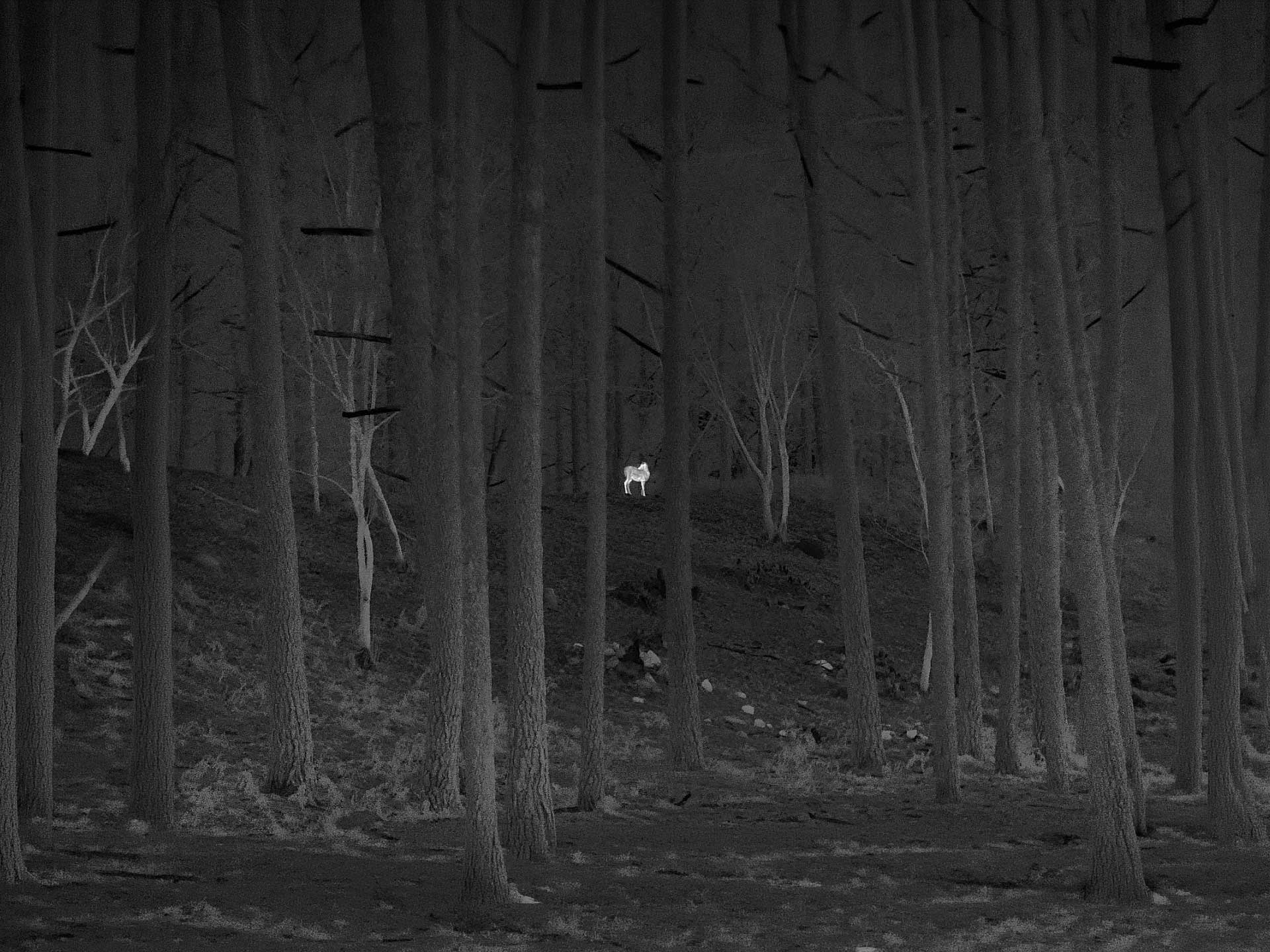
Moving vs stationary observation
Moving observation platforms such as vehicles, boats, or elevated stands introduce vibration and unpredictable motion. Stabilization systems help compensate for these disturbances.
In real-world hunting situations, stabilization also reduces misidentification risk. Here’s one of the cases where stabilization continuously helps Riccardo:
The thermal devices have given hunters the possibility to add quality to quantity during nighttime census. Because here where I live the animals are very disturbed, the red deer and stags are not easy to see during the day. The census during the rut season starts at 10 p.m. and finishes around midnight. Often, I have to move in the dark covering the widest area possible and this means walking lightly. Often with only my thermal bino in the harness. The stabilization feature helps me to detect even the smallest point in the stag antlers, having also the chance to deeply check the recorded video downloading it from the Stream Vision app in a few seconds. Ten years ago, I didn’t have the possibility to see in the dark, so the census was based only on listening to the various males roaring, without the chance to include more details on my census document. Now I can easily understand which animals are in the area, counting precisely even the females and detecting their class age (before, their number was obtained using a ratio of one male to six females).
Field warning: Stabilization improves handheld performance, but it cannot fully replace proper shooting support during precision targeting.
Does image stabilization improve detection, recognition, and identification?
Yes. Stabilization improves DRI performance by maintaining image clarity and reducing motion blur, particularly at higher magnifications. The DRI model breaks thermal performance into three stages:
- Detection — noticing an object is present
- Recognition — determining what category the object belongs to
- Identification — confirming the exact object or species
Impact on DRI performance
Detection typically occurs before stabilization becomes critical. Recognition and identification — which depend on edge detail and shape — are where stabilization has the most impact. It also reduces eye strain during long sessions, helping users stay focused. Thermal palettes and image contrast settings can also influence how easily targets remain distinguishable during movement.
Stabilization vs magnification trade-off
Without stabilization, users often reduce zoom to keep the image usable, sacrificing recognition detail in the process. Stabilization lets users hold higher magnification while preserving image quality.
Decision shortcut: If you frequently use digital zoom beyond base magnification, stabilization becomes significantly more valuable.

Real-world hunting implications
In hunting environments, stabilization helps observers positively identify animals from unstable positions such as standing observation, windy tripod setups, or vehicle-based scanning.
Stable image presentation reduces hesitation and uncertainty during observation, so, according to Riccardo, it’s definitely worth investing in:
It’s quite obvious to understand that zooming the image, all the movements we are making using a freehand device, thermal or standard, even the smallest, will be maximized on the display, preventing a steady image and not allowing us to enjoy the pleasure of a nighttime animal observation. Also, watching a recorded video later, after downloading it on our smartphone or our laptop, will be affected by the same issue. The lack of stabilization in these conditions will limit the features of a high-end device, cursing every single euro spent on purchasing that unit. In my opinion, to extend the possibility of use of a thermal device, it is very important to see if the stabilization is included in the software menu or not. Putting the stabilization in a small electronic device is a real paradox to solve for the designers, and it costs a lot; so, being sure that it’s included in the device features will also be the certification that the money spent on that unit was ‘well’ spent and all the other declared features are real and measured on the components and not on the instrument (like the NETD).
What are the limitations of image stabilization in thermal optics?
Stabilization improves usability but cannot eliminate all image instability. It works best as an enhancement alongside good technique and support, not as a replacement for either.
Frame rate limitations
Lower frame rates make stabilization appear less effective because image updates occur less frequently — a 30 Hz device shows more lag during fast movement than a 50 Hz system. EIS itself imposes no strict frame rate limit; the constraint comes from the sensor’s refresh rate.
Digital artifacts and lag
Poorly optimized systems can introduce warping, cropping, or visible lag. Well-designed EIS pipelines produce smooth correction with no noticeable artifacts or delay.
Battery consumption impact
Stabilization sensors consume approximately 1 mA — negligible compared to the thermal sensor and display.
Pulsar tip: Prioritize sensor resolution, NETD performance, and frame rate before focusing exclusively on stabilization features.
Image stabilization vs tripod: which is better?
A tripod provides maximum stability; image stabilization provides mobility. The right choice depends on the scenario.
Mobility vs stability trade-off
Handheld stabilization allows faster repositioning and flexible scanning angles. Tripods are slower to deploy but unbeatable for steadiness during precision work or prolonged scanning.
When to combine both
In windy conditions or at long range, using both together is ideal — stabilization absorbs minor vibration that wind or accidental contact can introduce even on a tripod.
Practical field scenarios
Forest hunters typically prioritize mobility; open-field observers scanning at distance often benefit more from a tripod. Many users switch between approaches depending on conditions.
Field warning: Stabilization improves observation comfort but should not be considered a substitute for safe shooting support or precision aiming technique.
How Pulsar integrates stabilization into thermal devices
Pulsar uses EIS driven by a gyroscope alone — the implementation does not rely on accelerometers or magnetometers. The gyroscope measures rotational movement, the system calculates the resulting pixel shift, and the image is corrected in real time.
Software-based stabilization optimization
Stabilization is placed strategically within Pulsar’s processing pipeline to minimize lag without affecting other image functions. The algorithm is lightweight by design, maintaining image quality without adding processing overhead.
Real-world benefits in Pulsar optics
The EIS system is tuned for real-world handheld conditions — wind, uneven terrain, cold weather — rather than controlled environments, prioritizing stable recognition during active scanning.
Integration with zoom and tracking features
Stabilization works alongside Pulsar’s digital zoom to preserve image usability at higher magnifications, where movement has the greatest impact. But it also has some other benefits, as shared by Riccardo:
The stabilization involves the possibility of not bringing a tripod or a stick to get a steady image. More tackle in the hands means the impossibility of moving freely in the environment; sometimes saving weight is important for spending less effort during a mountain hunting day, for example; because both hands free can mean having the chance to use the poles, which increases safety during steep climbs or descents. And again, the image quality using a free hand device will be much better, allowing us to share good videos on our social media or with our friends. A steady video means getting even the smallest detail of a heat signature, thanks to the high quality of the sensor, lens aperture, thermal sensitivity, display and other important features of the most expensive thermal device on the market, also zooming a lot.

How to choose a thermal device with effective stabilization
Prioritize high frame rates, advanced DSP, strong firmware, and proven EIS or DIS technology. Many buyers over-index on stabilization marketing while underweighting sensor quality and frame rate.
Key specifications that matter most
- Frame rate: 50 Hz or higher for smooth stabilization during motion
- Sensor resolution: higher resolution preserves more detail through digital correction
- DSP quality: determines how efficiently stabilization runs without lag or artifacts
Red flags in low-quality stabilization
Visible image warping, delayed correction, excessive cropping, or unstable panning all point to an underpowered processing pipeline.
Ideal combinations for hunters
Hunters using handheld thermal devices benefit most from:
- High frame rate (50 Hz or higher)
- Strong sensor sensitivity
- Optimized DSP processing
- Lightweight handheld ergonomics
- Proven gyro-based EIS stabilization
Decision shortcut: If you scan while walking, tracking, or moving between observation points, prioritize stabilization and frame rate together rather than zoom alone.
FAQ
Does image stabilization work in thermal scopes?
Yes. Modern thermal scopes use electronic or digital stabilization systems to reduce image shake caused by hand movement or environmental vibration. Stabilization improves image clarity, especially during handheld observation and high magnification use.
Is image stabilization necessary for thermal monoculars?
Image stabilization is not always necessary, but it becomes highly valuable during handheld scanning, long-range observation, and dynamic movement scenarios. It improves comfort and recognition performance.
Why do thermal images shake at high zoom?
High magnification amplifies small movements because the field of view becomes narrower. Even slight hand tremors appear larger at higher zoom levels, making image shake more noticeable.
Can image stabilization improve night hunting accuracy?
Yes. Stabilization improves recognition and identification accuracy by reducing motion blur and maintaining clearer target outlines. This helps hunters confirm targets more confidently.
What is the difference between digital and optical stabilization?
Digital stabilization uses software algorithms and motion correction to stabilize the image. Optical stabilization uses moving optical elements to physically counteract shake. Thermal optics usually rely on digital systems because they are more compact and practical.
Do all thermal devices have stabilization?
No. Some entry-level thermal devices do not include stabilization features. Premium thermal optics are more likely to include advanced EIS or DIS systems.
Can image stabilization replace a tripod?
No. Stabilization improves handheld usability but cannot fully replace the stability of a tripod during precision observation or shooting.
Does stabilization affect battery life?
The battery impact is minimal. Gyroscopes and stabilization sensors consume approximately 1 mA — a negligible draw compared to the thermal sensor and display.
About the experts

Co-Author:
Michael Gates
Michael Gates has progressed through multiple roles in production since joining Pulsar in 2021, building hands-on expertise in calibration, optical assembly, and inventory control. His experience spans the full manufacturing process, from component-level precision work to overseeing stock and workflow efficiency.

Expert Contributor:
Riccardo Tamburini
Riccardo Tamburini is a lifelong outdoorsman, hunter, fisherman, and professional wildlife photographer and filmmaker.
With over 35 years of experience across plains and mountains in Italy and abroad, he combines field expertise with a mechanical engineering background to explain the technology behind rifles, optics, and digital devices.
Before purchasing any night or thermal vision device, please make sure you adhere to the local legislation and only use it when it is allowed. Our ambassadors come from various countries and travel a lot, which allows them to test different devices. We do not encourage or support the illegal use of our devices in any events. If you wish to learn more about export and sales restriction policy, please visit the following link: Export and Sales Restriction Policy.