
Expert Contributor:
Erik Bjaelkvall
Estimated read time: 7 min.
The new Pulsar Thermion 3 takes Pulsar’s premium thermal riflescope platform — and the very first one to come in a classic design — into its latest generation. The new models, the Thermion 3 LRF XR60 and the flagship XT60, are built for full-range hunting. Both combine thermal imaging with 60 mm optics, an integrated 1,200 m (1,300 yd) laser rangefinder (LRF), ballistic support, and the familiar feel of a classic riflescope.
But how do these features translate into real hunting performance? And how do you choose the right model for your hunts? This in-depth review covers image quality, rangefinding and ballistics, ergonomics, field performance, and the key differences between the two models.
Quick overview of Thermion 3 LRF XR60 and XT60
Thermion 3 LRF comes in two models. The XR60 is tuned toward higher magnification, while the XT60 prioritizes high-definition (HD) image detail and a wider field of view (FOV). Both are designed to support confident observation and shooting across a broad range of hunting situations.
| Category | Details |
| Who it’s for | Hunters, forestry professionals, and pest control specialists |
| Main features | 60 mm optics, 1,200 m (1,300 yd) LRF, ballistic calculator, 30 mm tube mounting, 2,560 × 2,560 active-matrix organic light-emitting diode (AMOLED) display, classic design |
| Buy it if… | You want a premium thermal riflescope capable of covering a broad range of hunting distances and scenarios |
| XR60 advantage | Higher 4–40× magnification |
| XT60 advantage | 1,280 × 1,024 HD imaging and a wider 14.6° FOV |
| Bottom line | Premium full-range thermal riflescope platform combining image quality, ranging, ballistics, and classic riflescope handling |
| Price point | Premium segment |
What is the Thermion 3 LRF?
Thermion 3 LRF is the third generation of Pulsar’s flagship thermal riflescope. Thanks to its classic design, mimicking the daytime scopes, the original Thermion became the first of its kind. It mounts, handles, and feels like your usual daytime optics, with thermal imaging, rangefinding, and ballistic support built in.
Its performance is not limited to one shooting distance or situation. The platform is designed to support confident target detection and identification, ranging, and ballistic decision-making across varied hunting environments, in two models: the Thermion 3 LRF XR60 and XT60, compared in detail below.

Choosing between Thermion 3 LRF XR60 and XT60
While both models share a lot, their main difference lies in the sensor, which, in turn, results in a different viewing experience. The XR60 is optimized for a more focused, magnified view at distance, while the XT60 provides a much wider view of the surrounding terrain in HD detail.
| Attribute | Thermion 3 LRF XR60 | Thermion 3 LRF XT60 |
| Best for | Hunters who prioritize higher magnification and detailed observation at distance | Hunters who prioritize maximum image detail, wider scanning, and situational awareness |
| Thermal sensor | 640 × 480 @ 12 µm — strong sensitivity and detail | 1,280 × 1,024 @ 12 µm — more than four times the pixels, for a highly detailed HD thermal image |
| Magnification | 4–40× — starts closer and reaches higher magnification for inspecting targets at distance | 2–24× — lower base magnification provides a broader overview and makes scanning larger areas easier |
| Horizontal FOV, degrees | 7.3 — a more focused view suited to distance-oriented observation | 14.6 — roughly twice as wide a view, making it easier to scan and follow movement |
| Detection range, up to | 2,950 m (3,226 yd) — both models allow for target detection from vast distances | |
| LRF range, up to | 1,200 m (1,300 yd) — integrated ranging for accurate distance measurement | |
| Battery life, up to | 14 h — one of the longest runtimes available | 8.5 h — while shorter, still plenty to cover the whole night’s hunt |
| Typical fit | Open terrain, distance-oriented observation, and shooting where higher magnification is valuable | Mixed terrain, forested areas, and situations where awareness of the surrounding scene matters |
| Trade-off | Higher base magnification (4×) and a narrower FOV mean less of the surrounding terrain is visible at once | Maximum magnification stops at 24×, against 40× on the XR60. However, since the zoom is digital, the XT60 does retain more detail on higher zoom. |
Benefits and considerations
| Benefits | Considerations |
| 60 mm optics for a sharp, detailed thermal image
Full-range platform for varied hunting scenarios Integrated 1,200 m (1,300 yd) laser rangefinder, much faster than on the previous generation Integrated ballistic calculator with suggested point of aim (SPOA) Classic 30 mm tube mounting Recoil resistance up to 6,000 J 65 mm eye relief 128 GB internal memory One internal and one external battery, with easy swapping |
Ballistic features require initial setup and accurate input data
Feature set may exceed the needs of occasional users Larger and heavier than compact thermal scopes, because of the 60 mm optical platform New control layout needs a short adjustment period for users of earlier Thermion generations XT60 battery life (up to 8.5 h) is shorter than the XR60’s (up to 14 h) Premium price point |
Full technical specifications: Thermion 3 LRF XR60 vs XT60
We get into the full overview of key features below, but if you want numbers, here’s how each model stacks up.
| Parameter | Thermion 3 LRF XR60 | Thermion 3 LRF XT60 |
| Optics | 60 mm | 60 mm |
| Thermal imaging sensor | 640 × 480 | 1,280 × 1,024 |
| Pixel pitch | 12 µm | 12 µm |
| System NETD | <18 mK | <20 mK |
| Magnification | 4–40× | 2–24× |
| Horizontal FOV, degrees | 7.3 | 14.6 |
| FOV at 100 m | 12.8 m | 25.7 m |
| Detection range, up to | 2,950 m (3,226 yd) | 2,950 m (3,226 yd) |
| LRF measurement range, up to | 1,200 m (1,300 yd) | 1,200 m (1,300 yd) |
| Display | 2,560 × 2,560 AMOLED | 2,560 × 2,560 AMOLED |
| Eye relief | 65 mm | 65 mm |
| Recoil resistance, up to | 6,000 J | 6,000 J |
| Battery life, up to | 14 h | 8.5 h |
| Weight | 1.3 kg | 1.3 kg |
| Internal memory | 128 GB | 128 GB |
| Mounting | 30 mm rings | 30 mm rings |
System noise-equivalent temperature difference (NETD) shows the smallest temperature difference the sensor can pick up, so a lower number means higher thermal sensitivity
In-depth review of features and benefits
Image performance: premium detail across the range
At the heart of the Thermion 3 LRF are European-made thermal imaging sensors paired with 60 mm optics, delivering a sharp and detailed thermal image. The two models take different routes to get there. The XR60 uses a 640 × 480, 12 µm sensor with <18 mK system NETD, while the XT60 steps up to a 1,280 × 1,024, 12 µm sensor with <20 mK system NETD, which is more than four times as many pixels. And these pixels don’t just look good on paper: they deliver an extremely informative image, allowing you to spot the smallest details that are needed to make a confident decision in the field.

In use, the difference between the models isn’t hard to spot. Of course, as with any thermal, fog and humidity mess with the image a bit, but overall the amount of detail you get from the XT60 is truly exceptional, and hard to compare with anything else. The XR60 is naturally a bit lower in image quality, but still very informative, and its slightly higher thermal sensitivity helps in those poor conditions.
Here’s how Erik Bjaelkvall, a former Arctic Ranger turned competitive practical shooter, seasoned hunter, and gear expert from Sweden, describes the image of the Thermion 3 LRF XT60:
In White hot or Black hot, the Thermion 3 LRF XT60 renders the night like a black-and-white photograph of reality. You don’t get glowing blobs on a gray background. You get a landscape with texture and depth, where every animal has its own shape and character. Anyone can do detection today, because every modern thermal will find a warm spot at 500 m (500 yd). What matters is identification: what is it, and is it the right one? With 1,280 HD I can see the cold tips of a roebuck’s antlers and tell a yearling boar from a sow. I can count the piglets tucked against her flank. Earlier thermals told me something was there. The Thermion 3 tells me exactly what it is.
Magnification and field of view: two different viewing experiences
The biggest practical difference between the two models shows up in magnification and field of view. The XR60 offers 4–40× magnification with a 7.3-degree horizontal field of view, giving hunters considerably more magnification to work with. The XT60 starts lower at 2× and reaches 24×, but its 14.6-degree field of view shows roughly twice as much terrain horizontally at the same distance.

Now, what it means in practice depends mainly on how you hunt. If you’re typically around open terrain and need to acquire distant targets, that higher base mag will be really useful, and a narrower FOV will likely be just enough for you. However, for forested or mixed terrain, where maintaining situational awareness can be trickier, the XT60’s wider FOV will serve you much better.
Rangefinding and ballistics: measure, calculate, adjust
Both Thermion 3 LRF models feature an integrated laser rangefinder measuring up to 1,200 m (1,300 yd), with both single-shot measurement and continuous scanning modes. You can choose whether the distance is displayed in meters or yards in the settings of the device.
The rangefinder is also much faster than on the previous generation, which is a great advantage in the field, as you get the exact number back quicker, and can easily adapt to any changing situation.
Erik on the rangefinder:
Press, and the distance with the holdover is there. The LRF is fast and accurate, and that means one less thing to guess about before the shot.
Rangefinding works together with the built-in ballistic calculator, which you set up via the Stream Vision Ballistics app. Using the measured distance and the hunter’s personalized ballistic profile, the scope instantly displays an SPOA mark on screen, showing the required correction.
If you’ve never used ballistic apps before, you might experience a bit of a learning curve, but once you get past it, it becomes very intuitive. What matters most is the data you put in. SPOA is only as good as that data, so don’t skip this step. Accurate rifle and ammunition info is what puts the mark where the bullet lands, while a wrong input shifts the suggested point of aim away. Bullet speed is the best example. It’s usually recommended to measure it separately with a chronograph, because the numbers on the ammunition box are often incorrect. It might sound like a lot, but once you’ve done the initial setup, the suggestions needed for an accurate shot appear right on the screen of your Thermion 3.

Classic 30 mm riflescope design
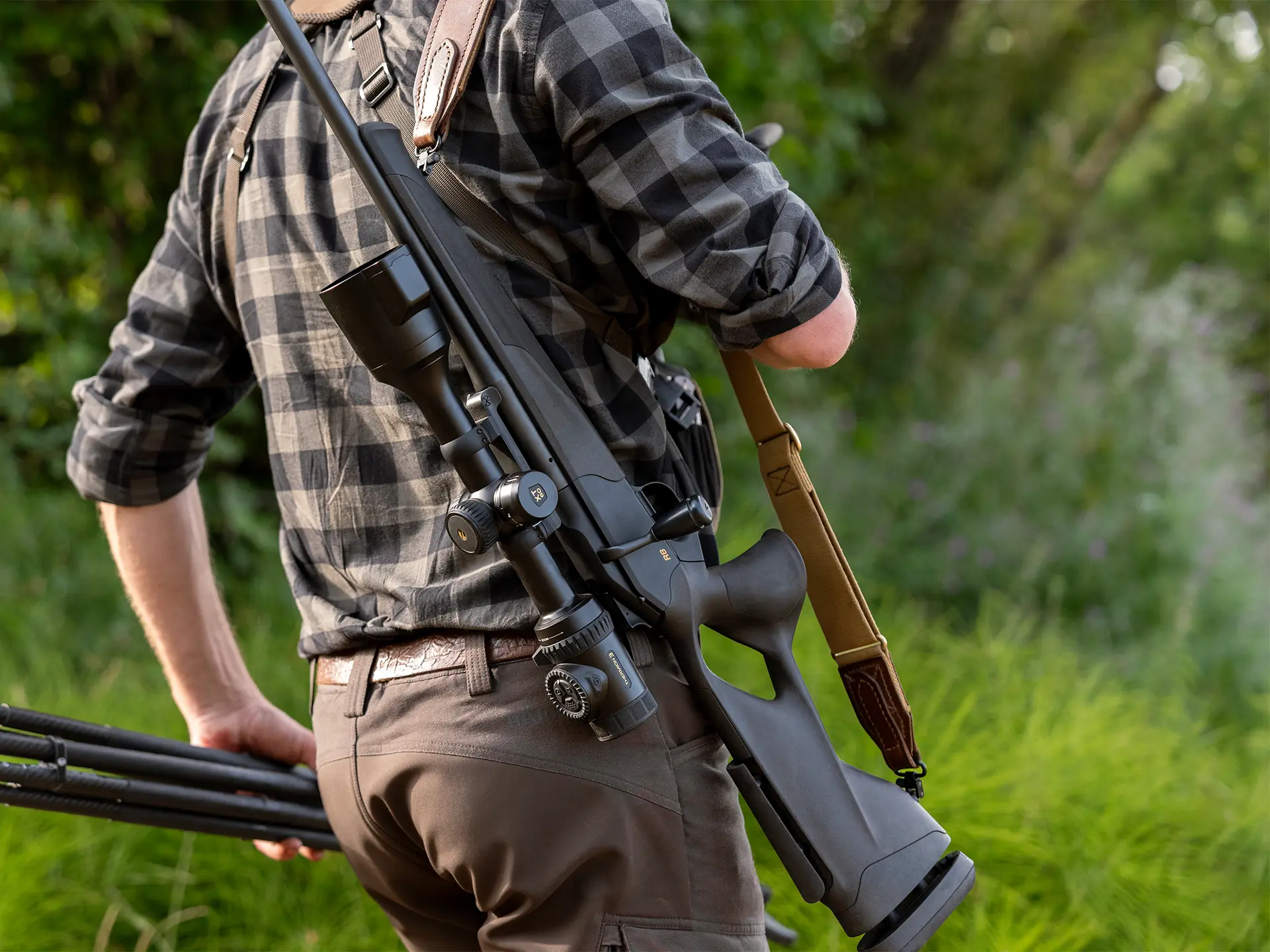
Despite the technology inside, the Thermion 3 LRF keeps the look and feel of a classic riflescope. Its 30 mm tube takes standard 30 mm rings, and the mounting format allows eye distance to be adjusted along the optical axis.
It is quite a big, heavy scope, but also a sleek, smooth one. If you like classic design, this is the one, and the mounting and overall rifle setup stay familiar.
Ergonomics and focusing: built around the shooter
The Thermion 3 LRF’s main controls sit closer to the shooter, on the eyepiece, for easier access. A circular encoder handles menu control, and a separate wheel takes care of zoom, allowing you to retain the muscle memory you’ve got from daytime shooting.
Focusing has moved to a top-turret wheel, easy to reach with both the left and the right hand.
The controls are new, so if you’re used to the earlier Thermion generations, expect to spend a little time readjusting. Once you do, I’m sure you’ll find them much easier to use. And the zoom wheel is remarkably comfortable.
Here’s what Erik says about the new zoom and focus wheels:
I love the new zoom wheel combined with the new focus wheel. As a competition shooter, I know split seconds matter, and that’s just as true for hunters. The faster you can see clearly and decide on the right shot, the better. With these controls I can go from a wide landscape view to the single animal I’m interested in, and sharpen the image, without lifting my head from the stock. It felt natural from the first night. My tip: set focus for the distance where you expect the animals before they show up, but be ready for anything.
Display and user interface
Both models use a high-contrast 2,560 × 2,560 AMOLED microdisplay, optimized for long-distance hunting. Thermion 3 LRF also comes with a new graphical interface, which makes readability better, and status information, quick menus, and the main menu easier to access and navigate.
Erik on the display:
The display is so fine that you stop thinking about pixels and start reading the animal.
Battery: long runtime and easy swapping
The XR60 runs for up to 14 hours and the XT60 for up to 8.5 hours. Both are maximum values measured at 22°C, so expect less in the field. The XT60 is the shorter of the two because of its more powerful sensor, so for really long and cold nights it is worth carrying a spare.
Both models use one internal battery and one external battery. Swapping the external one is as easy as it has always been, while the internal one was also made to have the possibility of extraction, in accordance with the EU requirements.

Recoil resistance and eye relief
Thermion 3 LRF is designed to handle high-caliber ammunition producing up to 6,000 joules (J) of muzzle energy. A 65 mm eye relief provides additional shooting safety when the scope is used with higher-caliber rifles.
Recording, connectivity, and supporting features
Thermion 3 LRF can automatically capture the moment of the shot using recoil-activated video recording, with three recoil-sensitivity settings available to match different shooting setups. Shadow Recording is also available, while Stream Vision 2 offers automatic shot detection, so you don’t need to look for the impact in the video manually. The device’s 128 GB internal memory provides space for hours of video and thousands of photos.
The riflescope also supports Stream Vision 2 and Stream Vision Ballistics, alongside 9 color palettes, 3 display shapes, 10 reticle shapes, 10 zeroing profiles, side incline indication, and elevation angle indication.
How the Thermion 3 LRF handles in real hunting conditions
Distances, terrain, and shooting situations can change throughout a single outing. Here is how the Thermion 3 LRF handles some of them.
Closer and mixed-range situations
At closer ranges and in mixed terrain, field of view, focusing, and controls matter most. The XT60’s wide view and 2× base magnification make it easier to scan the surroundings and pick up movement, while the top-turret focus wheel adjusts smoothly from close range to long distances, and the main controls stay within easy reach of the eyepiece. The XR60’s narrower view shows less of the scene at once, though its 4× base magnification already gives a closer look.
Erik, who has decades of field experience, on what a night out really looks like:
The typical hunt doesn’t exist, and that’s the most exciting part. A quiet night can turn into a lifetime moment in seconds. That’s when you need equipment that works exactly the same every time, and that’s how I experienced the Thermion 3. It let me set up a perfect image quickly and get on target fast, even in complete darkness and wet conditions. The feature that mattered most proved itself: the wide field of view combined with the new zoom wheel. I watch the whole field edge and every animal in the group, then roll in on the one I want without losing it from the image. Hunting is hours of patience and a few seconds of decision. The Thermion 3 is built for those seconds.
Open terrain
Across open ground, the 60 mm optics, detection up to 2,950 m (3,226 yd), and rangefinder measuring up to 1,200 m (1,300 yd) come into play. Those are maximum values, and fog and humidity affect any thermal, so expect less in real conditions. The XT60’s wider view helps find a target, and the XR60’s magnification of up to 40× helps inspect it. Be careful with the top magnification numbers, though — the zoom is only digital, so it does get pixelated once you go higher.
Longer-distance shooting
For longer shots, magnification, rangefinding, and SPOA correction work as a chain. The XR60’s higher magnification brings distant targets closer, the rangefinder measures the distance, and the SPOA mark shows the correction for it. The scope is rated for higher-caliber rifles as well, and the big screen size makes it much more comfortable to look through.
Pest control
Pest control means a lot of observation, ranging, and repeat shots, often over long nights. The XT60’s 1,280 × 1,024 sensor gives the most detail for identifying targets, the faster rangefinder and its continuous scanning mode keep distance readings coming as you sweep the area, and recoil-activated recording captures each shot, with 128 GB of memory to store it. The XR60’s battery life of up to 14 hours suits the longer sessions.
Forestry and land management
Forestry and land management work is mostly observation across varied terrain and distances. The XT60’s wide field of view and detailed image make large areas easier to scan, while detection up to 2,950 m (3,226 yd) reaches across open ground and the rangefinder gives a quick distance to whatever you spot. With 128 GB of memory, there is room to record what you find, and footage can be managed from your phone through Stream Vision 2.
Mounting, setup, and zeroing
Mounting
Mounting follows the usual riflescope routine. Check that the eye relief suits your actual shooting position before you tighten the rings, then tighten them to the torque value specified in the manual that comes with the device. The full process is covered in our guide on how to properly set up a thermal scope for hunting.
Zeroing
Zeroing your Thermion 3 is easy, and the Freeze function is very useful for adjusting the reticle. The process is as follows:
- Select the profile you’ll be using in the main menu.
- Set the distance.
- Fire a test round.
- Use the Freeze function to lock the screen, then move the reticle to your actual POI, both windage and elevation.
- Turn off the Freeze function and fire another test round.
- If it’s not exactly on target yet, repeat the process.
- Once you’re happy, press the save button to confirm and save your zero, then exit the menu.
Don’t forget the final save, since the save button is what confirms and stores your zero. With 10 zeroing profiles available, you can keep a separate zero for each rifle or load.
Erik on zeroing and ballistics:
Zeroing is easy as always, but that’s easy for me to say after doing it many times. If it’s your first time, read the manual properly, watch an instruction video, and use a target that actually shows up in thermal. For ballistics I use the Stream Vision Ballistics app. You build your profiles in the app and send them straight to the scope, and it can also factor in local weather. Long-range target shooting has taught me that a ballistic solution is only as good as the data you feed it. Measure your muzzle velocity, get the sight height right, and confirm at the distances you actually shoot. I rarely shoot long range when hunting, and I don’t encourage it, but the system is very accurate if your data is correct.
Ballistic profile and firmware
The ballistic profile is set up with the Stream Vision Ballistics app, and firmware updates go through Stream Vision 2. If you don’t need the full ballistic support, you can set up a simple zeroing profile directly in the scope.
Pulsar’s YouTube channel has plenty of practical videos on Thermion scopes, including zeroing and the ballistic calculator, so if it’s your first time using a Thermion, the tutorials might prove useful.
Comparison to alternatives: Is Thermion 3 LRF right for you?
Within the Pulsar thermal riflescope lineup, Thermion 3 LRF, Thermion 2 LRF, and Trail 3 LRF are designed around different priorities. The table shows where each one fits.
| Decision factor | Thermion 3 LRF | Thermion 2 LRF | Trail 3 LRF |
| Product role | Newest premium full-range platform | Proven premium Thermion platform (previous generation) | Compact thermal riflescope |
| Best for | Hunters wanting the newest imaging and a full-range shooting package | Hunters wanting proven performance and more model choices | Hunters prioritizing compact design with integrated precision tools |
| Mounting | Classic 30 mm rings | Classic 30 mm rings | Rail-mounted monoblock |
| Optics | 60 mm | 50–60 mm, model dependent | 50 mm |
| Detection range, up to | 2,950 m (3,226 yd) | 2,800 m (3,100 yd), model dependent | 2,300 m (2,500 yd), model dependent |
| Rangefinding | Integrated LRF, 1,200 m (1,300 yd) | Integrated LRF, 800 m (900 yd) | Integrated LRF, 1,200 m (1,300 yd) |
| Ballistic support | Ballistic calculator and SPOA | Ballistic support | Ballistic calculator and corrections |
| Imaging choice | Thermion 3 LRF XR60 for magnification; Thermion 3 LRF XT60 for HD detail and a wider FOV | Broad choice of sensor and magnification configurations | Trail 3 LRF XQ50 for thermal sensitivity; Trail 3 LRF XR50 for greater detail and reach |
| Price segment | Premium | Premium, previous generation | More accessible |
Read more:
- Explore the in-depth comparison of Thermion 3 vs Thermion 2
- Explore the in-depth comparison of Thermion 3 vs Trail 3
Final thoughts: Is the Thermion 3 LRF right for you?
The Thermion 3 LRF suits hunters and professionals who want one scope for everything from close encounters to long shots, without giving up the handling of a classic riflescope. Which model fits comes down to how you prefer to observe.
- Choose the XR60 if higher magnification and detailed observation at distance are your priority.
- Choose the XT60 if maximum image detail, a wider field of view, and broader situational awareness matter most.
- Choose the Thermion 3 LRF platform if you want high-end thermal imaging, integrated rangefinding, and ballistic support in a classic 30 mm riflescope format.

Erik, a gear expert with decades of field experience, sums it up:
Gold on the outside, HD thermal on the inside. The Thermion 3 sets the level the rest of the market will be chasing.
FAQs
What is the Pulsar Thermion 3 LRF?
A premium full-range thermal riflescope platform with integrated laser rangefinding, ballistic support, and classic 30 mm tube mounting.
Who is the Thermion 3 LRF for?
Its primary audience is hunters, forestry professionals, and pest control specialists working across a full range of distances.
What’s the difference between Thermion 3 LRF XR60 and XT60?
The XR60 uses a 640 × 480 sensor with 4–40× magnification, while the XT60 uses a 1,280 × 1,024 HD sensor with 2–24× magnification and a significantly wider field of view.
Which Thermion 3 LRF has the wider field of view?
The XT60, with a horizontal field of view of 14.6 degrees, compared with 7.3 degrees on the XR60.
Which Thermion 3 LRF has higher magnification?
The XR60, at 4–40×, compared with 2–24× on the XT60.
What is the detection range?
Both models offer a detection range of up to 2,950 m (3,226 yd), measured at 22°C. In the field, it will be lower.
How far does the laser rangefinder work?
Both models feature an integrated LRF with a measurement range of up to 1,200 m (1,300 yd).
Does Thermion 3 LRF have a ballistic calculator?
Yes. It provides an on-screen correction and an SPOA based on the measured distance and the user’s personalized ballistic profile.
Can Thermion 3 LRF be mounted using standard scope rings?
Yes. Its classic riflescope design uses standard 30 mm rings.
Can Thermion 3 LRF handle high-caliber rifles?
Yes. It is rated for recoil from ammunition producing up to 6,000 J of muzzle energy, and the 65 mm eye relief adds a margin of safety with higher-caliber rifles.
How long does the Thermion 3 LRF battery last?
Up to 14 hours on the XR60 and up to 8.5 hours on the XT60, measured at 22°C. Both models use one internal and one external battery.
How do you zero the Thermion 3 LRF?
Select your profile in the main menu, set the distance, and fire a test round. Then use the Freeze function to lock the screen and move the reticle to the actual point of impact, in both windage and elevation. Turn off the Freeze function and fire again, repeating the process until you’re on target, then press the save button to confirm your zero and exit the menu.
About the Experts

Co-Author:
Vilius Ūksas
Vilius Ūksas is an experienced precision shooter with a professional background in long-range marksmanship and ballistic application. Active in IPSC, IDPA, and the demanding Brutality match series, he combines practical, pressure-tested shooting skills with a deep understanding of ballistics and real-world rifle performance.
Expert Contributor:
Erik Bjaelkvall
Erik Bjaelkvall is a former Arctic Ranger, now a competitive practical shooter, seasoned hunter, and gear expert with decades of field experience.
Operating out of Sweden, Erik has extensively tested thermal imaging equipment across diverse environments – from open plains to rugged mountains, through snow, fog, and sun.
Before purchasing any night or thermal vision device, please make sure you adhere to the local legislation and only use it when it is allowed. Our ambassadors come from various countries and travel a lot, which allows them to test different devices. We do not encourage or support the illegal use of our devices in any events. If you wish to learn more about export and sales restriction policy, please visit the following link: Export and Sales Restriction Policy.