
Expert Contributor:
Peter Gibbon
Estimated read time: 9 min.
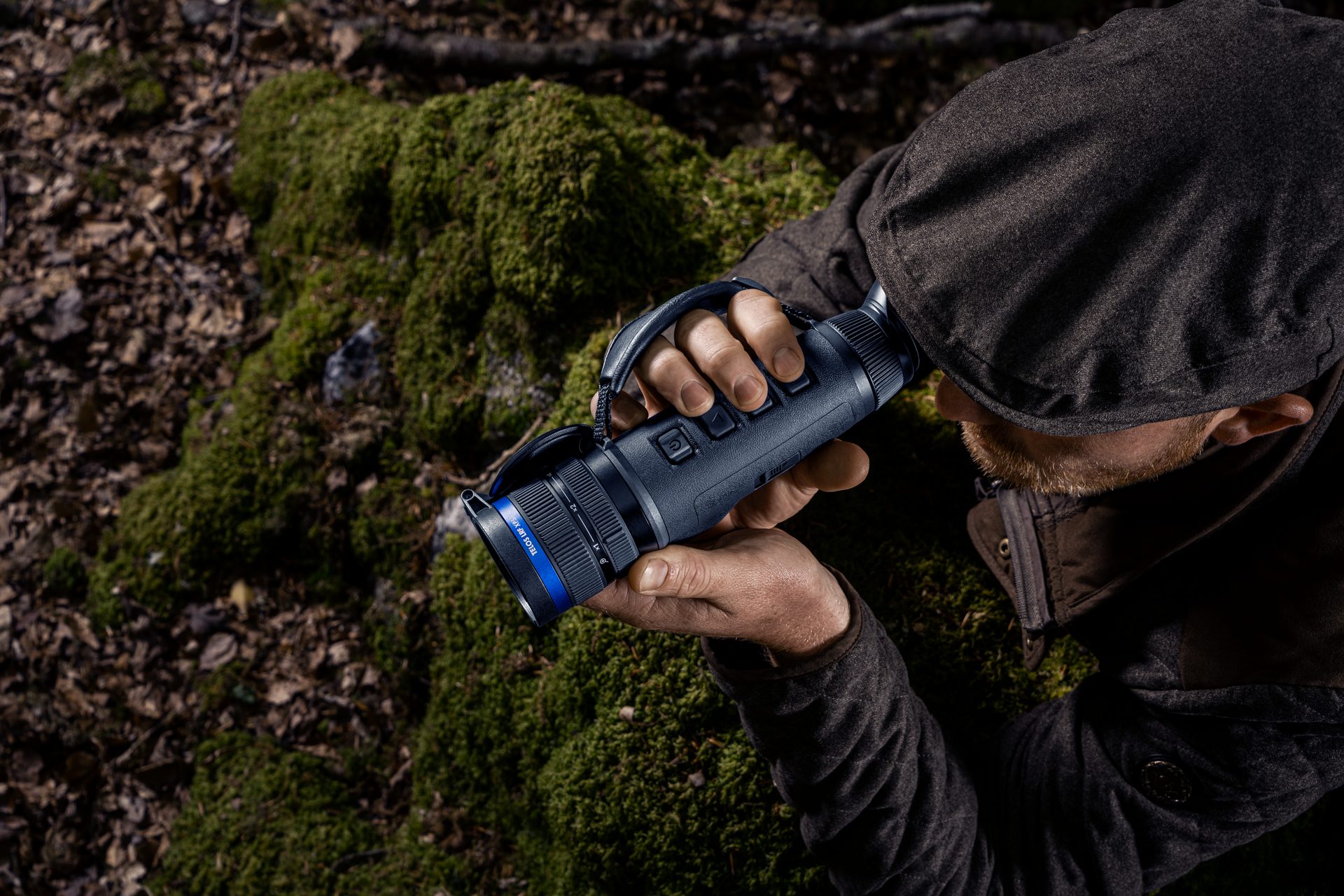
Thermal monoculars have become essential tools for modern hunters, offering the ability to detect heat signatures in complete darkness, heavy brush, or fog.
These handheld devices use advanced infrared sensors to deliver clear, real-time imaging where traditional optics fall short.
Whether you’re looking for a compact and lightweight monocular for quick scans, a budget-friendly entry-level option to start night hunting, or a professional-grade premium device with long-range detection and integrated rangefinder, today’s market has solutions for every hunter.
This guide highlights the top choices for 2026, helping you find the thermal monocular that best balances performance, features, and value for your hunts.
In Short: The best Pulsar thermal monoculars for hunting
- Best Overall: Pulsar TELOS LRF XT50 – Pulsar’s newest flagship and premium all-around thermal monocular for serious hunters and professional users.
- Best for Highest Sensitivity: Telos LRF XP50 – <15 mK thermal sensitivity for demanding observation in fog, rain, and other low-contrast conditions.
- Best for Scouting and Tracking: Oryx LRF XG35 – rugged, full-featured thermal monocular designed around true one-handed operation.
- Best for Long-Range Detail / Precision Identification: Telos LRF XL50 – HD thermal resolution for detailed observation and confident identification at longer distances.
- Best Compact / Lightweight: Axion XG35 Compact – compact and portable option for close- to mid-range hunting and general observation.
- Best Budget / Entry level: Axion XQ19 Compact – lightweight and accessible entry point into thermal observation.
The newest addition to the lineup is the Pulsar TELOS LRF XT50, which now sits at the top of the upgradeable Telos platform. Its 1280×1024 HD thermal sensor, wide 17.5° field of view, 2300 m detection range and integrated laser rangefinder bring detailed identification, efficient wide-area scanning and ranging together in one high-end device.
Rather than being built around a single standout specification, the TELOS LRF XT50 is the all-around flagship for users who need premium performance across demanding and extended field use.
Find your local dealer

Which type of thermal monocular do you need?
Thermal monoculars come in different sizes and configurations. The right choice depends on how and where you hunt, how much equipment you want to carry, and the level of image performance and functionality you need.
Compact thermal monoculars: maximum mobility
Compact spotters remain the darlings of hunters who want minimal weight and maximum mobility. Their small housings, pocket-friendly size, and now genuinely ergonomic operation make them easy to carry on long outings.
- Lightweight and portable for extended use in the field
- Ergonomic controls allow fast, one-handed deployment
- Ideal for mobile hunters or scanning on the move
The Axion Compact family represents this category, ranging from accessible entry-level models to higher-resolution compact devices.
Mid-size thermal monoculars: mobility with more capability
For users wanting more reach, integrated rangefinding and professional-grade performance without stepping up to a full-sized platform, Oryx bridges the gap between Axion Compact and Telos.
The Oryx LRF XG35 combines:
- Integrated laser rangefinding
- True one-handed operation
- Rear-mounted focus control
- Professional-grade thermal performance
- Rugged field construction
This makes it particularly well suited to mobile scouting and tracking where fast operation matters.
Full-Sized monoculars for maximum performance
Full-sized thermal monoculars prioritize image performance, longer observation sessions and advanced functionality.
They typically provide:
- Larger optics
- Greater image performance
- Extended power options
- More advanced functionality
- Better suitability for demanding and prolonged field use
This class also comes with a corresponding bump in price and weight, but it’s ideal for those who prioritise top-tier thermal clarity, long-session reliability, and upgrade potential.
The Pulsar Telos series stands out in this category for premium imaging, field-oriented ergonomics and an upgradeable platform designed for long-term ownership.
The Pulsar TELOS LRF XT50 sits at the top of the current Telos line.
Related: Everything You Need To Know About Thermal Monoculars
Best Pulsar thermal monoculars in detail
1. Pulsar TELOS LRF XT50 – Best overall
The Pulsar TELOS LRF XT50 is Pulsar’s flagship thermal monocular for serious hunters and professional users who spend significant time in the field and expect premium real-world performance – not specifications alone.
It combines high-detail HD thermal imaging, a wide field of view, long-range detection and integrated laser rangefinding in one premium handheld device.
The defining strength of the XT50 is the way those capabilities work together: scanning large areas, identifying animals with greater confidence, observing at longer distances and measuring range without switching devices.
Who this is for
- Serious and professional hunters who prioritize premium image quality and confident identification
- Hunters regularly scanning large forests, agricultural fields, mountains and other wide-open terrain
- Users who need wide-area observation and long-range capability in the same device
- Hunters spending long periods observing in the field
- Wildlife observers, forestry professionals and search-and-rescue teams requiring premium handheld thermal performance
Why we picked it
We chose the TELOS LRF XT50 as Best overall because it brings premium HD imaging, wide-area scanning, long-range observation and integrated ranging together in one flagship thermal monocular.
It is not positioned around one isolated performance metric; the value is in the complete field-use package.
Key features that matter
- 1280×1024 / 12 µm HD thermal sensor – high image detail for more confident observation and identification
- 17.5° / 30.7 m @100 m field of view – covers more terrain with each scan
- 50 mm F1.0 objective lens
- 2–16× magnification, with Zoom Boost up to 24×
- 2300 m detection range – supports long-distance observation in open terrain
- Integrated 1200 m laser rangefinder – distance assessment without a separate rangefinding device
- Electronic image stabilization – reduces image shake at higher magnification
- Replaceable LPS 7i battery – up to 8 hours of operation
- Upgradeable Telos platform – designed for long-term ownership
Strengths
- Combines high image detail with a notably wide scanning view
- Strong fit for mixed, open and mountainous terrain
- Integrated ranging reduces the need for separate equipment
- Designed for demanding and extended observation sessions
- Part of the upgradeable Telos platform
Limitations
- Larger and heavier than compact Axion models
- Not designed around true one-handed focus operation
Best use cases
- Scanning large forests, agricultural fields and mountainous terrain
- Identifying animals at longer distances
- Long hunting sessions where image quality, ergonomics and reliable ranging are equally important
- Recovering wounded game and evaluating animals before making decisions in challenging conditions
- Professional wildlife observation, forestry work and search-and-rescue operations
Field Footage showcase
Verdict
If you want one premium thermal monocular that brings detailed identification, wide-area scanning, long-range observation and ranging together, the TELOS LRF XT50 is our Best Overall pick.
Explore more:
- In-depth review of the Pulsar Telos XT50
- Find a local dealer to compare the feel and handling of the device.
2. Telos LRF XL50 – Best for long-range detail / precision identification
The Telos LRF XL50 is particularly well suited to hunters who prioritize fine image detail and confident identification at longer distances.
Its 1024×768 / 12 µm HD thermal sensor, 50 mm F1.0 lens and 2.5–20× magnification give it a clear role within the Telos lineup: detailed observation and distant target work.
Where the XT50 is positioned as the broader all-around flagship, the XL50 remains a strong choice when long-range detail itself is the priority.
Who this is for
- Hunters frequently identifying animals at longer distances
- Open-field and mountain hunters
- Users who place fine image detail high on their priority list
- Hunters working with distant targets where small visual details matter
Why we picked it
We chose the Telos LRF XL50 for Long-Range Detail / Precision Identification because its HD sensor and optical configuration are particularly well suited to detailed distant observation.
Key features that matter
- 1024×768 / 12 µm HD thermal sensor
- 50 mm F1.0 lens
- 2.5–20× magnification
- ~2300 m detection range
- Telos field-oriented housing and controls
- Upgradeable Telos platform
Strengths
- HD resolution for detailed thermal observation
- Strong fit for long-range identification
- Useful magnification range for distant targets
- Premium Telos construction and ergonomics
- Long-term upgradeability
Limitations
- Users seeking a wider scanning view and a broader all-around feature mix may prefer XT50
- Users prioritizing thermal sensitivity in difficult thermal conditions may prefer XP50
Best use cases
- Long-range deer identification
- Foxing across open fields
- Mountain hunting
- Observation where fine target detail matters
- Evaluating animals at greater distances before deciding whether to approach
Expert / field perspective
“Sensor choice is a very personal thing – sometimes, bigger is not always better. Everyone’s use of thermal is different: if you require a thermal to make fine detail identification, you will need an XL unit.”
— Peter Gibbon, hunter from the UK
Verdict
- Choose the Telos LRF XL50 when your primary requirement is fine detail and confident identification at longer distances.
- Choose XT50 when you want a broader flagship balance that also emphasizes wide-area scanning and integrated ranging.
Explore more:
- In-depth review of the Pulsar Telos XL50
- Find a local dealer to compare the feel and handling of the device.
3. Telos LRF XP50 – Best for highest thermal sensitivity
The Telos LRF XP50 takes a sensitivity-led approach.
Its 640×480 / 17 µm sensor delivers <15 mK thermal sensitivity, making it particularly valuable when thermal contrast in the scene is low.
Its role is broader than difficult weather alone: the combination of high sensitivity, useful field of view and Telos ergonomics also makes it a strong premium option for mixed terrain and long observation sessions.
Who this is for
- Hunters regularly operating in fog, rain, humidity or other low-contrast conditions
- Users who prioritize thermal sensitivity and situational awareness
- Long night stalking
- Hunters working across mixed terrain where stable thermal detail matters
Why we picked it
We chose the Telos LRF XP50 for Highest Thermal Sensitivity because its <15 mK sensitivity gives it a clearly differentiated role within the Telos lineup, especially when temperature differences in the scene are small.
Key features that matter
- 640×480 / 17 µm sensor
- <15 mK thermal sensitivity
- 50 mm F1.0 lens
- 2.5× base magnification
- Wide field of view
- Upgradeable Telos platform
Strengths
- Excellent thermal sensitivity
- Strong performance in low thermal contrast
- Wide field of view for situational awareness
- Well suited to prolonged observation
- Premium Telos ergonomics and upgradeability
Limitations
- Lower sensor resolution than XT50 and XL50
- Not the primary choice when maximum fine-detail identification is the goal
- Users prioritizing the all-around HD imaging + wide-scanning + ranging package may prefer XT50
Best use cases
- Foggy or wet hunting conditions
- High-humidity environments
- Long night stalking
- Mixed-terrain observation
- Situations where subtle temperature differences matter more than maximum resolution
Expert / field perspective
“For long night stalking with a thermal spotter, I have been running the Telos LRF XP50 since it hit the market. It features a 50 mm F1.0 lens paired with a 640×480 @ 17 µm sensor to deliver exceptional thermal sensitivity that still today beats all other spotters with equal sensor size on the market.
Base magnification of 2.5× provides a generous 21.8 meter field of view at 100 meters for great situational awareness and good details. The 1024×768-pixel AMOLED display gives sharp image details even with low light settings for pitch darkness settings.”
— Christian, personal field experience
Verdict
Choose the Telos LRF XP50 if thermal sensitivity, mixed-terrain observation and performance in low thermal contrast are higher priorities than maximum HD resolution.
Explore more:
- In-depth review of the Pulsar Telos XP50
- Find a local dealer to compare the feel and handling of the device.
4. Oryx LRF XG35 – Best for scouting and tracking
The Oryx LRF XG35 is designed for hunters who need to stay mobile, scan efficiently and measure distance without sacrificing ease of use in the field.
Sitting between the compact Axion range and the full-sized Telos platform, Oryx combines professional-grade thermal performance, integrated rangefinding and a compact, rugged chassis built around true one-handed operation.
That gives the Oryx a clear role in the Pulsar lineup: it is particularly well suited to scouting, tracking and active hunting situations where mobility, fast operation and reliable ranging matter.
Who this is for
- Mobile hunters who frequently scan while moving
- Scouting and tracking
- Hunters who value true one-handed operation
- Users who need an integrated laser rangefinder
- Long and demanding hunts where durability and battery life matter
- Hunters who want more functionality than a compact Axion without moving to the full-sized Telos platform
Why we picked it
We chose the Oryx LRF XG35 as Best for Scouting and Tracking because its design is built around practical field mobility.
The focusing wheel is positioned near the eyepiece, allowing the user to focus the image with the same hand holding the monocular. Combined with its ambidextrous design and integrated laser rangefinder, this makes scanning, focusing and measuring distance particularly intuitive during active hunting.
Key features that matter
- 640×480 / 12 µm thermal sensor – detailed thermal imaging in a compact platform
- 35 mm F1.0 lens
- 21.9 m field of view at 100 m – useful situational awareness for scanning
- Integrated laser rangefinder up to 1500 m – distance measurement directly from the monocular
- Rear-mounted focusing wheel – enables focusing with the same hand holding the device
- True one-handed, ambidextrous operation
- Digital image stabilization – helps maintain a steadier image during observation
- 500 g weight
- IP67 protection – water- and dust-resistant construction
- Dual-battery system – up to 12 hours of operation
Strengths
- True one-handed focusing and control
- Integrated long-range laser rangefinder
- Strong balance between portability and functionality
- Well suited to active and mobile hunting
- Rugged construction for long and demanding hunts
- Long battery runtime
- Digital image stabilization
Limitations
- Does not offer the same HD sensor resolution as XT50 or XL50
- Not part of the upgradeable Telos platform
- Users prioritizing premium HD imaging and the broader full-sized Telos experience may prefer the XT50
Best use cases
- Scouting and tracking
- Mobile hunting
- Frequent scanning while moving
- Situations requiring quick distance measurement
- Long and demanding hunts
- Hunting where one-handed control is particularly valuable
Field Expert Perspectives
The Oryx’s focus on mobility and integrated ranging is reflected in real-world use. Swedish hunter Stefan Orman describes it as his choice for situations where he wants to stay agile while having a laser rangefinder available:
“I see the Oryx as my new go-to unit in situations when I wish to be agile and need a laser rangefinder.”
He also highlights the ergonomics behind the device’s one-handed operation:
“The buttons are very intuitive and easy to reach, whereas the placement of the new focusing wheel near the eyepiece is awesome.”
This field experience reinforces the Oryx LRF XG35’s core positioning: a compact, rugged thermal monocular for hunters who value mobility, intuitive one-handed operation and integrated ranging in the field.
Verdict
Choose the Oryx LRF XG35 when mobility, scouting, true one-handed operation and integrated ranging are higher priorities than the full-sized HD imaging experience of the Telos platform.
Read more:
- In-depth review of the Pulsar ORYX LRF XG35
- Find a local dealer to compare the feel and handling of the device.
5. Axion XG35 Compact – Best compact / lightweight
The Axion XG35 Compact is designed for hunters who want capable thermal imaging in a genuinely pocket-sized device.
Its key strength is the balance between image quality, portability and identification capability. The 640×480 / 12 µm thermal sensor is packed into a lightweight, rugged body, while the 35 mm lens and 2.5× base magnification make the XG35 particularly well suited to hunters who want a compact monocular that remains useful when observation distances increase.
Who this is for
- The Axion XG35 Compact is best suited to:
- Active hunters who cover long distances on foot
- Hunters who want a thermal monocular that fits easily into a pocket
- Users who want to minimize equipment weight without giving up useful image quality
- General-purpose scanning and observation
- Hunters who need useful identification capability at longer observation distances
- Users looking for a compact thermal monocular they can carry regularly
Why we picked it
- We chose the Axion XG35 Compact as Best Compact / Lightweight because it combines high-resolution thermal imaging with the portability needed for active hunting.
- Its 640×480 / 12 µm sensor delivers detailed thermal images, while the compact dimensions and low weight make the device easy to carry during long days in the field. The 2.5× base magnification also makes it particularly relevant for hunters who work over longer distances.
Key features that matter
- 640×480 / 12 µm thermal sensor – high image quality in a compact format
- 35 mm lens
- 2.5× base magnification – useful for observation over longer distances
- 12.5° field of view
- Pocket-sized form factor – easy to carry throughout the hunt
- Lightweight construction – particularly useful when mobility matters
- Rugged magnesium-alloy housing – combines low weight with protection against demanding field conditions
- Wide-angle AMOLED display – supports comfortable observation with rich contrast
Strengths
- High-resolution thermal sensor in a pocket-sized body
- Strong balance of portability and image quality
- Useful magnification for observation at longer distances
- Lightweight enough for active hunters covering significant distances
- Rugged magnesium-alloy construction
- Easy to carry as an everyday thermal observation device
Limitations
- No integrated laser rangefinder
- Users requiring true one-handed focusing and integrated ranging should consider the Oryx LRF XG35
- Users prioritizing premium HD imaging, integrated ranging and the full-sized Telos platform should look toward Telos
Best use cases
- General-purpose thermal observation
- Mobile hunting and stalking
- Long walks and active hunts
- Short- to mid-range scanning
- Identification at longer observation distances
- Hunts where minimizing equipment weight and bulk matters
Expert / field perspective
“I have been using the Axion XG35 Compact for a few months now and it is a super capable little compact unit that fits in your hand, pocket or bag. It is easy to use and has a great battery life. It is perfect for identification of animals when I am out on the hunt or even just scanning to the ground to check for any signs of life. Its compact size means you are not worried about carrying something bulky about. It’s my go-to device if I am on the go these days.”
— Peter Gibbon
Verdict
Choose the Axion XG35 Compact if you want a thermal monocular that is small and light enough to carry throughout the hunt while still providing high-resolution imaging and useful observation capability across varying distances.
It is particularly well suited to active hunters who value mobility and portability but do not want compact size to come at the expense of useful thermal image quality.
Explore more:
- In-depth review of the Pulsar Axion Compact XG35
- Find a local dealer to compare the feel and handling of the device.
6. Axion XQ19 Compact – Best budget / entry-Level
The Axion XQ19 Compact is designed for hunters who want a simple, lightweight and accessible way into thermal observation without carrying a larger thermal device.
Its strength is not long-range detail. Instead, the XQ19 focuses on fast detection, a wide field of view and maximum portability. Its 19.5° field of view allows hunters to cover more terrain in a single scan, while the compact body makes it easy to keep the monocular with you throughout the hunt.
This makes the XQ19 particularly well suited to mobile hunting, wooded or brush-heavy environments, and short- to mid-range observation where speed and situational awareness matter more than long-range precision.
Who this is for
- First-time thermal users looking for an accessible entry point
- Budget-conscious hunters who still want dependable thermal detection
- Hunters who prioritize low weight and compact dimensions
- Mobile users who want a thermal monocular they can carry throughout the hunt
- Hunters working in forests, dense vegetation or mixed terrain
- Users who value fast scanning and a wide view over long-range fine-detail identification
Why we picked it
We chose the Axion XQ19 Compact as Best Budget / Entry-Level because it combines Pulsar’s most accessible thermal monocular positioning with practical features that matter in real hunting situations.
Its 19.5° / 34.7 m @100 m field of view provides a wide view for quickly locating animals and maintaining awareness of the surrounding terrain. At around 250 g without the battery, its compact format also makes it particularly easy to carry and deploy.
The result is an entry-level thermal monocular that focuses on the essentials: detect quickly, scan widely and stay mobile without adding unnecessary bulk.
Key features that matter
- 384×288 / 17 µm thermal sensor – dependable thermal detection for its intended short- to mid-range use
- <18 mK system thermal sensitivity – maintains useful thermal contrast in challenging conditions
- 19 mm F1.0 lens
- 19.5° / 34.7 m @100 m field of view – covers a large area in a single scan
- 1.5–6× magnification – low base magnification supports wide-area observation
- 750 m detection range
- Compact, lightweight construction – approximately 250 g without battery
- Up to 8 hours of battery operation
- IPX7 waterproof protection
- Built-in photo and video recording
- Wi-Fi and Stream Vision 2 connectivity
Strengths
- Wide field of view for fast scanning and situational awareness
- Lightweight and genuinely pocket-sized
- Easy to carry throughout long or active hunts
- Particularly useful in wooded, brush-heavy and mixed terrain
- Simple and intuitive operation
- Strong thermal sensitivity for its class
- Accessible entry point into thermal observation
- Recording and connectivity features despite its compact positioning
Limitations
- 384×288 sensor is not intended to provide the fine image detail of higher-resolution models
- 750 m detection range makes it less suitable for predominantly long-range open-terrain observation
- No integrated laser rangefinder
- Fine species or gender identification becomes more limited as distance increases
- Users prioritizing higher-resolution imaging and stronger identification capability should consider a higher-tier model
Best use cases
- Fast scanning and animal detection
- Mobile hunting
- Dense woodland and brush-heavy terrain
- Mixed terrain
- Short- to mid-range observation
- Long walks where keeping equipment weight down matters
- Dog handling and tracking
- Search-and-rescue situations where a wide field of view and portability are useful
Field Expert Perspectives
The XQ19’s strongest real-world advantage is perhaps best summarized by Swedish hunter and equipment tester Erik Bjalkvall, who emphasizes the value of having a thermal monocular small enough to actually carry everywhere:
“The best optic is the one you have with you.”
His field experience also supports the XQ19’s role as a practical thermal tool for a broad range of hunters — from beginners to experienced users — particularly when packing light is important.
Experienced hunter and professional shooter Stefan Orman highlights a more specific use case: dog handlers working in situations where a very wide field of view and minimal equipment weight are especially valuable. He also points to search-and-rescue work as another environment where those same characteristics become useful.
Erik also gives a particularly useful explanation of what the XQ19 image is designed to provide:
“The XQ19 doesn’t give details, but a perspective.”
That distinction captures the product positioning very well. The XQ19 is not designed around maximum fine-detail identification. Its value is seeing a wide area quickly, detecting what is there and maintaining situational awareness in a very portable format.
Verdict
Choose the Axion XQ19 Compact if you want an accessible, ultra-portable thermal monocular for fast detection and wide-area scanning, particularly in wooded, brush-heavy or mixed terrain.
It is especially well suited to users who value simplicity, mobility and a wide field of view more than long-range fine-detail identification.
If you want more resolution and broader mid-range capability while remaining compact, step up to the Axion XG35 Compact.
Read more:
- In-depth review of the Pulsar Axion Compact XQ19
- Find a local dealer to compare the feel and handling of the device.
Other Pulsar thermal monoculars to consider
Not every useful model needs its own “Best” category. Some devices make more sense as alternatives for specific requirements.
Telos LRF XG50 – Higher base magnification for long-range observation
The Telos LRF XG50 uses a 640×480 / 12 µm sensor, 50 mm F1.0 lens and 3.5× base magnification.
Its clearest role is long-range observation where higher base magnification is particularly valuable.
Peter Gibbon – Daily-Use Experience
“The Telos LRF XG50 is an excellent tool. It has a higher base magnification but when you use it for foxing or identifying deer at a longer distance, this is just perfect.
If I needed to do more close-up and detailed work, I would probably choose an XP or XL, but I feel for the work I do, it is a great value unit that will last a long time.”
Consider the XG50 when higher base magnification and long-range observation are particularly important to your hunting style.
Axion XG30 Compact – Wider view for dense terrain
The Axion XG30 Compact combines a 640×480 / 12 µm sensor with a 30 mm F1.2 lens.
Its wider-view configuration makes it particularly useful in dense terrain and closer-range observation, where locating and following moving animals can matter more than maximum reach.
Axion XQ30 Pro Compact – High sensitivity in a compact format
The Axion XQ30 Pro Compact uses a 384×288 / 17 µm sensor with <20 mK sensitivity and a 30 mm F1.2 lens.
It is especially useful for hunters who want a compact thermal spotter with good sensitivity when observation distance is less important.
Christian – Personal Field Experience
“I am running the XQ30 Pro as a compact spotter during stalking when I need to pack minimum weight and space and distance is of little concern. This spotter was selected specifically due to the compact form factor, low weight at 310 g, and a wide 23 m horizontal field of view at 100 m distance. The Pro 384×288 pixel sensor gives ample sensitivity for the price but does not reveal great details when zooming digitally.”
Telos models compared
| Model | Sensor / Pitch | Lens | Magnification | Detection Range | Best Suited To |
| TELOS LRF XT50 | 1280×1024 @ 12 µm | 50 mm F1.0 | 2–16×; Zoom Boost up to 24× | 2300 m | Premium all-around: HD detail, wide-area scanning, integrated ranging |
| Telos LRF XL50 | 1024×768 @ 12 µm | 50 mm F1.0 | 2.5–20× | ~2300 m | Long-range detail and precision identification |
| Telos LRF XP50 | 640×480 @ 17 µm (<15 mK) | 50 mm F1.0 | 2.5–10× (+ digital) | ~1800 m | Highest thermal sensitivity / low-contrast observation |
| Telos LRF XG50 | 640×480 @ 12 µm | 50 mm F1.0 | 3.5–14× | ~2300 m | Higher base magnification for long-range observation |
| Telos XQ35 | 384×288 @ 17 µm | 35 mm F1.0 | 3–12× | ~1300 m | Lighter, versatile Telos option |
How the main Telos models differ:
- Choose the TELOS LRF XT50 if you want the premium all-around flagship combining high image detail, wide-area scanning, long-range observation, and integrated ranging.
- Choose the Telos LRF XL50 if fine detail and precision identification at longer distances are your primary requirements.
- Choose the Telos LRF XP50 if maximum thermal sensitivity and performance in difficult thermal conditions are your priority.
- Choose the Telos LRF XG50 if higher base magnification and long-range observation are particularly important to your hunting style.
Read more: TELOS LRF XT50 vs TELOS LRF XL50: Which thermal monocular should you choose?
Compare Pulsar Axion Compact models
| Model | Sensor / Pitch | Lens | Detection Range | Best Suited To |
| XG35 Compact | 640×480 @ 12 µm | 35 mm F1.0 | ~1750 m | General-purpose compact hunting |
| XQ19 Compact | 384×288 @ 17 µm | 19 mm F1.0 | Short range | Entry-level / ultra-light use |
| XG30 Compact | 640×480 @ 12 µm | 30 mm F1.2 | Short–Mid | Dense terrain / wider-view use |
| XQ30 Pro Compact | 384×288 @ 17 µm (<20 mK) | 30 mm F1.2 | ~850 m | High-sensitivity compact observation |

Understanding Pulsar’s model naming
Pulsar’s model codes provide a quick way to understand the intended performance of each unit.
- XQ models use a 384×288 sensor with a 17 µm pixel pitch. They deliver mid-level performance, offering a balance between cost and image quality, with a moderate field of view suited for general-purpose scanning.
- XG models feature a 640×480 sensor with a 12 µm pixel pitch. They offer higher resolution and finer detail at longer ranges, with a slightly narrower field of view than XQ models when using the same lens size.
- XP models also use a 640×480 sensor but with a 17 µm pixel pitch and higher thermal sensitivity. This makes them perform better in fog and wet conditions, and they provide a wider field of view than XG models with the same lens size.
- XL models carry a 1024×768 sensor with a 12 µm pixel pitch. They deliver HD resolution for extreme detail at long range, but have the narrowest field of view, optimised for distant target work.
- XT models use a 1280×1024 sensor with a 12 um pixel pitch. In the TELOS LRF XT50, the high-resolution sensor is paired with a 50 mm F1.0 lens and a wide 17.5-degree field of view, combining detailed identification with efficient scanning across larger areas.
Expert note: “Sensor choice is a very personal thing – sometimes, bigger is not always better. Everyone’s use of thermal is different: if you require a thermal to make fine detail identification, you will need an XL unit. However, if you are just trying to spot something, the XQ sensor will do perfectly. The XG and XP sensors offer a great identification and valve.” – Peter Gibbon, a hunter from the UK with 25+ years of experience.
Lens focal length — shown by the number in the model name — further defines performance. Larger lenses (e.g., 50 mm) give a narrower but more detailed view at long range, while smaller lenses (e.g., 19–35 mm) offer a wider field of view for scanning and close-to-medium range spotting.
Personal tip from Christian: When comparing thermal spotters across brands, models, lenses, and sensors, the single most useful figure for me is the horizontal field of view (HFOV) at 100 metres. This tells you exactly how much landscape you can see in a single glance — a far more meaningful measure than a long list of lens and magnification specs.
Once you know the HFOV, consider the sensor size: a larger sensor allows you to zoom in digitally while keeping more detail. For most of my own hunting, the thermal spotter is for the initial detection of game and rough species guessing — the fine identification work, such as gender and age, I leave to the riflescope, where a lower HFOV is preferable.
Read more: Everything about the Pulsar product names
Which thermal monocular fits your hunting style?
Not sure which model suits your needs best? Use the table below to match your hunting scenario with the most appropriate thermal monocular from Pulsar’s 2026 lineup.
| Primary Use | Recommended Model | Key Advantage |
| Premium all-around / demanding field use | TELOS LRF XT50 | HD detail, wide 17.5° FOV, integrated ranging, upgradeable Telos platform |
| Long-range detail & precision identification | Telos LRF XL50 | HD resolution and fine detail at longer distances |
| Maximum thermal sensitivity / difficult weather | Telos LRF XP50 | <15 mK sensitivity in low thermal contrast |
| Long-range / higher-magnification observation | Telos LRF XG50 | Higher base magnification and long detection range |
| Mobile scouting & fast scanning | Oryx LRF XG35 | True one-handed operation and fast rear focus |
| Woodland stalking | Axion XG30 Compact | Lightweight design and wide FOV for dense terrain |
| General-purpose compact use | Axion XG35 Compact | Balanced range, resolution, and size |
| Budget-conscious / first thermal | Axion XQ19 Compact | Accessible entry point and lightweight design |
Dive Deeper: Compare all recommended models side by side
Pulsar’s 2026 lineup: From compact to customizable
With Pulsar’s 2026 thermal monocular lineup covering everything from pocket-sized spotters to full-sized, upgradeable flagships, the question becomes: which model is right for you?
The answer depends on:
- Your hunting style
- The terrain you operate in
- How you balance features vs cost
Before committing to a purchase, it’s worth considering a few key factors.

1. Match the monocular to your hunting environment
Assess your primary terrain and target species:
- In dense woodland or mixed farmland, go for a shorter focal length (19–35 mm)
- Offers wider field of view for tracking moving game up close
- In open landscapes like fields or valleys, a 50 mm lens offers more detail at distance
- Ideal for foxes, wild boar, or deer often spotted across large areas
2. Consider your budget and key features
Thermal monoculars range from affordable entry-level models to high-resolution, full-featured systems.
Ask yourself:
- Do you need maximum detection range?
- Is image clarity your top priority?
- Do you want a built-in rangefinder?
- Will you be out for long sessions needing extended battery life?
Examples:
- Axion XQ19 Compact: Core thermal features at an accessible price
- Telos XP50 / XL50: High-end sensors, advanced optics, and modular upgrades
3. Ergonomics and field usability matter
A technically capable monocular that’s awkward to use will cost you critical moments.
Look for:
- True one-handed operation
- Intuitive controls and focus mechanisms
- Balanced weight and compact design
The Oryx LRF stands out with a rear-mounted focus wheel — ideal for single-handed adjustments during active stalks.
4. Future-proof your investment
Thermal technology moves fast — your investment doesn’t have to be left behind.
Pulsar’s Telos series offers:
- Sensor upgrades
- Lens changes
- Add-on rangefinders — all via official service
This ensures your device evolves with your needs and Pulsar’s advancements.
Expert Advice: Buy for your needs, not just specs
When choosing the right device, it is not always about buying the biggest and most expensive unit.
Find the device that suits your needs. If you need super fine detail, go for the XL sensor.
If you need a general workhorse for finding game, a midrange sensor will do perfectly.
Budget can also be an issue — but with upgradeable units, you can buy what you can afford now and upgrade later.
I’ve had a Pulsar unit for over 10 years. The build quality is excellent, so you won’t have to worry about it falling apart.
Dive Deeper: How To Choose The Right Thermal Imaging Monocular for your needs
A shifting market in 2026
In 2026, the thermal monocular market has matured into two distinct but closely related categories: ultra-compact spotters and full-sized monoculars.
Across both, there’s a clear shift towards true one-handed operation — not just for menu navigation but also for fine focus adjustment. This means hunters can now operate their thermal without juggling grip and focus, making long stalks and quick observations far more practical.
The integrated laser rangefinder, once awkwardly placed for left-handed users, is now almost universally mounted beneath the lens, improving balance and accessibility for all shooters.
While each major manufacturer still brings its own quirks and refinements, the overall direction is towards a more uniform, user-friendly form factor — and that’s good news for anyone in the market for a new thermal.
Performance Trends and Pulsar’s Position
Sensor specs are converging, but trade-offs remain
On paper, most manufacturers now offer similar 640×480 thermal sensors and increasingly sophisticated image-processing algorithms.
While higher-resolution sensors like 1024×768 and 1280×1024 are available, they typically introduce real-world compromises:
- Reduced thermal sensitivity in marginal conditions
- Heavier processing loads, impacting image smoothness
- Shorter battery life, especially during extended use
Pulsar maintains a lead through refinement and reliability
Pulsar continues to stand out, especially through its balance of performance and field-tested reliability.
- The XP50 model, for example, still outperforms many newer competitors
- It uses a 17 µm pixel pitch sensor — a design that has remained competitive for years thanks to Pulsar’s continual software and processing improvements
Pulsar Tip: Newer isn’t always better — refinement often trumps raw specs in real-world hunting conditions.

My Final Thoughts
When hunters ask me about the best thermal monoculars, I always say it depends on what “best” means for your hunting style. Some of us prioritize compact size and portability, others need detection range and sensor resolution, while professionals often look for long-term upgradeability. In other words, there isn’t one single answer — the right choice is the one that matches your terrain, your target species, and your personal priorities.
From my experience, Pulsar’s 2026 thermal monocular range really does cover the full spectrum — from the pocket-ready Axion Compact, to the one-handed, all-round Oryx, to the modular, future-proof Telos. Each series reflects a clear market shift toward ergonomics, integrated rangefinding, and high-sensitivity sensors designed for real hunting conditions.
Which one is best for you?
Choosing between them comes down to your terrain, your target species, and how much you prioritise features like:
- Upgradeability
- Sensor resolution
- Weight and portability
- Field durability
- Rangefinding capability
If you need a compact companion for every stalk, the Axion Compact is hard to beat — offering essential performance in a jacket-pocket format.
If you’re looking for professional-grade thermal performance in a lightweight, single-handed device, the Oryx offers a well-rounded, field-proven option.
And if you want the last monocular you’ll ever need to buy, the Telos — with its sensor and lens upgrade path, modular design, and premium features — is the obvious long-term choice.
Ready for any terrain in 2026
Whatever you choose, I can vouch for Pulsar’s combination of European engineering, proven LYNRED sensors, and hunter-focused design — every model in this lineup is built for the realities of the field, in 2026 and beyond.
Ready for the next step? Find your local dealer
FAQs
What is the best Pulsar thermal monocular?
For users seeking Pulsar’s premium all-around thermal monocular, the Pulsar TELOS LRF XT50 sits at the top of the current Telos range. It combines a 1280×1024 HD thermal sensor, wide 17.5° field of view, 2300 m detection range and integrated laser rangefinder.
What is the difference between TELOS LRF XT50 and XL50?
The TELOS LRF XT50 is positioned as the all-around flagship, combining HD image detail with a wider field of view, long-range observation and integrated ranging.
The Telos LRF XL50 is better positioned for users whose primary requirement is detailed observation and precision identification at longer distances.
Which Pulsar thermal monocular is best for difficult weather?
The Telos LRF XP50 prioritizes thermal sensitivity with its <15 mK sensor, making it particularly suitable for observation in low thermal contrast and challenging weather conditions.
Can you use a thermal monocular for hunting?
Yes. Thermal monoculars are widely used by hunters for spotting game in low light, dense cover, and at night. They detect heat signatures rather than relying on visible light, making them effective in conditions where traditional optics fail.
What are some common uses for thermal monoculars?
Beyond hunting, they’re used for wildlife observation, search and rescue, security, property inspection, and pest control.
Are thermal monoculars worth it for hunting?
For many hunters, yes — especially in dense cover or at night. They can dramatically improve spotting efficiency, reduce missed opportunities, and aid in game recovery.
What magnification is best for a hunting thermal monocular?
Lower base magnifications (2–3×) with a wide field of view are ideal for scanning. Higher magnification helps at longer distances but narrows the view, which can make tracking moving game harder.
What to look for when buying a thermal monocular?
Key factors include sensor resolution, sNETD sensitivity, lens size, field of view, ergonomics, battery life, and whether it has an integrated rangefinder.
Why are thermal monoculars so expensive?
The cost comes from the advanced thermal sensors, high-grade optics, image-processing electronics, and durable weatherproof housing. Manufacturing is complex, and many components — especially high-sensitivity European sensors — are costly to produce.
Read further:
- Best thermal monocular for deer hunting
- Best thermal scope for hunting
- Best thermal scope for hog hunting
- Best thermal scope for coyote hunting
About the Experts

Co-Author:
Christian Rysgaard
Christian Rysgaard brings a lifetime of hunting experience, holding certifications as both a rifle and shotgun instructor, along with a long-standing passion for archery, ballistics, and night optics.
As a hunting journalist with a strong engineering background, he delivers technical articles and in-depth gear reviews for the European hunting market.

Expert Contributor:
Peter Gibbon
Peter Gibbon has been immersed in shooting since the age of 10 and began hunting more than 25 years ago. With two decades of hands-on experience using thermal and night vision technology, he brings deep practical knowledge of modern optics.
Based in northeast Scotland, Peter spends much of his time outdoors, combining lifelong field skills with a passion for the latest gear.
Before purchasing any night or thermal vision device, please make sure you adhere to the local legislation and only use it when it is allowed. Our ambassadors come from various countries and travel a lot, which allows them to test different devices. We do not encourage or support the illegal use of our devices in any events. If you wish to learn more about export and sales restriction policy, please visit the following link: Export and Sales Restriction Policy.