
Expert Contributor:
Riccardo Tamburini
Estimated read time: 7 min.
When every second counts in the field, what you can see matters just as much as how far you can see. Hunters often focus heavily on detection range, magnification, or sensor resolution when choosing thermal optics. Yet one of the most overlooked specifications is often the one that shapes the entire hunting experience: field of view (FOV).
Whether you are scanning a forest edge for wild boar at dusk, observing deer movement across open farmland, or tracking fast-moving predators through dense vegetation, the FOV directly affects how quickly you detect movement, maintain awareness, and react when opportunities appear.
In thermal hunting optics, FOV becomes even more important, because hunters often rely on heat signatures instead of traditional visual contrast. A wider view allows you to interpret movement, terrain, and animal behaviour more naturally – often even before the animal realizes you are there.
This guide explains how field of view works in thermal binoculars and thermal riflescopes, why it matters for hunting performance, and how hunters can choose the right balance between awareness and precision using thermal devices from Pulsar Vision.
Quick answer:
- FOV describes the width of the terrain you can see through your optic at a specific distance.
- A wider FOV helps hunters detect movement faster and track animals more naturally.
- A narrower FOV usually comes with higher magnification and improved long-range precision.
- Thermal binoculars and monoculars often prioritize wider FOV for observation and scanning.
- Thermal riflescopes often prioritize precision, resulting in a narrower visible image.
- FOV directly affects target acquisition, tracking performance, and situational awareness.
In practical hunting terms, a wide FOV works best in dense terrain and moving situations, while a narrow FOV often benefits long-range observation and precise shot placement. Choosing the right FOV depends on your hunting style, terrain, and shooting distance.

What does FOV mean in optics?
FOV describes the width of the visible area seen through an optic at a certain distance. In thermal devices, FOV determines how much terrain appears on the viewing display.
A wide FOV means more of the environment is visible at once. A narrow FOV zooms deeper into the scene but reduces visible surroundings.
For hunters, this is the difference between spotting a moving boar entering a clearing versus only seeing a small part of the terrain.
Thermal optics often present FOV in meters at 100 or 1000 meters, or in degrees of angular measurement. While numbers matter, practical understanding matters more.
Imagine standing at the edge of a forest at night: with a wide FOV, you may see multiple animals, surrounding vegetation, and movement patterns simultaneously. With a narrow FOV, you may only see one section of the terrain – useful for detail but limiting your awareness.
Related: How thermal scopes work: Pulsar expert explains
Linear vs angular FOV – what’s the difference?
Manufacturers usually present FOV in two ways:
Linear field of view
This measures the width visible at a specific distance, normally in meters.
For example: “21.8 m at 100 m” means you see 21.8 meters of terrain when looking at an object 100 meters away.
Angular field of view
This uses degrees to measure the viewing width independently of distance.
For example: “12.4°” means your total viewing angle spans 12.4 degrees — no matter how far away the object is. For the number savvy persons, the calculation looks like this: width = 2 * tan(θ/2) * range. The result: You see approx. 21.6 meters at 100 meters distance.
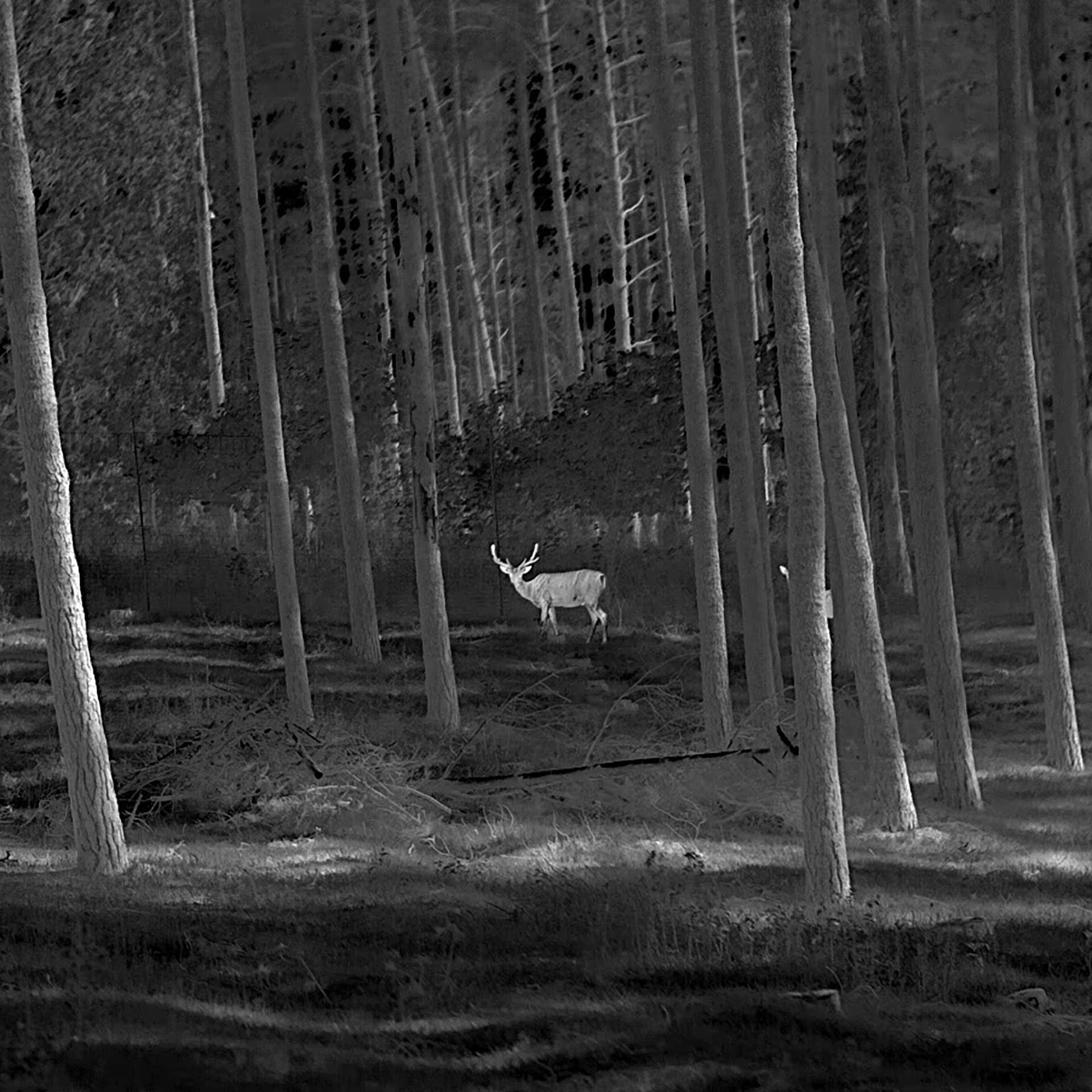
A larger angular number generally means a wider viewing experience.
For most hunters, linear measurement is easier to understand because it translates directly into terrain coverage in meters. However, our expert hunter Riccardo Tamburini usually goes for angular:
I prefer the angle because it immediately gives me the possibility to understand how big the FOV is. The human being is a predator. There are a lot of things in our body which say that: one of them is the frontal arrangement of the eyes, typical of felines (cats) and (a little bit less) of canines (dogs). What does it mean? We have a 180° FOV monocular sight and also the possibility to overlap what the right eye and the left eye are seeing: this helps a lot to better focus what we have in front of us and also sense the movement, increasing the perception of the depth of field. This happens for an angle around 120°. So, knowing the FOV of a vision device in angular degrees immediately gives me the possibility to compare it with the human natural FOV.
How FOV works in binoculars vs riflescopes
Thermal binoculars and thermal riflescopes are designed for very different purposes.
Observation devices, like binoculars and monoculars, prioritize awareness and scanning with a wider FOV. Riflescopes prioritize precision and shot execution, with a much narrower FOV. This naturally changes the FOV.
Read more: Thermal monocular vs thermal binoculars
Why thermal binoculars have a wider FOV
Thermal binoculars and other handheld devices are built for searching and scanning the terrain.
The hunter is constantly scanning landscapes, tree lines, fields, and movement corridors. A wider FOV allows faster observation and smoother tracking.
Devices such as the Symbion and Merger series prioritize immersive observation, giving hunters a natural viewing experience that resembles traditional binoculars.
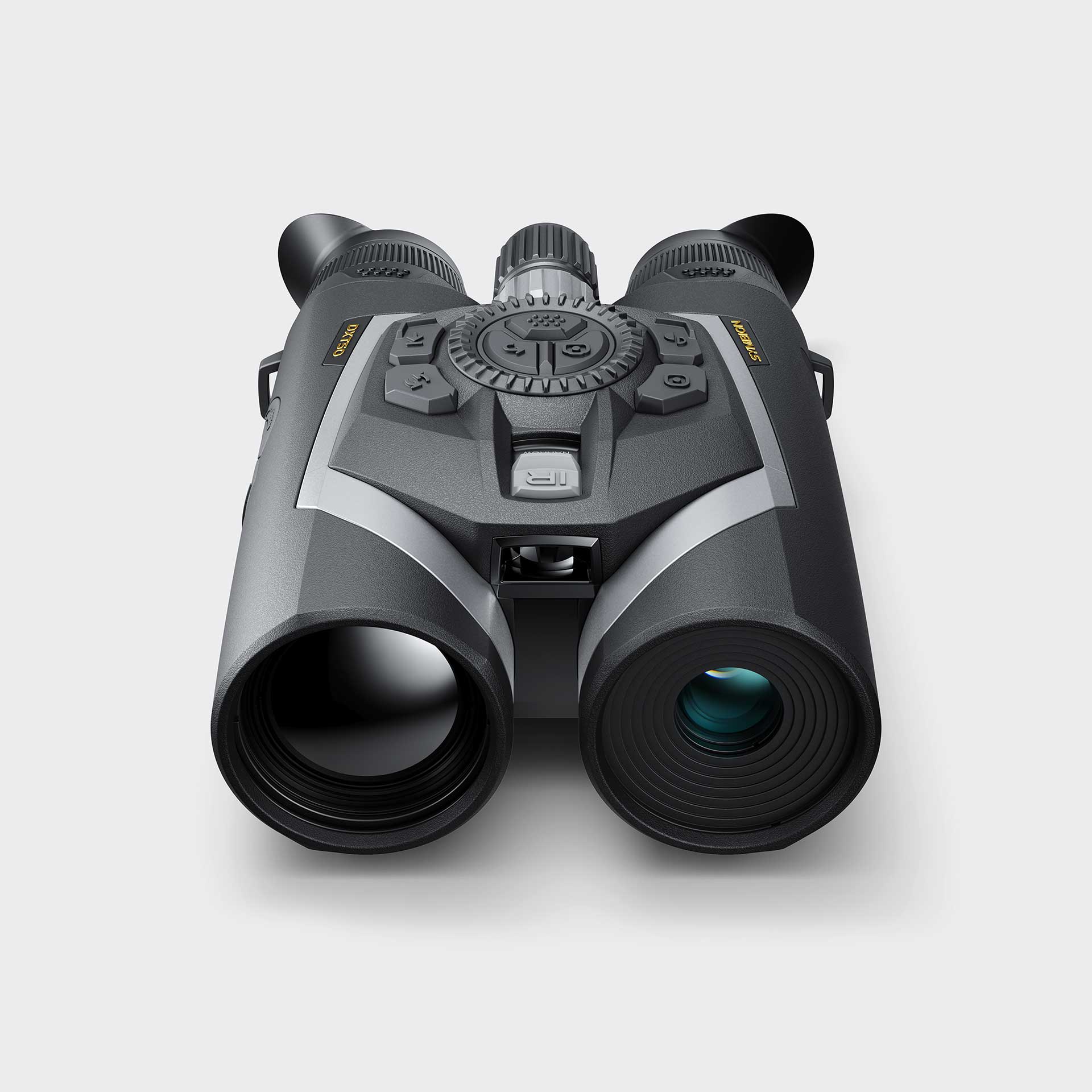
Likewise, the Oryx, Telos and Axion Compact thermal monocular families are optimized for mobility and rapid detection.
Imagine scanning a large field after sunset for wild boar:
A wider FOV will help you:
- Detect subtle movement faster
- Maintain awareness of the surrounding terrain
- Observe multiple animals at once
- Follow moving game more naturally
Hunters often underestimate how much time is saved simply by seeing more terrain with every sweep. In practical hunting, fewer scanning movements often mean less fatigue and better observation quality over long periods. That being said, observational devices can be a bit more forgiving, as explained by Riccardo:
In an observation device, FOV is less important than in a riflescope because the user has the possibility to easily turn it from the right to the left (and vice versa) observing a wider area in front of him. But if you need to get steady videos or you are looking for precise animals, you have to work with a stick or a tripod. A tripod is the best, but it’s heavy and hunters prefer moving lightly; this is why they often use sticks, rods or bipods: lighter and more handheld than a tripod but with less possibility of movement. Some time ago my answer would have been the Telos XL50 because it has a super wide FOV. Matching it with a standard bino gave me the possibility to detect the smallest movement in the woods, freezing me instantly and giving me the time to use the standard bino to better understand the animal I spotted. Now I’m able to do that with a single device: the multispectral Symbion. Despite the different base mag of the daytime and nighttime channels, the FOV is good with more than 16° at 100 m; an incredible value thinking about the 6.5x base mag.
Why thermal riflescopes have a narrower FOV
Thermal riflescopes prioritize identifying the animal and aiming precision.
Because of the higher magnification levels, riflescopes naturally provide a narrower image.
Products such as the Trail 3 and Thermion 2 families are designed to help hunters identify animals clearly and place ethical shots with confidence.
The trade-off is simple:
Higher magnification increases precision but reduces visible surroundings. This is especially noticeable at longer distances.
When magnification increases, hunters may struggle to quickly relocate moving animals because less terrain is visible in the image being displayed.

That is why many experienced hunters first detect animals using a thermal binocular or monocular before transitioning to a thermal riflescope for the engagement. Here’s how it translates to real-life situations, according to Riccardo:
It’s super important. Many hunters don’t understand that. I have a lot of friends who are using competition riflescopes in hunting. Generally speaking, they have a super image quality and a super-fine setting of the ballistic turret. But they have a poor FOV because in a competition, FOV is not important. You have to stay focused on the target, and a wide FOV could distract you from it, losing the concentration.
They are conceived and designed to have a narrow FOV; in hunting, the situation is completely different: you need to have the widest FOV possible for the reason I explained before: predators have a natural big binocular FOV, it helps them to better focus the prey, to easily understand the depth of field, and immediately perceive the movements. The prey has a bigger FOV, but it’s only monocular because they only have to detect the movement of their predators. When we are looking at an animal in the wild, we are like a predator, although technology helps us to improve our day and night sight ability, staying covered and observing animals from very far away. But doing that while limiting the movements and having the chance to check a bigger area watching through the nighttime device eyepiece makes the hunter absolutely more lethal.
Related: How to choose a thermal scope
The relationship between FOV and magnification
The relationship between FOV and magnification is straightforward:
As magnification increases, FOV decreases.
Higher magnification compresses visible terrain and narrows your awareness area. Lower magnification increases terrain visibility. This creates one of the most important trade-offs in thermal hunting.
Real-world hunting example
Imagine hunting wild boar in thick woodland: a high-magnification optic may show excellent detail but only a small portion of the environment. If animals suddenly move, reacquiring them becomes difficult. A wider FOV allows you to follow movement naturally, especially when animals split up, change direction, or appear suddenly.
Now imagine open farmland during deer season:
Animals may appear several hundred meters away. Here, greater magnification becomes more valuable because hunters need better detail for identification and ethical shot placement.
The right balance always depends on the type of terrain – and here’s how Riccardo achieves it:
Having a big FOV and a great base magnification is a paradox, so we have to balance these two features to get the best result possible. Generally speaking, in a multipurpose device a wide FOV is probably more important. Pulsar already understood this some years ago, introducing a super wide FOV in its Thermion 2 LRF XL50. Generally speaking, hunting in very different scenarios from each other, I prefer to have a riflescope with a wide FOV and low base magnification, also because I tend to shoot not increasing the magnification a lot, just not to sacrifice FOV, even a few seconds before shooting in an open field. When I hunt in the woods waiting for wild boars at a feeding point, I can forgo a bigger FOV using an XQ class sensor with its typical good base magnification. I know that animals will come where I’m waiting for them; then, I’m often surrounded by a very dense vegetation cover, which doesn’t give me the possibility to take advantage of a wide FOV.
Read more: Scope magnification explained: Best zoom for hunting
Why FOV matters for hunting
FOV directly affects hunting performance.
It influences:
- Detection speed
- Situational awareness
- Tracking ability
- Animal acquisition
- Decision-making speed
In thermal hunting, these factors become even more important because hunters often rely entirely on heat signatures.
Wide FOV for scanning and tracking moving game
A wide FOV shines in:
- Dense forests
- Driven hunts
- Fast-moving game situations
- Nighttime predator observation
- Close-range hunting
Imagine multiple boars entering a feeding area: a wider FOV helps hunters understand movement patterns instead of focusing too narrowly on one heat source. The ability to observe the full picture often leads to better decisions.
Narrow FOV for precision shooting
A narrower FOV becomes useful when:
- The terrain is open
- Distances are longer
- Identification is important
- Shot placement becomes critical
Thermal riflescopes such as the Thermion 2 and Trail 3 families excel when hunters need precise information for confident shooting.
The key is understanding that precision and awareness exist on opposite ends of the spectrum.
How to choose the right FOV for your hunting style
Choosing the right thermal optic starts with understanding your hunting environment. A wider FOV is best for fast-moving or close-range scenarios, and a narrower FOV is best for long-range precision.
Best FOV for dense forest hunting
Hunters in forests generally benefit from a wider FOV.
Short engagement distances and unpredictable movement make rapid awareness more important than extreme magnification.
Observation devices like Symbion, Merger and Oryx perform especially well here.
Best FOV for open field & long-range hunting
In open farmland or mountain environments, longer distances often justify a narrower FOV. Higher magnification helps identify animals and improves precision.
Thermal riflescopes like Thermion 2 and the new Trail 3 become valuable tools – here’s a practical example from Riccardo.
When I’m out for wild boar control, it’s imperative to have the widest FOV possible. Because wild boars generally live, move, and feed in big herds, and also because I need to have the possibility to double the shot. In Italy, we can’t use light calibers or semiauto rifles for wild boar culling. Often the recoil prevents the possibility to immediately double a shot, so a thermal riflescope with a big FOV helps me to understand the situation after the first shot more quickly. I could give a lot of examples, but recently, I was out with a friend helping him as spotter. He had the chance to cull one of two wild boar that appeared in the crop with his Thermion 2 LRF XQ50. After the shot, the other went away, disappearing from his display but, thanks to the super wide angle of my Oryx LRF XG35, I was able to advise him that the second animal was coming back towards the point of impact of the first shot. The result was a clear second shot, and another animal dropped down.
Balancing FOV with magnification
The best hunters rarely optimize for one specification alone.
Instead, they balance:
- Magnification
- Sensor resolution
- Detection range
- FOV
- Terrain type

The smartest setup is often a thermal observation device paired with a thermal riflescope. Safety is a vital subject. A thermal riflescope, or any riflescope is not meant for scanning an area. Only use binoculars or monoculars for scanning an area, and confirming there is no humans in the background, before using your riflescope.
FOV vs other optical specifications
FOV never works alone. It interacts with several other important characteristics.
FOV vs sensor resolution
A higher-resolution sensor improves image detail. But even excellent resolution cannot compensate for an overly narrow FOV.
Read more: Thermal sensor guide
FOV vs Base magnification
Base magnification directly impacts the amount of visible terrain. A higher base magnification means narrower awareness.
FOV vs Detection range
Extreme detection range sounds impressive on paper, but hunters still need enough FOV to interpret the surroundings effectively.
Read more: Detection vs. identification explained
FOV vs image detail
Detail matters, but awareness matters too. Seeing more terrain often helps hunters make better decisions faster.
It might seem challenging to choose your priorities in a smart way, so we turn to Riccardo for some advice:
I think that a wide FOV is probably one of the most important features in a thermal device. Absolutely imperative in a thermal riflescope. I can renounce some other features to get a wide FOV. Image detail doesn’t kill, above all when you are culling wild boars against crop devastation; because sometimes the hunter’s skills can overcome a lower image quality. Same for detection range. Actually, now the technology doesn’t allow us to understand which animal you are seeing from very far away, but already a mid-price thermal device is able to detect a heat signature from hundreds of meters. And this is enough. Having to decide between FOV and magnification… FOV every time. A lower pixel pitch and a high sensor resolution help to have a good image quality, even when it increases the base magnification a bit. Most often this is what we need in terms of precision. I could sacrifice some degrees of field of view just for the sensor resolution because this gives me the possibility of using my thermal device in completely different scenarios. Very important for a hunter who hunts in the plains as well as in the mountains.
Common mistakes hunters make when evaluating FOV
Many hunters make the mistake of chasing magnification alone. This often creates tunnel vision in real hunting situations.
Common mistakes include:
- Choosing too much magnification
- Ignoring the terrain type
- Underestimating tracking difficulty
- Confusing detection with identification
The best optic is rarely the one with the biggest numbers. It is the one that matches the hunt.
In thermal hunting, success is rarely determined by one specification alone. FOV may not attract the same attention as magnification or detection range, but experienced hunters understand its importance immediately in real-world conditions.
Seeing more terrain, understanding movement, and maintaining awareness often matter more than simply zooming closer. Choosing the right balance of FOV for your hunting style can ultimately make observation more efficient, decisions faster, and every hunt more effective.
FAQ
What is a good FOV for thermal binoculars?
A wider FOV is generally preferred because it improves scanning efficiency and awareness.
Does higher magnification reduce FOV?
Yes. Higher magnification narrows the amount of visible terrain shown on the display.
Why do thermal binoculars have a wider FOV than thermal scopes?
Because they are designed for observation rather than precision shooting.
Is wider FOV always better?
No. Wider FOV improves awareness, while narrower FOV often improves long-range precision and identification.
How does FOV affect target acquisition?
A wider FOV makes it easier to locate and track animals quickly. A narrower FOV makes it easier to identify the animal and take a precise shot.
Which Pulsar thermal devices are best for wide-area scanning?
The Symbion, Merger and Oryx families are especially effective for observation and terrain scanning.
Which Pulsar thermal devices are best for hunting?
The Trail and Thermion families are especially effective for identification and shot placement.
About the experts

Co-Author:
Freya Askjaer
Freya Askjaer is a Danish huntress living in Sicily, with over a decade of experience hunting across the world.
She has tested Pulsar optics in snow-covered mountains, thick brush, and desert-like areas through every season.
Expert Contributor:
Riccardo Tamburini
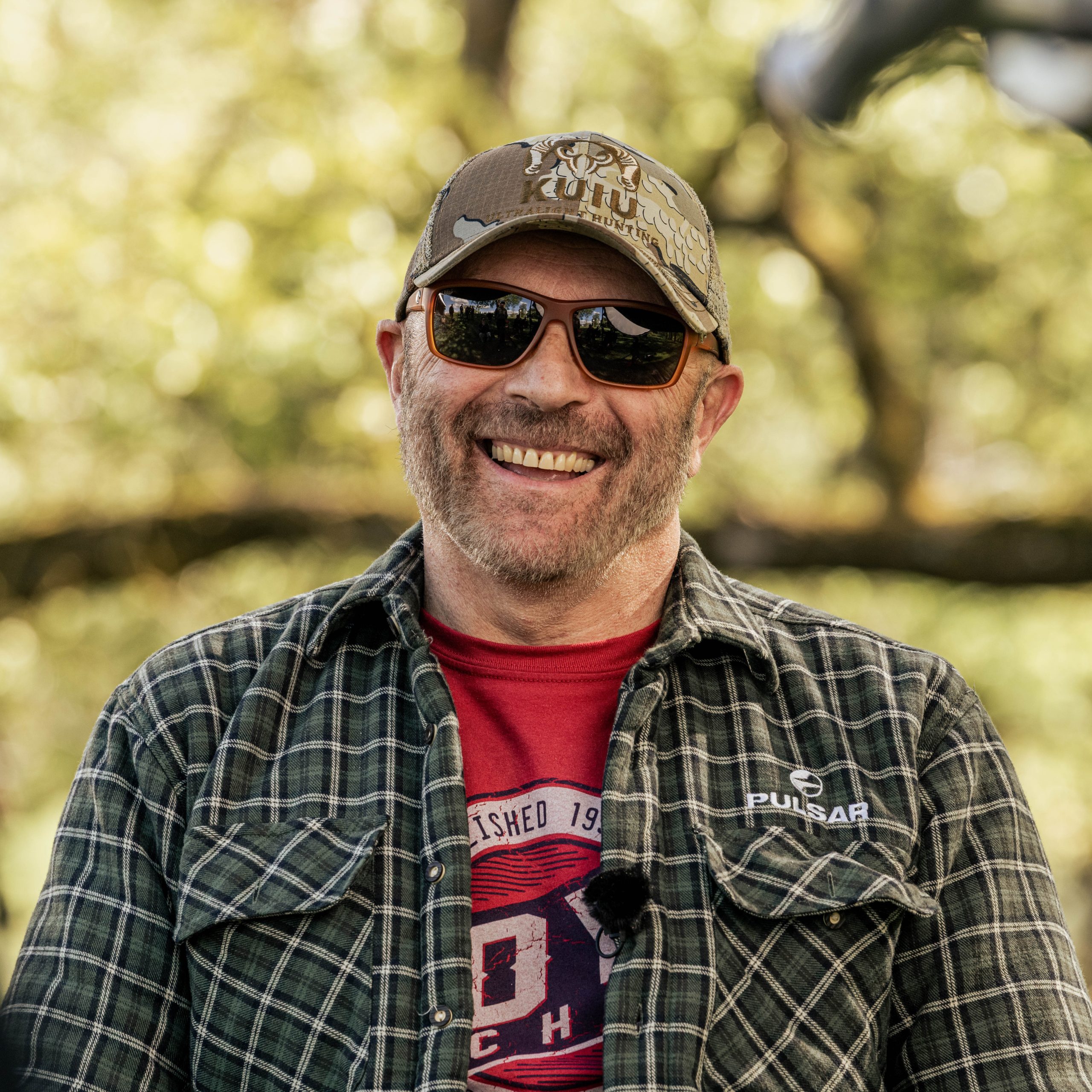
Riccardo Tamburini is a lifelong outdoorsman, hunter, fisherman, and professional wildlife photographer and filmmaker.
With over 35 years of experience across plains and mountains in Italy and abroad, he combines field expertise with a mechanical engineering background to explain the technology behind rifles, optics, and digital devices.
Before purchasing any night or thermal vision device, please make sure you adhere to the local legislation and only use it when it is allowed. Our ambassadors come from various countries and travel a lot, which allows them to test different devices. We do not encourage or support the illegal use of our devices in any events. If you wish to learn more about export and sales restriction policy, please visit the following link: Export and Sales Restriction Policy.