
Expert Contributor:
Patrick Long
Estimated read time: 8 min.
Looking for the best thermal for coon hunting that actually works in tight timber and treetops at night? Raccoons blend into warm bark, vanish behind brush, and move unpredictably while hounds are working. A thermal optic built for fast scanning and high sensitivity is the key to success.
This guide breaks down the exact specs that matter for racoon hunters – FOV, NETD, resolution, refresh rate, and battery life – and matches them to the right Pulsar device category and model tier, so you can identify treed coons more quickly and confirm them safely.
Legal disclaimer: Regulations on the use of thermal imaging devices for raccoon hunting vary widely across countries, states, counties, and local jurisdictions. Some areas allow thermal use for furbearers, while others restrict or prohibit it, especially at night. It is every hunter’s responsibility to review and follow all applicable laws before using thermal optics in the field.
Quick answer
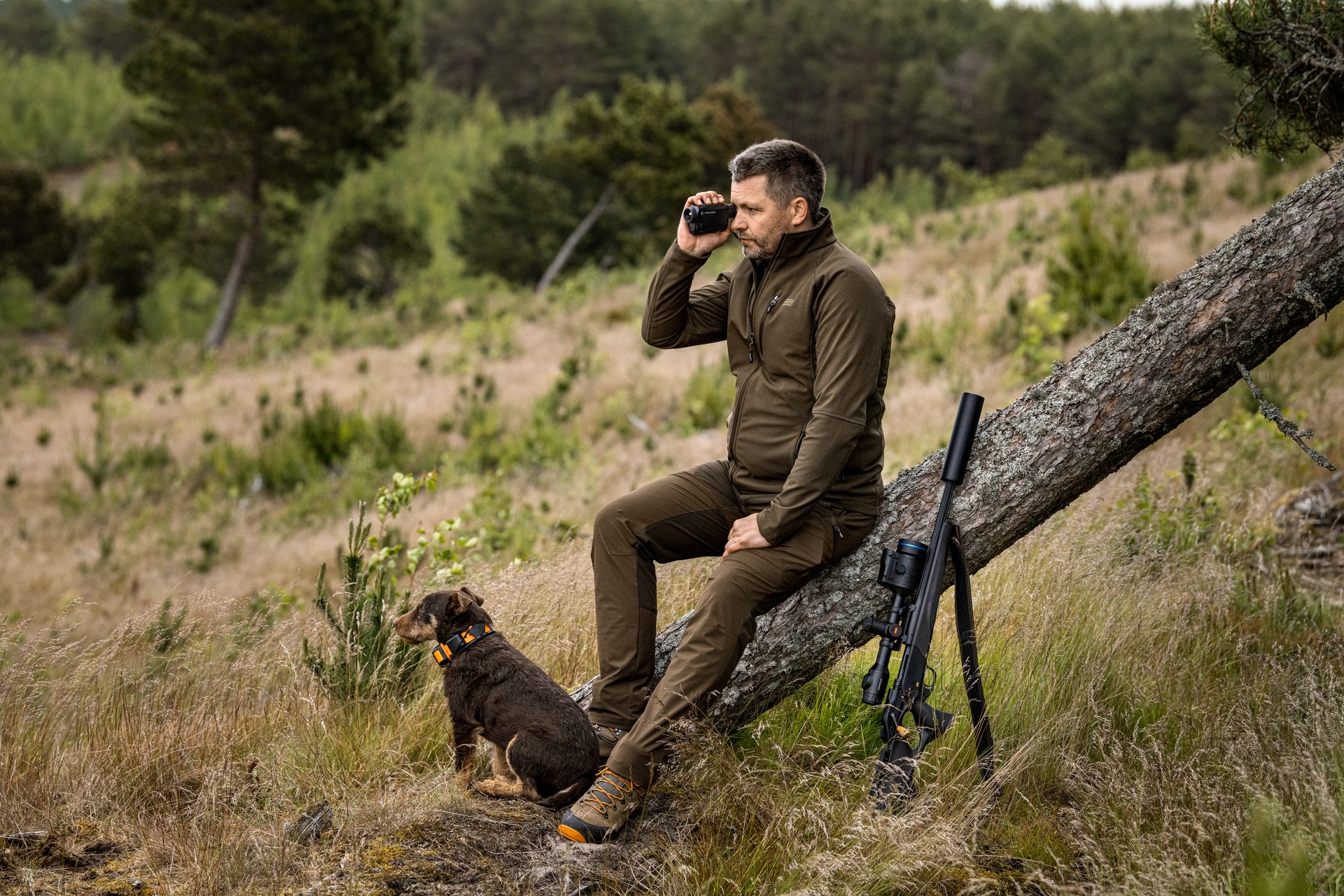
Raccoons are often found at mid-range in thick woods and in treetops. You will want a handheld thermal monocular with a wide FOV, low NETD, and moderate base magnification. Monoculars give you the speed and scanning efficiency required during hound hunts, where targets may appear quickly or partially hidden.
What to prioritize for treed raccoons:
- Wide field of view (FOV): scan multiple trees and brush fast at 20–150 m.
- Low NETD / high sensitivity: separates a coon’s heat from warm bark and branches during humid nights.
- 384 vs 640 resolution: 384 works for detection and most IDs; 640 is best for confident treetop identification in thick cover.
- 50 Hz refresh rate: smoother tracking of moving racoons and dogs under the canopy.
- Battery system built for all-night hunts: swappable packs or long runtimes trump extreme range.
Best device category for coon hunters:
- Handheld thermal monocular: Pulsar Telos, Axion Compact, or Oryx as your main tool.
When to choose binoculars/scopes instead:
- Thermal binoculars: Pulsar Merger LRF is for reducing fatigue during longer scanning sessions.
- Thermal riflescope/clip-on: only when open-lane shooting is part of your raccoon hunting setup.
- Multispectral binoculars: Pulsar Symbion — the latest Pulsar binoculars, combining thermal detection with digital imaging for 24/7 day-and-night observation and more confident identification when hunts extend from dusk into full darkness.

Why coon hunting needs different thermal priorities than other night hunts
Coon hunting commonly takes place in dense timber, with short- to mid-range shooting, constant scanning, and treed targets that hide behind branches. Raccoons often climb, pause, or shift around trunks, requiring a wide FOV and sensor sensitivity. This makes coon hunting a unique thermal-use case compared to hogs, coyotes, or open-field predators, where long-range shots are taken.
Typical distances and angles in racoon hunts
- Scan out to 20-100 m, where most IDs happen.
- Raccoons can be partially hidden behind branches, requiring sensors that recover detail despite obstructions.
- Canopy angles can create off-axis viewing situations where ID clarity depends on sensitivity and resolution, not distance alone.
- Treetop viewing: requires contrast through layers of warm bark.
- Detection vs identification: the ranges differ dramatically in wooded terrain.
- Line of sight: shifts constantly during hound movement.
Why handheld thermal optics are usually the primary tool
A handheld thermal monocular is the fastest and most ergonomic way to scan during a hound hunt. It keeps one hand free, provides the widest FOV options, and reduces fatigue during repeated tree checks. Riflescopes are too narrow for rapid woodland panning, which is why they remain a secondary tool.
Key thermal specs that matter most for raccoons in the woods
Raccoons are larger than squirrels but still small enough to blend into warm bark and cluttered treetops. This makes sensitivity, FOV, and base magnification the most important specs, followed by resolution, refresh rate, and battery performance.
- Sensor resolution for small-game identification starts with 384-class sensors, which handle most raccoon detections and identifications, while 640-class sensors provide stronger detail, making treetop IDs more reliable.
- Pixel pitch and microbolometer quality also influence fine detail beyond just resolution numbers.
- Low NETD separates a raccoon’s heat signature from warm bark and leaves, especially on humid nights. The lower the NETD rating, the fewer false positives that happen.
- Higher sensitivity improves contrast when backgrounds and raccoons share similar temperatures.
- Wide FOV is critical for fast scanning across multiple trees during hound hunts. 25mm is the widest and fastest; 35mm balances wide scanning with better ID; and 50mm+ are riflescopes meant for shot placement.
- A 50 Hz refresh rate keeps the image stable and reduces motion blur when panning quickly or tracking fast movement. A higher refresh rate also helps maintain visibility of hounds moving under the canopy.
- Battery life and cold-weather reliability during long coon hunts require strong battery life or swappable packs to avoid losing thermal visibility late at night. Cold temperatures drain batteries faster, making reliable Li-ion systems essential.
- External power options help extend runtime when covering large distances or many tree checks.

Explore more:
- How to choose a thermal monocular for hunting
- How to choose a thermal riflescope for hunting
- How to choose thermal binoculars
- How to choose thermal clip-on scopes
What’s the best Pulsar thermal device category for coon hunting
| Device category | Best role in coon hunting | Why it works for raccoon hunting | Pulsar product to consider |
|---|---|---|---|
| Thermal monocular (handheld) | Ideal for locating raccoons in brush and treetops while following hounds | Fast one-hand scanning, wide FOV options for close timber, strong NETD helps separate a coon’s heat from warm bark or leaves | Telos, Axion Compact, Oryx thermal monocular lines |
| Thermal binoculars | Extended scanning for all-night coon hunts | Two-eye viewing reduces fatigue; high-end sensors improve treetop ID on warm nights; PiP zooms treed coons without losing woodland awareness | Merger LRF series |
| Multispectral binoculars | Day-to-night observation and confident identification | Combines thermal detection with digital imaging to confirm raccoons in treetops and along edges as light fades | Pulsar Symbion LRF DXR50 / DXT50 |
| Thermal clip-ons / attachments | Thermal aiming add-on for open lanes or farm edges | Scan with a handheld first, then add thermal aiming to a daytime scope; strong mixed-use option | Krypton FXG 2 clip-on line |
| Thermal riflescope | Dedicated thermal aiming for edges and natural borders | All-in-one thermal scope removes extra steps for fast, decisive shots | Thermion 2 LRF series, Talion series |
Explore more:
Best Pulsar thermal picks for coon hunting (by budget & woods scenario)
The best Pulsar thermals for coon hunting depend on how dense your woods are, how often you hunt, and how confidently you need to identify animals high in the treetops. Below is a breakdown of the most suitable models based on budget and typical hunting environments.
Entry-level scanning for weekend racoon hunts
Entry-level optics focus on a wide FOV and low NETD rating for detecting raccoons at close timber ranges. These devices are best for casual hunters who prioritize practicality and simplicity over maximum detail. The Axion XQ19 Compact and Telos XQ35, lightweight 384-class handhelds, provide sufficient clarity for most treed-coon confirmations.
Mid-range for regular hound nights
Mid-range thermals offer stronger NETD performance and better battery ecosystems for multi-hour hunts with active hounds. These devices deliver better clarity in warm, humid forests and provide longer runtime during large-ranging chases. Pulsar’s Telos XP50, Oryx LRF XG35, and the Axion XG30 Compact are all excellent choices.
Pro level for crisp treetop identification & filming
Pro-tier thermal devices provide more image information and advanced observation capabilities for hunters who prioritize detailed treetop observation, filming, or frequent hunting across varied terrain.
For hunters who still want to retain the handheld monocular format, the TELOS LRF XT50 represents the premium option. Its 1280×1024 / 12 µm HD thermal sensor, 17.5° field of view and 2× base magnification combine high image information with the broad scanning view that remains important in woodland environments. This makes it particularly relevant when a hunter needs to scan treelines efficiently and then examine a partially obscured heat signature in greater detail.
Premium binoculars such as the Merger LRF provide comfortable two-eye observation for longer scanning sessions, while Thermion 2 LRF models serve hunters who specifically require a dedicated thermal riflescope.
In dense cover, multispectral optics such as the latest Pulsar Symbion add another layer of confirmation by combining thermal detection with digital imaging, helping reduce false positives in treetops and brush.
These premium options are particularly relevant for hunters who film hunts, guide others, hunt frequently, or require more detailed observation across varied terrain.
How to choose the right thermal for coon hunting
Choosing the right thermal quickly comes down to three simple factors: your typical shooting distances, the density of the woods you hunt, and how much identification confidence you need. Follow these three steps to narrow your choice instantly
If you hunt thick timber under 150 m, pick this spec profile:
- Wide FOV
- Strong NETD
- 25–35 mm lens
- 384 or 640 resolution
If you often hunt mixed woods/edges, pick this profile:
- Balanced FOV and ID clarity
- 35 mm lens
- 640 resolution
- Strong battery performance
If warm, humid summers dominate, pick this profile:
- Lowest NETD you can afford
- High-contrast processing
- 640 sensor or higher preferred
- Battery system rated for heat + long nights

Other recommended coon-hunting thermal setups
Most hunters run a handheld thermal for scanning and a light or optic for final confirmation. Here’s how Patrick Long, a lifelong hunter, approaches the process:
A handheld thermal is definitely the best way to scan and spot raccoons. In the eastern United States, you are going to struggle to ID a coon past 75 or so yards. The thick trees and vegetation make it tough. My best strategy is to get to an area where I can see through the woods the most, like valleys or hardwoods that bud up to brush. That way you can make the most out of your thermal.
Handheld thermal + headlamp/gun light for positive ID
Your thermal shows heat, not species, so ethical racoon hunters always confirm with visible light when required by law, and if not required, as an ethical hunter. A handheld thermal paired with a disciplined headlamp or gun light provides both speed and safe target identification.
Benefits:
- Positive species ID before taking the shot.
- Beam discipline prevents spooking animals.
- Safer decision-making in dense forests.
When a thermal riflescope makes sense (rare cases)
Thermal riflescopes are optional for coon hunting, mainly when shots occur in open lanes, crop edges, or creek bottoms. They provide precise aiming but should not replace handheld scanning due to their narrow FOV. Though this is the ultimate light discipline to avoid spooking the racoons, be wary of tunnel vision from being glued to your scope.
Conclusion
Coon hunting lives and dies in the woods at night, so the best thermal is the one that helps you scan fast, spot heat in treetops, and confirm a raccoon cleanly while the dogs are working. Prioritize a wide-FOV, high-sensitivity handheld monocular as your primary tool, and scale up to binoculars or an aiming optic only if your hunt conditions demand it.
Ensure that you check the laws involving the use of thermal optics and hunting raccoons, and be certain that what you are shooting is a raccoon. With the right Pulsar setup, you’ll spend less time questioning warm branches and more time finding treed coons with confidence.
FAQ
Are thermals legal for raccoon hunting in my state?
Thermal legality varies widely by state, county, and local regulations. Some states restrict thermal devices to hunt racoons, like West Virginia, while others, like Maine, strictly allow flashlights and don’t necessarily allow thermal optics.
Is thermal worth it for coon hunting?
Yes. Thermal optics dramatically improves detection in timber, reduces time spent checking cold trees, and helps confirm treed raccoons safely. It also enhances coordination during hound hunts by locating animals faster in thick cover.
What resolution thermal do I need for raccoons?
A 384 sensor optic works well for detection and close-range IDs, while a 640 sensor offers better clarity in branches and during warm nights. Choose a 640 sensor optic if you frequently hunt mixed terrain or want maximum confidence in treetop identification.
What lens size is best for coon hunting?
A 25–35 mm lens offers the best mix of wide scanning and clear ID in timber. Larger lenses slow down scanning and are better suited to riflescopes than handheld spotters.
Is a 50 Hz refresh rate important in the woods?
Yes. 50 Hz improves tracking of moving raccoons and hounds, especially when panning quickly or following animals through clutter. Lower refresh rates produce motion blur that can obscure small heat signatures.
Do I need binoculars, or is a monocular enough?
Most coon hunters rely on handheld monoculars for speed and efficiency. Binoculars are helpful for long, slow-paced sessions or frequent multi-tree checks where reduced fatigue is valuable.
When does a thermal scope make sense for coons?
A thermal scope is useful when you regularly take shots in open lanes, farm edges, or creek bottoms after scanning. It should complement – not replace – a handheld spotter.
About the experts

Co-Author:
Joshua Skovlund
Joshua Skovlund has covered stories for Task & Purpose, Outdoor Life, and Coffee or Die Magazine. He has photographed and filmed multinational military exercises and hunting trips in austere environments around the world, with his first archery kill in Kona, Hawaii.
Joshua grew up in South Dakota, learning how to scout and hunt deer, turkey, pheasant, and waterfowl. He currently scouts and hunts black bears, turkeys, and deer, while taking every opportunity to go to the range and further hone his pistol and rifle shooting skills.

Expert Contributor:
Patrick Long
Patrick Long is a lifelong hunter, writer, and outdoorsman who splits his time between chasing bears, bucks, and birds. He is the founder of the Omega Outdoors blog and the Editor-in-Chief of Crosshair Content Co. (C3), where he leads a team dedicated to producing expert-driven outdoor and firearms content.
Before purchasing any night or thermal vision device, please make sure you adhere to the local legislation and only use it when it is allowed. Our ambassadors come from various countries and travel a lot, which allows them to test different devices. We do not encourage or support the illegal use of our devices in any events. If you wish to learn more about export and sales restriction policy, please visit the following link: Export and Sales Restriction Policy.