
Expert Contributor:
Patrick Long
Estimated read time: 8 min.
When daylight fades, hog hunting truly begins. Feral swine are very active during the night—feeding under cover of darkness and vanishing at first light. To outsmart them, hunters must adapt to their world.
Pulsar experts combine field-craft and cutting-edge thermal optics to turn night into opportunity. With the right setup—handheld thermal for scanning and a riflescope for precise shots—you can detect, stalk, and recover with confidence, even in total darkness.
This guide breaks down how to plan around wind, moonlight, and movement; how to make ethical, accurate shots; and how to stay within the law. Whether you’re new to night hunting or refining your tactics, these proven methods and real-world insights will help you hunt smarter, safer, and more effectively after dark.
Quick answer
-
Hunting feral hogs is most effective at night because that’s when they are the most active and tend to move farther to feed.
-
The drop in temperatures and human activity is why they move more at night.
-
The fastest and safest way to find and take hogs after dark is to pair a handheld thermal for scanning and a thermal riflescope for shooting.
Key considerations:
-
Plan every approach around wind conditions, and follow state-specific night-hunting and device regulations.
-
Always verify the current laws before hunting.
What this guide will provide:
-
Field-craft, step-by-step methods, and clear legal examples enable both novices and seasoned hunters to walk away with new, practical tactics.
-
We’ll show how to set up, stalk, shoot, recover, and stay on the right side of the law while putting Pulsar optics to work.
Recommended Pulsar devices for U.S. hog hunting
Choose your thermal setup based on how and where you hunt.
- Premium scanning and detailed observation — TELOS LRF XT50
A premium thermal monocular with LRF, ideal for wide-area scanning, detailed observation of hogs within a sounder, and distance assessment before beginning a stalk. - Preseason scouting and checking feeders — Axion XQ19 Compact
A compact thermal monocular for lightweight, mobile scanning around feeders, trails, and field edges. - Mapping nightly travel routes — Merger LRF XP35
Thermal binoculars with LRF for comfortable two-eye observation and ranging during longer scanning sessions. - Precise shots in total darkness — Thermion 2 LRF XG60 / Thermion 2 LRF XL60
Thermal riflescopes with LRF for target observation, ranging, and precise shot placement after positive identification. - Blood-trail and recovery — Axion XQ19 Compact
A compact handheld thermal for mobile searching and detecting heat signatures during recovery.

Why night hunting works for hogs
Hogs are heat-sensitive, pressure-shy, and opportunistic. At night, they travel from bedding to feed—alfalfa, peanuts, corn, and mast. They use edges, drainages, and field roads. Weather can influence their movements, and they can be active during the day. However, in areas with heavy human pressure, they are primarily active at night—when thermal scopes reign king.
Thermal imaging turns their movement into bright, unmistakable signatures, letting you detect sounders hundreds of yards away, sort targets, and time your stalk. Daylight hunts struggle because hogs loaf in cover and move sporadically; night hunts, on the other hand, compress decision-making into a predictable window when pigs are active and exposed.
Actionable takeaways
- Treat every field edge like a conveyor belt. Pigs enter and exit along the same gaps—ditch crossings, low gates, terrace breaks.
- Expect a “second wave” an hour after dark. If you bump a group, just wait. Other hogs often slide in behind them.
- Thermal contrast improves as the night cools. Image quality typically peaks in the last 90 minutes before dawn.
And most importantly, be methodical. As our expert Patrick Long, a lifelong hunter, explains:
When you’re hog hunting after dark, go slow and check your thermal often. You’ll see more scanning patiently with your thermal than traveling distance. Hogs hide in everything until they move, and a quick glance can mean you’ve just missed them.
Read more: Night vision vs thermal for hunting
Best conditions for hunting hogs
A short primer on timing variables that materially change your odds.
Moon phase plays a part, or at least that’s what scientific research says.
On dark, new-moon nights, hogs roam boldly across open ground; in these conditions, you will be more effective with spot-and-stalk tactics. On bright, high-moon nights, hogs hug cover; they favor ambush from blinds or fence corners. If you’re limited to night vision, plan hunts around brighter moons or strong IR—if you have Pulsar thermal scopes, no need to worry about what phase the moon is in.
Wind and scent are essential to planning your hunt.
Wind trumps everything. Build your route so your scent never crosses a feeder, wallow, or approach lane. At night, down-slope wind thermals settle; in river bottoms, scent pools and then drain with light shifts. If the wind gets swirly, back out and re-attack from a different angle rather than forcing a bad approach. If in doubt, drop a piece of milk weed and see where it goes—it’s a great natural tool to see where your scent is going.
Note from Patric:
Personal scent control is just as if not more important than the wind. Hogs have an amazing sense of smell that more than compensates for their poor vision. Washing your gear, storing it right and using scent free products for scent control is the baseline. After that, wind becomes a factor.
Seasonal shifts are something most hunters are aware of if they have scouted and hunted a property long enough.
After harvest, grain fields become hog magnets. In late winter, food scarcity compresses movement around remaining feed and warm cover. In heavy mast years, hogs spread out in oak flats; you’ll do more glassing from high points and less sitting.

Essential gear for night success
Your base kit is straightforward: a handheld thermal scanner, a thermal riflescope for precision (where legal), a rifle with dependable hog ammo, quiet boots, and a light-discipline approach. Handheld scanning keeps your rifle still and your fatigue low; it also lets you angle your body behind cover while your eyes do the work.
Optics for hog hunting (comparison table)
| Category / Use case | Thermal riflescope | Thermal monocular | Thermal binoculars | Night vision devices |
| Primary function | Precision aiming and ethical shooting with the rifle | Fast handheld scanning | Wide field of view for prolonged observation | Low-light amplification where it’s legal |
| Detection range | Up to ~2,000 m (depending on model & conditions) | ~1,200–1,800 m | Up to ~2,000+ m (often with LRF) | Limited; depends on moon/IR |
| Performance in total darkness | Excellent (no light needed) | Excellent | Excellent | Limited; needs IR or bright moon |
| Accuracy & identification | Highest for shot placement | From medium to excellent (depending on the model) | Excellent for identifying small details | Lower at a distance |
| Mobility / Weight | Medium (weapon-mounted) | Usually lighter, can be pocket-friendly | Heavier; best from blinds/vehicles | Light but IR-dependent |
| Best use case | Taking precise shots at night | Fast field scanning, ID, rangefinding (depending on the model) | Tracking and ranging big sounders | Close-range where regulations allow |
Rifle and ammo: Use what you know will deliver a lethal blow. For AR-15s, bonded or monolithic .223/5.56 bullets (62–77 gr) will drop pigs with good placement.
For .308-class rifles, 150–168 gr controlled-expansion bullets shine. Subsonic .300 BLK is quiet but demands close, exact hits and tough bullets, unless you’ve spent time training longer shots with this round (it experiences a significant drop after approximately 100 yards, depending on what type of ammo).
And here’s what our expert Patrick typically recommends for hog hunting – and what he uses himself:
.223 Remington is sometimes considered to be a little light for hogs, but the very similar 5.56 NATO is common. .308 Winchester and .300 Blackout are very common.
I prefer a .308 Winchester with 180-grain bullets for hog hunting. The heavier bullet has the additional momentum and penetration for big boars. It carries more energy downrange, with better resistance to tough shot angles, and drops hogs quickly without much tracking. The .308 is versatile enough to get accurate shots in open fields, while still being manageable enough in thick cover. The .308 is a simple, dependable configuration that packs a punch and gets the job done.
Zero your rifle at a realistic night distance (often 100 yds) and confirm holds with your specific thermal’s digital zoom.
Support gear:
- Tripod or tall shooting sticks: steadier than kneeling over a backpack, especially over grass.
- Quiet pack with exterior lashing: Do everything possible to maintain noise discipline. That includes the use of sticks, tripods, and recoveries.
- Thermal-triggered trail camera: validates arrival times and wind angles without constant human pressure.
- Headlamp on low: for hands-free recovery and positive ID when needed (cup the lens to cut spill).
- Rangefinder (or LRF binoculars): thermal flattens depth; range more than you think.
Explore more:
Techniques and step-by-step playbooks
Below are practical, repeatable sequences you can run tonight. New hunters: copy them verbatim. Experienced hunters: adapt and improvise if it’s new to you.
1) Scan-plan-stalk (baseline night hunt)
- Scout by scan: From a downwind corner, glass with a handheld thermal. Sweep big to small: tree lines → field centers → fence gaps. Don’t swing your rifle; keep it shouldered or slung.
- Map the wind: Note direction and any terrain-induced swirls. Mark a safe line of approach that never cuts your scent across where hogs are feeding or approaching from.
- Close the distance: Use the terrain and scent control to your advantage: hogs don’t see so well at night, so if you have good wind and remain silent, you can get pretty close.
- Set the shot: Prone behind a terrace, kneel over sticks, or lock into a tripod. Use Picture-in-Picture (PIP) on your Pulsar scope to maintain a precise aim while keeping an eye on the group.
- Break the shot and manage the group: Take the largest stationary pig or the dominant boar first to prevent chaos. Cycle the action while reacquiring secondary targets; sounders often hesitate for 1–3 seconds when one hog drops.
Warning: this approach is only considered ethical in the US. Note that other countries may have very different rules!
Pro tip for experienced hunters: If a crosswind is steady, angle your stalk so the group moves toward your downwind limit; they’ll feed into your cone rather than out of it.
2) Blind ambush at bait or travel
- Placement: If baiting is legal, keep it 70–120 yards out for easy holds with 2–4× base magnification.
- Timing: Arrive right before the sunset – hogs will start moving as soon as it gets dark. Enter from the darkest, quietest route (dirt rather than gravel; grass rather than brush).
- Lighting: Run thermal only until recovery is achieved. If you must use a headlamp, bounce light off your palm and keep beams low.
- Shot process: Let the group settle. Take a broadside adult with a mid to high-shoulder shot to break both wheels and anchor quickly. Follow with controlled shots on trailing animals.
Bait blending: Mix whole corn with flavored attractant or sour mash where legal. In cattle country, use a small hog-height trough to keep cows from taking your bait.
3) Field-edge relay (two-hunter method)
- Roles: The scanner holds a handheld thermal and calls positions (“Three hogs, 220 yards, moving left along pivot track”). The shooter stays on sticks, tracking the called hog.
- Comms: Use short, repeatable calls—“Range 165… broadside… send.” The Scanner never calls a shot unless the backstop is clear.
- Follow-ups: After the first shot, the Scanner picks the next safe pig and calls it immediately. This prevents both hunters from swinging at the same target
4) Recovery and blood-trailing at night
- Immediate mark: Burn the collapse point into memory with a landmark—pivot tower number, fence post, lone cedar. Ping it with your LRF if possible.
- Thermal method: Scan for warm blood spatter, hoof heat on grass, and lingering body heat in brush. Heat diffuses outward—work concentric arcs if the initial line is cold
Ethics note: Night hunting is only “easy” when prep is perfect. If visibility, wind, or backdrop are not right, pass on the shot. Your reputation—and access—ride on clean kills and safe decisions.
Your go-to technique and approach will depend on many different things, but it’s always best to learn from more experienced hunters. Here’s how Patrick likes to set-up:
One of my favorite set-ups is getting out there early to my tripod overlooking an ag field that I know for sure hogs like to come to right at dusk. They are creatures of habit, if you have patterned them once, they are likely to come in the same way again. The tripod gives me a height and stability to see movement as the light is fading and by the time it is pitch black, I’m already settled. Patience is key in any successful hunt.
Related: Night Hunting for Beginners | Guide to Gear, Safety & Tips
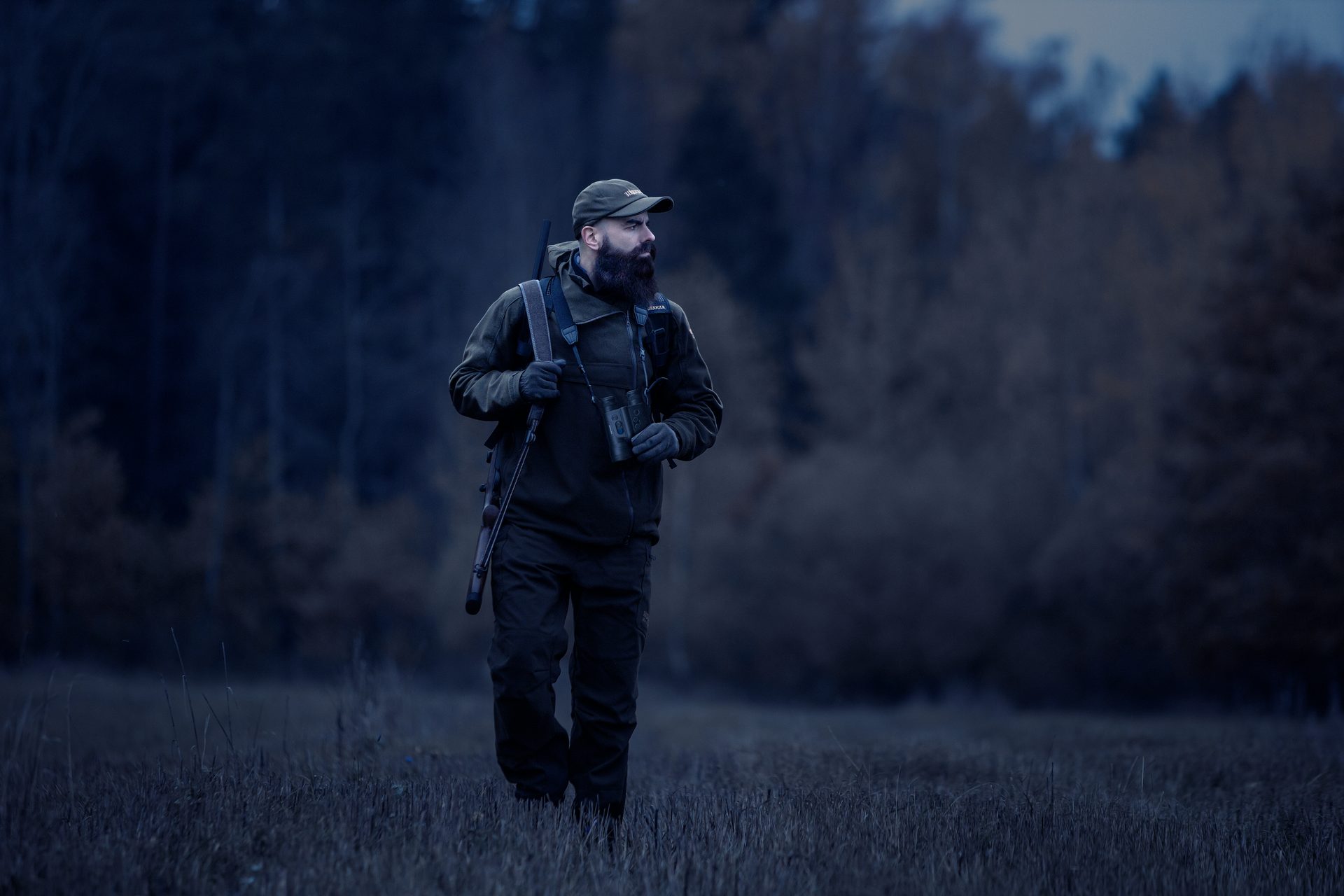
Safety and legal considerations with U.S. state examples
Night rules vary by state, land type, and—sometimes—county ordinance. The examples below are accurate at the time of writing, but you must verify current regulations before hunting.
- Florida (private land): Wild hogs on private property may be hunted year-round with landowner permission, including at night with a gun and a light. No hunting license is required on private land, but public WMAs have separate, stricter rules. Always check WMA brochures and county ordinances.
- Texas (private land): With landowner consent, you may hunt feral hogs on private property without a hunting license (2019 law change). Night hunts are common on private land; for public lands and special properties, additional permits and standard licenses may apply. Local discharge rules and county-level restrictions can exist near populated areas. However, as Patrick notes, hog hunting in Texas is very unique:
Night hog hunting in Texas is an entirely different ballgame. The heat keeps hog movement to a minimum before dark for most of the summer. Then at sundown they come streaming out of creek bottoms and mesquite thickets to devour everything in ag fields and feeders. Experience quickly teaches you that it’s not a chase, it’s about being in position where they want to be when they finally step out. Thermal optics lets you watch the entire transition in real time and make clean, efficient shots.
- Oklahoma (nuisance control): Landowners and their designated agents may take feral swine at night using spotlights, night vision, or thermal optics; notification or permitting may be required, depending on the season and overlap with deer gun season. Shooting from public roads and across property lines is illegal.
- Georgia (private land). There is no closed season and no bag limit for feral hogs on private land; night hunting with a light is allowed. On public lands, hog rules typically follow other season frameworks and may limit nighttime take and use of devices.
Mandatory legal disclaimer: Laws on night hunting and thermal/night-vision devices—including weapon-mounted thermal, night vision, IR illuminators, vehicle use, and suppressors—vary by state, property type, and even county/municipality. Always read the current state regulations and local ordinances, and obtain written permission from the landowner before hunting.
Why the caution matters: Feral swine create massive damage—U.S. losses and control costs are estimated in the billions annually, driving aggressive but tightly regulated control measures.
Read more: Night hunting laws
Expert upgrades most hunters miss
These small edges change outcomes for both new and experienced hunters.
- Noise-floor management: Test-walk your entry route in daylight wearing your exact night kit. Trim vegetation that snags. Wrap clanking buckles with tape. The quietest team wins.
- Glass the downwind tree line first: That’s where hogs feel safest; if it’s empty, your scent cone is likely clear for a short window.
- Hold selection: You really want to avoid hitting the shoulder, these pigs are built like tanks, you may not penetrate. You can hit the heart or lungs behind the shoulder, or make a headshot.
- Tripod height: Set the top of your tripod at a height that corresponds to your collarbone. You’ll stand taller over grass and reduce scope wobble from muscle tension.
- Digital zoom discipline: Stay at native or 2× for the shot; use PIP to zoom without losing FOV. Over-zooming hides movers and backstops.
- Thermal focus sweep: Rock your scope’s focus slightly before the shot; micro-focus changes snap hair-level detail and help separate pigs from the background.
- After-shot protocol. If a pig runs into cover, reload, mark, and listen. Count seconds to the crash; direction and distance help build your recovery plan.
- Team SOP: Pre-brief safety calls: “No backstop, hold,” “Fence line right,” “Cattle in field,” and “Cold gun.” You’ll shoot less but recover more.
Recommended Pulsar devices for U.S. hog hunting
Choose by role—each tool solves a different problem.
| Hunting situation / need | Recommended device type | Why it helps at night | Pulsar device example |
|---|---|---|---|
| Preseason scouting and checking feeders | Thermal monocular | Silent, discreet scanning without waving a rifle | Axion XQ19 Compact |
| Wide-area scanning and detailed sounder observation | Premium thermal monocular with LRF | Wide FOV helps cover fields and treelines efficiently, while HD thermal detail and ranging support closer evaluation of individual hogs before moving | TELOS LRF XT50 |
| Mapping nightly travel routes | Thermal binoculars | Wider FOV and comfortable glassing; LRF for precise ranges | Merger LRF XP35 |
| Precise shots in total darkness | Thermal riflescope | Crisp reticles, PIP, and ranging for ethical hits | Thermion 2 LRF XG60 / Thermion 2 LRF XL60 |
| Blood-trail and recovery | Handheld thermal (or scope) | Detects warm sign and heat signatures in cover | Axion XQ19 Compact |
Please note: the exact gear selection will depend a lot on your personal preferences – this is just a general recommendation. If you can, ask around what your local hunters prefer to use in different situations. For example, this is what Patrick uses:
A combination I’ve found works really well for hog hunting is a handheld thermal monocular and a rifle mounted thermal scope. The monocular is very convenient to use since it allows for constant scanning without fatigue or revealing movement, and once it’s time to shoot, the scope is there to provide you with a large, stable image. Quality thermal gear allows you to put all your focus into reading hog body language and making the shot, without fighting with your gear.
Read More:

FAQ
What’s the best time of night to hunt hogs?
First two hours after dark and the last 90 minutes before dawn. Those windows combine cool temperatures, lower pressure, and high contrast for thermal efficiency.
Is thermal better than night vision for hogs?
For detection, yes. Thermal sees heat without light and cuts through light fog, smoke, and some brush. Night vision can work at closer ranges with IR and bright moons, but is more limited for scanning big fields.
What caliber is best at night?
Use a rifle you shoot confidently with controlled-expansion bullets. Common choices: .223/5.56 with bonded/mono bullets, .300 BLK with sturdy expanding subs at close range, and .308 for authority across mixed distances. Don’t forget the latest 8.6 BLK, but consider the overkill factor if you’re trying to harvest the meat.
Can you legally hunt hogs at night?
Often on private land, yes—but it varies. Florida allows night hunts on private land; Texas allows private-land night hunts without a license (but with permission); Oklahoma and Georgia allow night/thermal under defined conditions. Always verify current rules where you hunt.
What are the safest techniques at night?
Keep muzzles down, verify backstops, use radios or hand signals, and don’t take shots through multiple animals. If you can’t positively identify what’s behind the target, hold fire.
Further reading:
About the experts

Co-Author:
Joshua Skovlund
Joshua Skovlund has covered stories for Task & Purpose, Outdoor Life, and Coffee or Die Magazine. He has photographed and filmed multinational military exercises and hunting trips in austere environments around the world, with his first archery kill in Kona, Hawaii.
Joshua grew up in South Dakota, learning how to scout and hunt deer, turkey, pheasant, and waterfowl. He currently scouts and hunts black bears, turkeys, and deer, while taking every opportunity to go to the range and further hone his pistol and rifle shooting skills.

Expert Contributor:
Patrick Long
Patrick Long is a lifelong hunter, writer, and outdoorsman who splits his time between chasing bears, bucks, and birds. He is the founder of the Omega Outdoors blog and the Editor-in-Chief of Crosshair Content Co. (C3), where he leads a team dedicated to producing expert-driven outdoor and firearms content.
Before purchasing any night or thermal vision device, please make sure you adhere to the local legislation and only use it when it is allowed. Our ambassadors come from various countries and travel a lot, which allows them to test different devices. We do not encourage or support the illegal use of our devices in any events. If you wish to learn more about export and sales restriction policy, please visit the following link: Export and Sales Restriction Policy.