
Expert Contributor:
Christian Rysgaard
Estimated read time: 8 min.
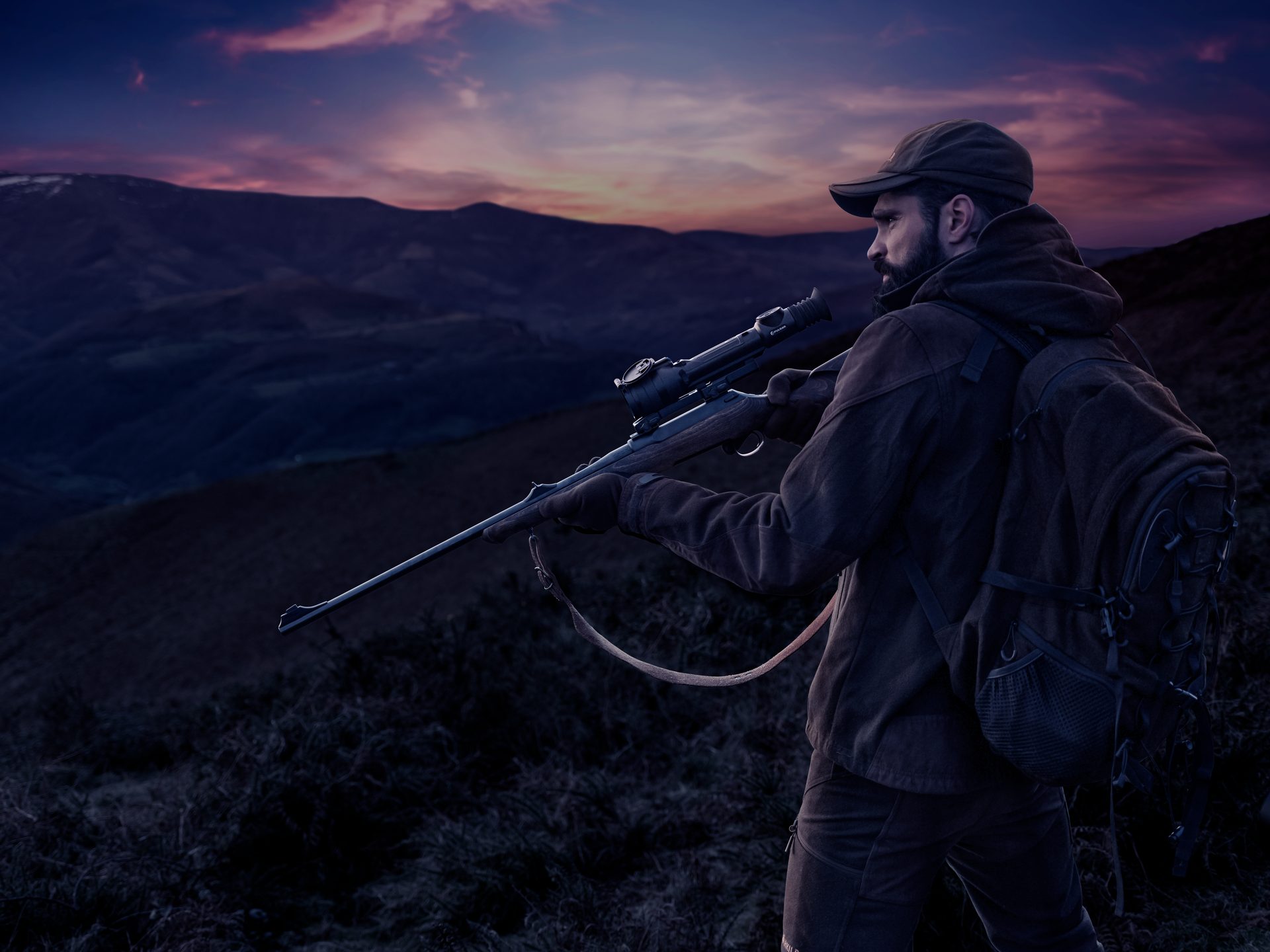
Night hunting for small game can be both rewarding and challenging. When daylight fades, visibility becomes your biggest obstacle — and that’s where the right gear makes all the difference. Whether you’re trying to spot a rabbit in tall grass or a fox moving along the treeline, thermal and night vision optics let you see what your eyes can’t.
In this guide, we’ll break down everything you need to know before heading out after dark — how thermal and night vision technologies work, what features matter most for small game hunting, and how to stay safe and legal. Drawing on Pulsar experts’ insights, you’ll get practical, field-tested advice to help you hunt more confidently and ethically at night.
Quick answer
To hunt small game at night safely and effectively, you’ll need gear that helps you see clearly in total darkness.
-
Start with a thermal monocular — such as the Pulsar Telos LRF XL50, Oryx LRF XG35, or Axion XQ19 compact — for scanning and detecting heat signatures even through grass or brush.
-
Pair it with a night vision or thermal riflescope like the Pulsar Thermion 2 LRF XG60 or Talion XG35 for precise aiming and accurate shot placement.
- Alternative option: The Pulsar Trail 3 LRF, the latest compact, rail-mounted thermal riflescope, suits planned small-game and predator setups where integrated rangefinding and repeatable shots from known distances matter.
Additional essentials:
-
Add an infrared illuminator to boost clarity for night vision optics.
-
Wear quiet, camouflage, scent-control clothing suited for cool nighttime temperatures.
-
Always confirm your local regulations.
-
Maintain positive target identification.
-
Practice ethical, controlled shooting within visible range.
The right combination of optics, lighting, and preparation turns darkness into a clear, confident, and responsible hunting environment.

What makes night hunting small game different from daylight hunts?
Night hunting turns familiar routines into a new discipline. In daylight, hunters rely on natural light, color contrast, and movement cues. After dark, these advantages vanish—sight lines shrink, shadows distort shapes, and tracking becomes far more challenging.
Success at night depends on technology and understanding nocturnal behavior. Thermal and night-vision optics, infrared illumination, and silent movement replace visual instincts. Hunters must also adapt their preparation—scouting routes in daylight, using GPS navigation, and managing battery life for electronic gear.
Every tool gains new weight in darkness. Optics become your eyes, infrared lighting ensures safe identification, and quiet, lightweight clothing helps maintain stealth. Ultimately, night hunting demands precision under constraint: interpreting limited visual data safely and ethically with specialized gear built for the dark.
Activity patterns of typical small game at night
Most small-game species become active once the sun sets. Rabbits, hares, and foxes leave their shelters to feed or patrol, taking advantage of cooler temperatures and reduced human presence. This heightened nocturnal activity creates more opportunities, but also demands faster reactions and sharper detection.
Moonlight, temperature, and wind all influence how these animals move. Bright nights make them cautious, while darker, overcast conditions encourage longer feeding. Hunters equipped with thermal or multispectral optics can detect subtle movement or heat signatures regardless of lighting or terrain.
Understanding these patterns helps hunters anticipate routes, minimize disturbance, and achieve precise, ethical shots even in total darkness.
Naturally, activity patterns vary by species, but certain examples might help you understand the whole concept better. So, we turn to Christian Rysgaard, a hunter with numerous experience, to share his observations of the red fox:
The red fox is a classic example of how small-game behaviour shifts after dark. At night, foxes emerge from cover to patrol fields and edges, hunting for rodents and rabbits. Their routes and boldness depend on moonlight and weather—on bright nights, they stick closer to cover, while on dark, overcast nights, they venture further into the open. For the night hunter, understanding these patterns is invaluable: setting up along travel corridors or near rabbit warrens increases your chances, and with thermal or night-vision optics, you can spot a fox’s subtle movement well before it’s visible to the naked eye.
Reading a fox’s behaviour through your thermal spotter also reveals how likely it is to respond to calling. A fox that moves slowly, pauses, and scans is often in hunting mode and receptive to a good call or mouse squeak. If it reacts by turning its head or cautiously approaching, your call has worked. Conversely, a fox moving with purpose or ignoring prey is less likely to respond. With practice, you’ll learn to interpret these cues, timing your calls for maximum effect and turning fleeting sightings into real opportunities.
Read more:
Key challenges: visibility, scent control, unpredictability
Night hunting introduces challenges that test both fieldcraft and technology. Darkness limits visibility, alters animal behavior, and amplifies scent—turning every movement or noise into a potential alert.
- Visibility limitations: Once natural light fades, judging distance or identifying species becomes difficult. Thermal and night-vision optics replace guesswork with clear imaging, revealing hidden heat sources and ensuring safe, ethical targeting.
- Scent control: Cool night air carries human scent farther. Hunters rely on odor-neutral clothing, sprays, and downwind positioning to remain undetected, paired with non-reflective, quiet gear to avoid visual or auditory cues.
- Unpredictable behavior: Nocturnal species move erratically and change routes often. Quick scanning and integrated rangefinding—as seen in Pulsar’s Merger LRF XT50—help track these shifts and maintain awareness even in fast-changing conditions.
Preparation, patience, and dependable equipment turn these obstacles into advantages, transforming uncertainty into confident precision.

Essential optics and vision tools for night small-game hunts
Hunting small game after dark demands optics that deliver fast detection, clear identification, and long-term comfort. Small targets like rabbits or foxes require precision tools that combine range, responsiveness, and image quality. The right mix of thermal and night-vision devices helps hunters operate safely and accurately in low-light conditions.
| Type of device | Primary function | Best for | Key advantages | Things to consider |
|---|---|---|---|---|
| Thermal monocular | Detecting heat signatures of animals in total darkness | Scanning wide areas and locating hidden small game (e.g., rabbits, hares) | Works in total darkness; detects animals through fog, brush, or tall grass | Lower-end models may offer limited detail — best combined with another optic |
| Thermal scope | Aiming and identifying targets based on body heat | Accurate shots at moving or partially concealed small game | Enables precise detection and targeting | Heavier and pricier than night vision scopes |
| Thermal clip-on scope | Converts a daytime riflescope into a thermal imaging system | Hunters who want versatility without changing optics | Quick to attach and detach; maintains rifle zero; dual-purpose setup | Slight image quality trade-off vs. dedicated thermal scopes |
| Night vision scope | Amplifies existing light (moonlight, starlight) for clearer visibility | Identifying small game in open or semi-lit environments | Natural-looking image, detailed view of surroundings | Requires ambient light or an IR illuminator |
| IR illuminator | Provides invisible infrared light for night vision optics | Extending range and clarity of night vision scopes | Improves brightness and contrast for Gen 2/3 devices | Not compatible with thermal and sometimes multispectral optics |
| Binoculars or spotters | Observing terrain and tracking movement from a distance | Scouting and identifying small game before approach | Wide field of view, comfortable for prolonged observation | Not suitable for aiming or direct engagement |
| Multispectral device | Combines thermal and digital vision imaging | Hunters who need both heat detection and optical detail | Offers the best of both technologies in one unit | More complex interface, higher cost, and increased power use |
When to choose a thermal imaging scope vs night vision scope
Choosing between thermal imaging and night vision depends on your hunting conditions and goals. Each technology offers unique advantages and combining both can deliver unmatched precision for small game. Here’s what Christian advises:
Pairing a thermal spotter with an infrared riflescope is, in my expert view, the most effective and responsible approach for night hunting and pest control. The thermal spotter excels at rapid detection of heat signatures in darkness or dense cover, allowing me to scan large areas efficiently and spot game or pests that would otherwise go unnoticed. Once detected, I transition to the IR scope, which provides the clarity needed for positive species and sex identification before taking the shot, ensuring both accuracy and ethical hunting.
This combination is also an excellent starting point for hunters who are new to interpreting thermal signatures. The infrared scope allows much of the game identification and sex assessment to rely on familiar visual cues, while the thermal spotter handles detection. Over time, as hunters gain experience, they can extract more information from thermal images alone, but beginning with this setup makes the learning curve much smoother. Ultimately, this workflow maximizes success rates, upholds high ethical standards, and leverages the best available technology for humane and effective wildlife management.
Thermal imaging scopes detect heat signatures, making them ideal for total darkness, fog, or dense vegetation. They expose even the smallest animals through cover and remain effective regardless of light conditions.
- Best for: low or no light, cloudy nights, wooded terrain.
- Example: Pulsar Thermion 2 LRF XG60 – long-range thermal precision for small game hunting.
Night vision scopes amplify available light, producing a natural, high-contrast image that helps identify species and details like fur color or movement.
- Best for: open fields or semi-lit nights.
Many hunters, like Christian, use both—a thermal monocular for quick scanning and a night-vision riflescope for accurate aiming. This hybrid approach combines speed, clarity, and ethical shot placement in any lighting scenario.
Read more: Thermal vs night vision: which to choose?
Mounting & eye-relief considerations for small game hunting
Proper mounting and eye relief ensure comfort, accuracy, and consistent performance in night hunting. Even the most advanced optic underperforms if it’s not correctly positioned on your firearm.
Christian’s tip:
Mounting a scope correctly is just as important as choosing the right optic. Prioritize generous eye relief—ideally 65 mm or more for heavy-recoiling rifles—to ensure both safety and comfort. The scope should be mounted so that, when you shoulder the rifle naturally with your eyes closed, you open your eyes to a full, clear sight picture without needing to adjust your head position. Because scope mounts have a fixed height, achieving a natural line of sight often requires attention to your rifle stock. I strongly recommend using a stock with an adjustable comb or adding an aftermarket cheek riser if your line of sight sits too high above the bore. Even a simple slip-on riser can make a world of difference, ensuring your cheek weld is repeatable and comfortable. Ultimately, a well-mounted scope should feel like an extension of your eye—every time you mount the rifle, your sight picture should fall into place automatically.
If local laws allow, I always recommend adding a silencer to your rifle setup. While eye relief is determined by the scope model you select and cannot be adjusted after the fact, a quality silencer does absolute wonders for your shooting experience. By significantly reducing recoil and muzzle blast, a silencer not only makes shooting more comfortable but also helps you maintain a consistent shooting position and sight picture—especially important when using high-magnification optics. The reduction in recoil provided by a silencer allows you to focus on your target and follow-through without flinching or anticipating the shot, which ultimately leads to better accuracy and less shooter fatigue. In my experience, combining proper eye relief with a good silencer results in a setup that is both safe and highly effective, letting you get the most out of your optics and your rifle.
A low or medium mounting profile maintains balance and a natural cheek weld, essential for lightweight rifles or shotguns. Secure zeroing is critical—especially with high-resolution optics like the Pulsar Thermion 2 LRF XG60, where even small shifts can affect precision on smaller targets.
Maintain an eye relief of 50–70 mm for quick target acquisition and safety. Wide-eye-box designs, such as in the Pulsar Thermion 2 LRF 60 line, allow easy alignment in low light and reduce fatigue during long sessions.
For versatility, quick-detach mounts or clip-on devices like the Pulsar Krypton 2 FXG50 enable instant transitions between day and night setups without re-zeroing.
A stable, ergonomic configuration keeps your optic aligned, comfortable, and ready for every shot in darkness.
Integration with your rifle/shotgun platform
Matching your optic to the firearm matters more at night—small targets and low visibility leave no margin for error. Choose gear that preserves balance, maintains zero, and supports quick, repeatable shots.
Fit and compatibility
Confirm rail type (Picatinny/Weaver) and clearance for your chosen scope or clip-on. Lightweight rifles benefit from compact scopes (e.g., Talion XG35); heavier precision builds pair better with Thermion-class optics.
Zeroing and retention
Zero your setup in realistic field conditions (same mounts, same ammo). Use one-shot zero or digital reticle adjustments when available, and recheck after installing or removing quick-detach mounts or clip-ons.
Recoil and durability
Optics with robust housings and recoil-rated mounts keep point-of-impact stable. Magnesium or high-grade alloy bodies reduce weight while resisting vibration that can shift zero on repeated shots.
Some hunters prefer a compact, rail-mounted thermal riflescope with a monoblock design for maximum structural rigidity. Pulsar’s Trail 3 LRF, the latest addition to the lineup, follows this approach to support reliable zero retention and long-term durability on night-hunting setups.
Ergonomics and balance
Keep the center of mass close to the action—too front-heavy hampers tracking. Short eye relief or awkward head posture slows target acquisition; choose mounts and scopes that preserve a natural cheek weld.
Practical add-ons
A low-profile bipod or shooting stick helps steadiness for small targets; integrated rangefinders speed ethical decision-making. If using suppressors, confirm that throat/POI shift is tested and compensated for.
Right integration turns separate components into a single, reliable system—fast to aim, repeatable under pressure, and accurate when it counts.
Pulsar thermal devices for small game night hunting
Small-game hunting at night requires precision, speed, and dependable detection. Pulsar’s thermal optics combine advanced sensors, fast image processing, and ergonomic design to deliver clear, confident viewing in total darkness. Whether scanning fields or tracking movement, Pulsar turns the night into a clear, actionable view.
| Model | Sensor resolution | Detection range | Night-hunting role & ideal use case | Distinct advantage in low-light conditions |
|---|---|---|---|---|
| Telos LRF XL50 (Monocular) | 1024×768 @ 12 µm (<20 mK sNETD), 2.5–20× magnification | ~2,300 m | Long-range day and night observation tool for scanning large open areas and detecting faint heat traces at distance. | Ultra-sharp HD thermal detail even through darkness, fog, or brush. |
| Oryx LRF XG35 (Monocular) | 640×480 @ 12 µm (<20 mK sNETD), 2.5–20× magnification | Up to 1,800 m | Compact fast-scanning thermal spotter for mobile stalks and dense cover. | Lightweight one-hand control with integrated laser rangefinder for quick reacquisition. |
| Merger LRF XT50 (Binocular) | 1280×1024 @ 12 µm (<20 mK sNETD), 2–16× magnification | Up to 2,300 m | Thermal binoculars for long observation sessions in forests, fields, and uneven terrain. | Dual-eyepiece comfort and stable depth perception in complete darkness. |
| Thermion 2 LRF XG60 (Riflescope) | 640×480 @ 12 µm (<20 mK sNETD), 4–32× magnification | ~2,800 m | Precision thermal riflescope for long-range predator and small-game hunting. | Integrated laser rangefinder and ballistic calculator for pinpoint night accuracy. |
| Talion XG35 (Riflescope) | 640×480 @ 12 µm (<20 mK sNETD), 2–16× magnification | ~1,750 m | Lightweight scope for mobile hunters and mid-range night shots. | Wide 12.5° FOV enables fast acquisition in mist or rain. |
| Trail 3 LRF XQ50 | 384×288 @ 17 µm (<15 mK sNETD), 3.5–14× magnification | ~1,800 m | Rail-mounted riflescope for structured predator control from known distances. | Monoblock design with LRF and ballistic support for repeatable zero. |
| Trail 3 LRF XR50 | 640×480 @ 12 µm (<18 mK sNETD), 3–24× magnification | ~2,300 m | Extended-range riflescope for open terrain and long-distance shots. | Higher resolution sensor for improved ID at distance. |
| Krypton 2 FXG50 (Clip-on) | 640×480 @ 12 µm (<20 mK sNETD), fixed 3× | ~2,300 m | Clip-on thermal for day/night flexibility without re-zeroing. | Adds thermal detection while preserving existing daytime optics. |
| Merger DUO NXP50 (Multispectral) | Thermal 640×480 + Digital 1920×1200 CMOS | ~1,800 m (thermal) | Multispectral detection and identification in mixed or changing light. | Combines thermal detection with Full-HD digital night vision. |
Explore more:
Pulsar’s thermal lineup gives small-game hunters versatility and precision across any environment. From quick handheld scans to long-range shots, these devices ensure fast target acquisition, reduced eye fatigue, and consistent accuracy in complete darkness.
How to choose optics for night hunting small animals
Selecting the right optics for small-game hunting means balancing detection range, clarity, and handling. Because rabbits and foxes move quickly and unpredictably, your gear must deliver sharp detail and fast response in low light.
Thermal imaging detects heat through cover and complete darkness, while night vision amplifies existing light for natural-looking images. Many hunters pair both—a thermal monocular for scanning and a riflescope for accurate identification and aiming.
When comparing devices, focus on what matters most:
- Sensor resolution: At least 384×288 for thermal or Full HD for digital NV.
- Field of view: Wider views make it easier to track moving animals.
- Refresh rate: 50 Hz or higher for smooth motion.
- Battery life & durability: Reliable performance in cold or wet conditions.
- Ergonomics: Lightweight, silent controls that support quick repositioning.
A well-chosen optic enhances detection, identification, and ethical precision—turning every night hunt into a controlled, confident experience. Particular priorities will, of course, depend on the hunter, but if you’re looking for an expert advise, here’s how Christian approaches choosing the right optics:
In my experience, the most important features for night hunting optics are those that directly support fast, confident decision-making in the field. For small game like rabbits and foxes, you need gear that not only detects heat or movement but also delivers enough detail for reliable identification—often in a split second. The thermal spotter is the workhorse for initial detection and assessment: this is where you scan, locate, and make your first judgment about the animal, often determining not just presence, but also species, gender, and whether the opportunity is worth pursuing. The riflescope, in this workflow, becomes a secondary tool—only coming into play once you’ve already established that the right game is present, at the right distance, and you’re ready to take the shot. This approach sets the tone for quick and easy target acquisition, minimizing unnecessary movement and maximizing efficiency.
For hunters using calibers where ballistics can be a challenge, accurate range estimation is critical. I strongly recommend choosing a scope with an integrated laser rangefinder or, at the very least, one that allows you to quickly and easily match the distance you’ve obtained from your thermal spotter. High sensor resolution is essential, but it’s the combination of a wide field of view and a fast refresh rate that truly makes a difference when tracking unpredictable targets. Equally critical are ergonomics and durability—lightweight devices with intuitive, silent controls allow you to reposition quickly and stay focused on the hunt, while reliable battery life and weather resistance ensure your optic performs through cold, wet, and long nights. Ultimately, the right combination of thermal spotter and riflescope streamlines the entire process, making night hunting both more effective and more enjoyable.
Explore more:

Lighting, camouflage & clothing setup for darkness
Visibility and concealment define success in night hunting. The right lighting tools and clothing help you see clearly without being seen, balancing awareness with stealth.
Lighting
Use red or green filters instead of white light—they preserve night vision and reduce the chance of spooking animals. Pair a tactical headlamp or IR illuminator with your Pulsar night-vision device for hands-free use and extended range. Always carry spare batteries or an external power source in cold weather.
Camouflage
At night, focus less on pattern and more on texture, silence, and scent control. Matte, non-reflective fabrics and odor-neutral sprays help you blend in and move quietly.
Clothing
Layer for temperature shifts—thermal underlayers for warmth, breathable outer shells for movement, and waterproof boots for silent traction. Gloves and face coverings reduce light reflection and human scent.
In darkness, the right gear lets you remain invisible while maintaining full control of what you see.
Additional tips for staying concealed and comfortable – from our expert Christian:
In my experience, staying at the right temperature is far more challenging than remaining concealed during long night hunts. Matching your clothing to both the type of hunt and the shifting temperatures over several hours is always a balancing act. When I’m sitting quietly and waiting for game, I have to force myself to bring much warmer clothes than I’d ever think necessary—overalls that truly trap body heat are essential, and for the coldest nights, I’ll even consider electric underwear to keep my core warm. It’s easy to underestimate how quickly the cold can sap your focus and patience when you’re stationary for long periods.
For stalking at night, my approach changes completely. I dress relatively light to avoid overheating, but I always carry a rucksack with extra layers. If my movements slow down or I need to pause for extended periods, I can quickly add insulation to stay comfortable. The key is to anticipate how your activity level will change and to be prepared for both exertion and inactivity—because nothing ends a night hunt faster than getting too cold to concentrate.
Firearm, ammunition and accessory gear for small game at night
At night, accuracy and control matter more than power. Choose a lightweight, maneuverable firearm that lets you acquire small, fast targets quickly. Typical choices are .22 LR, .17 HMR or lightweight .223 rifles, or shotguns with tight chokes for close work. Shorter barrels improve handling in dense cover; consider a sound moderator where legal to reduce disturbance.
Use accurate, purpose-built loads to minimize wounding and pelt damage. Rimfire precision loads are economical and effective. Subsonic rounds with a suppressor cut noise and maintain accuracy. Aim only within ranges you can positively ID—75–100 m is a practical ethical limit for most small-game night setups.
Essential accessories (compact & purpose-driven):
- Rangefinder — confirm distance before every shot.
- Stable support (bipod/shooting stick) — steady small-target shots.
- Hearing protection — electronic muffs preserve situational awareness.
- Weapon-mounted IR / thermal illuminator or compatible mounts — pair with your optic for clearer IDs.
- Spare batteries / external power bank — electronics fail fast in cold.
Prioritize safe backstops, confirm species and distance, and re-check zero after any mount or suppressor changes—ethical night hunting depends on disciplined setup and repeatable accuracy.
For additional guidance on firearm safety and ethical hunting practices, review the International Hunter Education Association’s safety principles.
Safety, navigation and legal essentials before you head out
Night hunting adds complexity to every decision. Limited visibility, orientation challenges, and regional regulations mean preparation is as critical as equipment.
Safety and awareness
Always carry reliable lighting, a GPS or mapping app, and a backup power source. Use red-light mode to preserve night vision and signal safely. Stay connected with your hunting partner through two-way radios or pre-agreed light signals, and always know your backstop before taking a shot.
Navigation
Scout the area in daylight to mark access routes, feeding zones, and safe shooting lanes. Rely on offline maps or a compass if electronics fail, and move slowly to minimize noise and maintain awareness.
Legal considerations
Regulations differ across regions. Always verify:
- Whether night hunting is allowed for your target species.
- Which optics and illuminators are permitted.
- Caliber limits and season dates for nocturnal game.
- Any required permits, insurance, or training.
Always confirm your local regulations before heading out. In the U.S., guidance from the U.S. Fish & Wildlife Service on hunting laws and your state’s wildlife agency provide up-to-date details on seasons, permits, and night-hunting rules. For European regulations, visit the European Federation for Hunting and Conservation (FACE).
Compliance ensures ethical hunting and protects access for future generations. Respect the land, wildlife, and fellow hunters—responsibility defines the difference between a good hunt and a great one.
Read more: Night hunting laws: Legal and ethical use of thermal devices
Conclusion
Night hunting for small game is a discipline that rewards preparation, awareness, and respect for nature. Success at night doesn’t depend on luck — it’s built on precision, patience, and trust in your equipment.
The right combination of thermal and night-vision optics turns darkness into opportunity, helping hunters detect, identify, and act responsibly. Whether scanning fields with a compact monocular or tracking fast movement through a riflescope, your gear should extend your senses — not replace them.
Pulsar’s advanced thermal and multispectral devices are made for this balance: technology that enhances your skill while keeping safety and ethics at the center of every decision.
When you know your tools, your terrain, and your targets, the night stops being a challenge — it becomes part of the hunt itself.
Ready to see the night differently?
Explore Pulsar devices to discover how the right technology turns night hunting into a precise, ethical, and rewarding pursuit.
FAQ
What gear do I need for night hunting small game?
Start with reliable thermal or night vision optics, a steady rifle setup, and essential support gear—such as an IR illuminator, rangefinder, and scent-control clothing. Lightweight, quiet materials and compact optics make a big difference when moving through dense terrain at night.
Do I need a thermal scope or just a flashlight for night hunting small game?
A flashlight helps with navigation but won’t provide enough range or detail for accurate target identification. A thermal or night vision scope offers heat-based detection and image clarity, letting you spot and identify animals even in total darkness.
How do I choose camouflage clothing for night hunting rabbits and foxes?
Focus on texture, sound, and scent rather than color. Matte, non-reflective fabrics and odor-neutral layers keep you hidden. Darker or earth-toned patterns work best under low light, especially when paired with quiet footwear and gloves.
Is it legal to hunt small game at night in Europe and the USA?
Regulations vary by country and state. Some regions allow night hunting with thermal or night vision devices; others limit light-assisted methods. Always confirm local wildlife and firearm laws before heading out, and obtain the required permits or licenses.
What lighting color is best for not spooking small game when hunting at night?
Red or green light is ideal—they preserve your night vision and are less likely to startle animals. Use them sparingly and aim beams away from the animal’s direct line of sight until ready to identify or engage.
How far can I ethically shoot small game at night with a thermal or night-vision scope?
For accuracy and safety, keep your range within 75–150 meters, depending on your optic’s clarity and your shooting skill. Always verify your target and backdrop before taking a shot—ethical hunting comes before distance.
Further reading:
About Expert

Expert Contributor:
Christian Rysgaard
Christian Rysgaard brings a lifetime of hunting experience, holding certifications as both a rifle and shotgun instructor, along with a long-standing passion for archery, ballistics, and night optics.
As a hunting journalist with a strong engineering background, he delivers technical articles and in-depth gear reviews for the European hunting market.
Before purchasing any night or thermal vision device, please make sure you adhere to the local legislation and only use it when it is allowed. Our ambassadors come from various countries and travel a lot, which allows them to test different devices. We do not encourage or support the illegal use of our devices in any events. If you wish to learn more about export and sales restriction policy, please visit the following link: Export and Sales Restriction Policy.