
Expert Contributor:
Patrick Long
Estimated read time: 10 min.
Want to know how to hunt bobcats at night and actually succeed? You’re in the right place. Night hunting for bobcats is one of the most thrilling challenges for any hunter. In the dark, every move counts — your thermal scope, calls, and patience decide the outcome.
In this guide, I and other Pulsar experts share our best tips, gear recommendations, and proven strategies for hunting bobcats at night. Keep reading to learn how to spot, call, and take your shot with confidence — and turn every hunt into an unforgettable adventure.
Quick answer:
Bobcats are most active between 10 PM and 3 AM, making night the most effective time to target them. To hunt bobcats successfully after dark, you need:
- Thermal optics specifically for bobcat detection — devices like the Pulsar Thermion 2 LRF XG60 or Telos XG50 are designed to spot the subtle heat signatures of bobcats in total darkness, even when they move silently through thick brush.
- Distress calls (rabbit, rodent, bird) placed 30–50 yards away help lure in cautious bobcats without exposing your position.
- Longer set times — bobcats are slow, stealthy, and may take 30–45 minutes to respond.
- Flat-shooting rifles like .223 Remington for precise, ethical shots.
- Full legal compliance — check your state’s regulations on night hunting permits, optics, and allowed weapon types.
Top tip: Bobcats often circle downwind — set up with wind advantage and consider adding a visual decoy near your call.
A note from Patrick Long, a lifelong hunter, writer, and outdoorsman:
They are active during these times sure, but I would say they are most active during dawn and dusk (being crepuscular). I have seen plenty of bobcats during the day.
Thermal = Help: Unlike coyotes or hogs, bobcats blend into cover — thermal imaging is very helpful for detecting their small, low-profile heat signatures.
Always confirm your target — bobcats share habitat with other predators and non-target animals.

Why hunt bobcats at night?
Bobcats (Lynx rufus) are stealthy, often nocturnal predators. When the sun dips below the horizon, they slip into motion — working fencerows, ridgelines, and creek bottoms in search of rabbits, rodents, and quail.
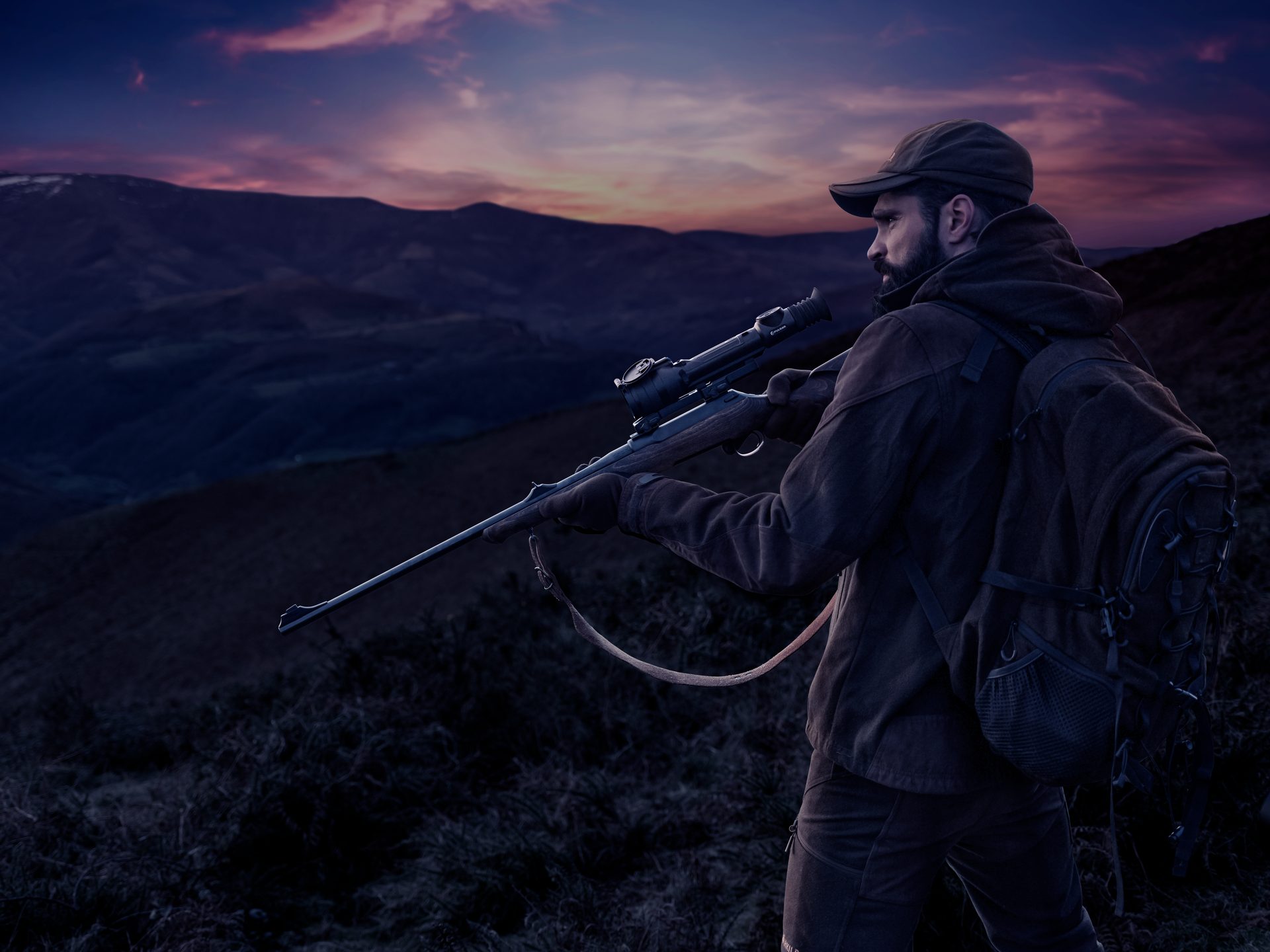
Hunting at night aligns your timing with their natural rhythm — when bobcats are most active and easiest to locate. Modern thermal optics make this possible, allowing hunters to observe and identify movement long before the naked eye could.
People outside the hunting community often ask why bobcats are hunted at all — but the answer lies in ecological balance.
In areas with high predator density, unchecked bobcat populations can place pressure on:
- Game birds and upland nests
- Young fawns and small mammals
- Livestock and poultry operations
Regulated hunting helps maintain this balance, while also funding wildlife conservation through license sales and habitat restoration programs.
For hunters, pursuing bobcats at night isn’t about trophies — it’s about the challenge.
Their caution, silence, and intelligence make every encounter hard-earned.
With modern thermal gear and a commitment to ethical shot placement, night bobcat hunting becomes more than a pursuit — it becomes a lesson in patience, skill, and stewardship.
Patrick adds:
Bobcats are very methodical during the daylight hours. They are slow and deliberate, sitting and scanning one area for minutes before moving to another spot. This makes them almost impossible to see, even when they are quite close. Things change at night though; they are moving around much more. This gives the thermal optics hunter a huge advantage. The slow, methodical target that was difficult to spot by day is now a realistic opportunity with a thermal device.
Legal considerations and regulations
Night hunting laws for bobcats vary widely between states. In some regions, night hunting is restricted or only allowed with specific permits. Before heading out, verify the following through your state’s wildlife agency:
- Legal shooting hours: Some states allow only until midnight or prohibit night hunting entirely.
- Permits and licensing: You may need both a furbearer license and a separate night-hunting permit.
- Weapon and light restrictions: Many states regulate artificial light use and limit calibers for predator hunting.
When in doubt, call your local game warden or check your state’s Department of Natural Resources website. Legal compliance isn’t just about avoiding fines — it’s about maintaining your ability to hunt and protecting your reputation as a responsible hunter.
Essential gear for nighttime bobcat hunting
Thermal and night-vision technology has reshaped how hunters approach any hunt during the night. The right setup can mean the difference between success and frustration. Here’s what you need to consider:
Thermal and night vision optics
Pulsar’s Thermion 2 LRF XP60 and Talion XQ35 Pro provide rifle-mounted thermal options for medium- to long-range observation and shooting where legally permitted. For handheld scanning, the Oryx LRF XG35 offers a compact, mobile option, while the Telos XG50 provides higher base magnification for observing smaller targets at greater distances. At the top of the Telos lineup, the new TELOS LRF XT50 adds a premium option for hunters who prioritize wide-area scanning, HD image detail, and integrated ranging.
Night vision amplifies existing light but requires moonlight or IR illumination. It’s useful in semi-lit areas but less effective in total darkness. That’s why our expert Patrick goes for thermal. Here’s his go-to combo:
I like running the Telos XG50 with the Thermion 2 LRF XP60 when I’m hunting bobcats at night. You spend a lot more time scanning than shooting, and the Telos makes that easy since it’s compact, fast to bring up, and has a great detection range for spotting subtle movement in the brush. Once it’s time to make the shot, the Thermion 2 really shines. Its image detail and built-in rangefinder make target ID and precise shot placement easy, even on small predators that don’t sit still for long.
Comparison: Thermal vs. night vision for bobcat hunting
| Feature | Thermal imaging | Night vision |
|---|---|---|
| Detection range | Up to 2,000 m (ideal for spotting movement at distance) | 100–400 m (depends on ambient light) |
| Performance in total darkness | Excellent — works with zero light | Limited — needs moonlight or IR |
| Target identification | Clear heat contrast even in brush | Sharp detail in partial light, but less reliable in dense cover |
| Weather resistance | Works in fog, dust, or smoke (but image quality might drop) | Performance drops in poor visibility |
| Cost | Higher initial investment | More affordable entry-level |
| Best use case | Scouting and ethical shooting in pitch black | Semi-lit or open terrain with some moonlight |
Summary: Thermal is the go-to for serious predator hunters who operate in deep darkness. Night vision remains a solid backup for legal areas with light restrictions or budget-conscious setups.
Dive deeper: Thermal vs night vision
Predator calls
Electronic calls can mimic the distress cries of prey or the yips of other bobcats. Mouth calls still have their place — they’re lightweight, reliable, and less prone to spooking shy predators (as long as you are good at using them, notes Patrick).
Lights
Use a red or infrared light to scan before raising your weapon. Red preserves your night vision and is less likely to alarm a bobcat; IR works invisibly.
Firearms
A .223 Remington or .22-250 rifle is ideal — flat-shooting and precise. Shotguns with #4 buckshot can work well in tight cover, but aren’t great for preserving pelts. Always identify your target beyond doubt before taking the shot — bobcats share habitat with several non-target species. The last thing you want is to kill the wrong species and lose your rights to hunt.

Comparison table: Thermal optics for bobcat hunting at night
| Category / use case | Thermal riflescope | Thermal monocular | Thermal binoculars | Night vision devices |
|---|---|---|---|---|
| Primary function | Precision aiming and ethical shooting | Quick handheld scanning | Wide FOV for long observation | Low-light amplification |
| Detection range | Up to ~2,000 m | Usually up to 1,800 m | Can exceed 2,000 m | Limited; needs moonlight |
| Performance in darkness | Excellent | Excellent | Excellent | Limited; relies on available light |
| Accuracy & identification | Highest | Excellent | Excellent | Lower |
| Mobility / weight | Medium | Very light to medium | Medium to heavy | Light |
| Best use case | Rifle-mounted precision | Scanning ridges & brush | Monitoring |
Explore more:
Now, you’ll need to know what thermal device works best for your hunting experience level and budget.
Best Pulsar devices for bobcat hunting at night
| Device | Type | Key strengths for bobcat hunting | Detection range | Best use case |
|---|---|---|---|---|
| TELOS LRF XT50 | Premium thermal monocular with LRF | 1280×1024 HD imaging, wide 17.5° FOV and integrated 1200 m LRF for detailed observation and ranging | 2,300 m | Premium wide-area scanning across field edges, treelines and mixed terrain |
| Telos XG50 | Thermal monocular | Higher base magnification, long detection range and strong battery performance | 2,300 m | Observing smaller targets at greater distances and long scanning sessions |
| Oryx LRF XG35 | Thermal monocular with LRF | Compact, lightweight design with integrated ranging and practical FOV | 1,800 m | Mobile scanning along ridgelines and brushy creek beds |
| Pulsar Talion XQ35 Pro | Thermal riflescope | Reliable startup and crisp image at short to medium range | 1,350 m | Shots at bobcats responding to calls where thermal riflescopes are legally permitted |
| Pulsar Thermion 2 LRF XP60 | Thermal riflescope with LRF | High thermal sensitivity, traditional scope ergonomics and integrated ranging | 2,000 m | Observation and precise shooting in difficult thermal conditions where legally permitted |
Each of these devices provides clear thermal contrast, helping you distinguish a bobcat from background clutter or similar-sized animals. The Thermion Duo DXP55 combines thermal and digital day optics, allowing seamless transitions between scanning and aiming.
Patrick shares a bit more about why he prefers the Telos XG50:
I like the Telos XG50 because it is a fairly small and lightweight thermal monocular that is made for all-nighters in the field. With a 2,300-meter range and great battery life, it’s great for long sets or glassing over big pastures. The operation is very ergonomic, and the image is crisp enough to discern fine detail, even through heavy cover. It’s my go-to for bobcat hunting and glassing for that split second after detection before I transition to my scope for the shot.
Explore more:
Understanding bobcat behavior at night
Bobcats are solitary and territorial. At night, they patrol the same travel routes along edges, game trails, and creek bottoms where prey concentrates.
Movement patterns: They often start hunting shortly after dusk, with peak movement between 10 PM and 3 AM.
Preferred habitat: Transitional zones — where thick cover meets open ground — are ideal ambush sites.
Signs of presence: Look for tracks with retractable claws, fresh scat, or feather piles from small kills. Thermal gear makes spotting subtle movement in these zones far easier.
Bobcat activity chart: nocturnal movement by hour
| Time | Activity level | Behavior |
|---|---|---|
| 6–9 PM | Moderate | Emerging from dens, beginning to patrol hunting areas. |
| 9 PM–12 AM | High | Actively hunting along field edges and creek bottoms. |
| 12–3 AM | Peak | Maximum movement, most responsive to calls. |
| 3–5 AM | Declining | Returning to cover, resting before dawn. |
| Daylight Hours | Moderate | Likely still hunting, but harder to spot. |
Field tip: For the best results, plan stands between 9 PM and 2 AM — the sweet spot when most bobcats are on the prowl and responding to sound.
Proven tactics for night bobcat hunting
Calling techniques
Bobcats respond well to prey distress calls like cottontail or rodent squeals. Start at moderate volume, then increase slowly. They approach quietly, and you likely won’t hear them—patience is key. Electronic calls let you place sound sources 30–50 yards away, drawing attention off your location.
Stand placement
Choose high ground or a wind-crossing setup, which allows you to intercept the bobcat as it attempts to circle downwind—they commonly circle downwind before committing. Always have a clear, safe backstop in your line of fire—even when shooting at heat signatures.
Decoys and sound placement
Visual decoys like fluttering feathers or motion-activated tails can seal the deal when paired with calls. Place them within visible range of your thermal scope for quick identification.
Patience and set duration
A single stand may take 30–45 minutes before a bobcat commits. Remain still — they often appear silently and vanish just as fast. Speaking of patience, Patrick recalls his most recent encounter:
On my last hunt, I picked out a bobcat on the treeline. It was a bobcat just sitting there looking at the field. It sat still for several minutes without moving or making a sound just watching the open area like they do. It started creeping along the edge of the field. I watched it until it sat broadside and that is when I made my shot.

Safety, ethics, and best practices
Night hunting demands heightened awareness. Visibility is limited, and depth perception suffers under artificial or thermal vision.
- Identify before you shoot: Ensure your target is a bobcat, not a domestic cat, fox, or coyote. Thermal clarity helps, but double-check shape and movement. Do your research before heading out on a hunt.
- Safe angles: Don’t take shots toward skylines or unknown backdrops. You must be sure that your bullet will impact in a safe direction, not your neighbor’s dog.
- Conservation: Responsible predator hunting supports balanced ecosystems, healthy prey populations, and livestock.
- Ethics: Aim for high-percentage lethal shots — broadside or frontal chest — to ensure clean, humane kills.
Every ethical shot reinforces the credibility of hunters in the eyes of non-hunters and regulators alike.
Additional note from Patrick:
Bobcats are tough to hunt, but that’s no excuse for slacking off on the basics of hunter safety. Every setup deserves the same respect and discipline as any other hunt, knowing your target, what’s beyond it, taking only clean, confident shots. For me, hunting bobcat ethically also means respecting the animal and the challenge it represents. It’s not just about making a kill, but making the right kill safely and responsibly, every time.
Conclusion
Hunting bobcats at night isn’t just about having the right gear — it’s about understanding their elusive behavior, respecting the laws, and maintaining ethical hunting practices. These stealthy predators demand patience, observation, and a slower rhythm than other game.
With advanced thermal optics ranging from the new flagship TELOS LRF XT50 and field-proven Telos XG50 handheld monoculars to Pulsar Thermion 2 LRF riflescopes, hunters can detect and observe subtle heat signatures in complete darkness before transitioning to a shooting optic where legally permitted.
- Know their peak movement hours (10 PM–3 AM)
- Use smart calling tactics and visual decoys
- Always identify your target with confidence
- Follow legal regulations to preserve hunting access
When done right, night hunting bobcats becomes more than a pursuit — it becomes a masterclass in patience, precision, and predator management.
Explore our Pulsar thermal optics to upgrade your night-hunting setup with gear trusted by field professionals worldwide.
Frequently asked questions
Can you use thermal imaging to hunt bobcats?
Yes, in most regions where night hunting is legal. Thermal optics like the Pulsar Telos XG50 let you detect bobcats’ heat signatures clearly, even in complete darkness.
How to attract bobcats at night?
Use prey distress calls (rabbit, mouse, or bird sounds) placed away from your position. Combine them with decoys for added realism.
What are the best tools for identifying bobcats at night?
Thermal monoculars such as the TELOS LRF XT50 and Telos XG50 help hunters detect and observe bobcats before transitioning to a shooting optic, while binoculars such as the Merger LRF XP50 provide comfortable two-eye observation during longer scanning sessions. The XT50 prioritizes wide-area scanning, HD image detail and integrated ranging, while the XG50 offers higher base magnification for observing smaller targets at greater distances.
What time of night are bobcats most active?
Typically, movement occurs between 10 PM and 3 AM, though it depends on temperature and prey activity.
Is hunting bobcats at night ethical?
Yes, when conducted legally. Clear target identification and humane shot placement make night hunting bobcats a vital role in predator management.
What is the best time to hunt bobcats?
Late winter and early spring, when fur quality peaks and breeding makes them more responsive to calls.
Further Reading:
About the experts

Co-Author:
Joshua Skovlund
Joshua Skovlund has covered stories for Task & Purpose, Outdoor Life, and Coffee or Die Magazine. He has photographed and filmed multinational military exercises and hunting trips in austere environments around the world, with his first archery kill in Kona, Hawaii.
Joshua grew up in South Dakota, learning how to scout and hunt deer, turkey, pheasant, and waterfowl. He currently scouts and hunts black bears, turkeys, and deer, while taking every opportunity to go to the range and further hone his pistol and rifle shooting skills.

Expert Contributor:
Patrick Long
Patrick Long is a lifelong hunter, writer, and outdoorsman who splits his time between chasing bears, bucks, and birds. He is the founder of the Omega Outdoors blog and the Editor-in-Chief of Crosshair Content Co. (C3), where he leads a team dedicated to producing expert-driven outdoor and firearms content.
Before purchasing any night or thermal vision device, please make sure you adhere to the local legislation and only use it when it is allowed. Our ambassadors come from various countries and travel a lot, which allows them to test different devices. We do not encourage or support the illegal use of our devices in any events. If you wish to learn more about export and sales restriction policy, please visit the following link: Export and Sales Restriction Policy.