
Expert Contributor:
Riccardo Tamburini
Estimated read time: 9 min.
Rabbit hunting at night is when most action happens — rabbits leave their burrows after sunset to feed in open fields, making this the prime time for hunters.
The cover of darkness gives a big advantage, allowing you to move quietly and stay unseen. With thermal or night-vision gear, you can easily spot heat signatures and movement even through tall grass.
This guide explains how to prepare for night rabbit hunting, what equipment works best, and how to stay safe, ethical, and effective while tracking rabbits under the stars.
Key takeaways
- Rabbit hunting at night offers a higher success rate because rabbits are most active after sunset.
- Thermal optics, such as the Telos XG50 and Merger LRF XL50, enable clear detection in total darkness.
- Always confirm legality—night hunting is regulated differently across regions, including the UK, the U.S., and the EU.
- Use quiet fieldcraft: low light, slow steps, and wind awareness are key for close-range accuracy.
- Choose the right conditions: moonlit or breezy nights help mask your movement and scent.
- Prioritize safety and ethics: identify targets clearly, and follow local wildlife laws.

Why hunt rabbits at night?
Hunting rabbits keeps the damage at bay, and they are a good source of lean, high-protein meat.
During the day, they are less active and stay hidden to avoid natural predators. They are primarily nocturnal feeders, leaving burrows at dusk to graze in open fields.
Thermal imaging and night vision devices enable hunters to spot heat signatures in dense grass or brush, where traditional lamps might fail.
Make sure to avoid common mistakes:
- Make sure you have an ironclad ID on the rabbit you are targeting; don’t shoot without it.
- Other small game animals and warm rocks may appear to be a rabbit in your thermal scope.
- Move quietly. Remember, slow is smooth, smooth is fast.
Are you allowed to hunt rabbits at night? (Laws & Ethics)
United States
In the U.S., regulations on using thermals to hunt rabbits at night vary from state to state. Some states allow night hunting but ban the use of thermal devices.
- In Arizona, you can hunt rabbits 30 minutes before sunrise and 30 minutes after sunset, but not with the use of thermal devices.
United Kingdom
For those in the U.K., the use of thermal devices to aid night hunting of rabbits is legal; however, make sure you check your hunting regulations well in advance of your night hunt.
- Night-time pest control shooting is authorized under the Wildlife and Countryside Act, allowing landowners, or those with written landowner permission, to manage rabbit populations after dark.
- Shooters must still follow firearm licensing and humane dispatch rules.
European Union
Europe is complicated when it comes to whether thermal devices can be used to hunt rabbits at night, or if it’s legal at all.
- Germany’s federal hunting law, the Bundesjagdgesetz, generally bans the use of night vision or thermal devices for hunting or hunting rabbits at night. Though Bavaria allows hunting rabbits at night.
- France generally does not allow night hunting of rabbits, but there are special exceptions.
No matter where you are hunting rabbits at night, always verify local laws before heading out. Ethically, hunters should only target rabbits for population management or food, avoiding excessive harvests that disrupt local ecosystems. To elaborate slightly more on the ethics of hunting rabbits, we turn to Riccardo Tamburini, a life-long hunter:
All of us started meeting the rabbit very soon in our life. Who doesn’t know Bugs Bunny, White Rabbit, Oswald or Roger Rabbit? People love rabbits because they are cute, harmless and innocent; cartoons contributed to creating this common opinion to the rabbit, but the reality should tell us a different story.
The rabbit can become a real plague for the environment. Faster than light. What happened in Australia is under the eye of everyone who is managing the invasive species. But maybe most people don’t know that. Some sailors released 10 couples of rabbits in 1859 just to be sure to find an easy food when they would come back. After 100, years the rabbit population was around 600 million!!! The Government tried to drop the population in any way: introducing alien predators like European red fox firstly, and viruses then; the West side of Australia, where the population lived, was isolated from the East side with a fence, the “Rabbit proof fence”, 3000 km long! Today, the population is around 200 million there, and the crop damages are calculated in 200 million $. Rabbit can give birth up to 8 times per year, up to 12 bunnies.
So, it’s very easy to understand that this species must be seriously managed. And the “lead” is probably the best “no side-effect” solution.
Read more: Night hunting laws: Legal and ethical use of thermal devices

Understanding rabbit behavior after dark
Rabbits exhibit peak activity just after sunset and before dawn. They prefer calm, humid nights when sound carries less and temperatures stay mild. Movement patterns concentrate around hedgerows, field edges, and crop boundaries where cover meets feeding grounds.
Thermal monoculars help identify these travel lanes. Devices like the Pulsar Krypton 2 FXQ35 can detect rabbits tucked beneath shrubs or among furrows where visible light wouldn’t reach.
- Feeding: occurs mostly between 9 p.m. and 3 a.m.
- Resting: rabbits retreat to burrows or thick vegetation when disturbed.
- Weather: wind or rain often limits movement, so clear, still nights yield the best results.
Understanding these rhythms allows hunters to anticipate where and when to scan with thermal optics.
Additional note from Riccardo:
The big problem is that rabbit is a very small target. And it literally disappears in the tall grass or when the plantations aren’t still harvested. It’s important to find an agreement with the farmer because the biggest chances to decrease a rabbit population is later in the autumn or during winter. This comes after spring and summer, when the potential crop devastation is already done. For this reason, prevention is very important. In Italy, this is not possible because the pest control action can be activated only after a proved crop damage. This is why the hunter must work together with the farmer to keep the situation under control before degenerating.
Related: Beginner night hunting guide
Essential gear checklist for night rabbit hunting
Night-vision devices vs thermal
Night-vision devices amplify existing light, showing clear images when there’s moonlight or artificial illumination. Thermal optics detect heat signatures instead, working in total darkness or fog where night vision fails.
Read more: Thermal vs night vision: Which to choose?
Supporting equipment: infrared torches, laser rangefinders, stable shooting rests
Supporting tools make or break accuracy during night hunts. Infrared torches, laser rangefinders, and a shooting rest or tripod are game changers for every night hunt.
Firearms/air rifles setup for night small-game
Night hunting for rabbits demands quiet, accurate firearms or air rifles. Calibers like .22 LR, .17 HMR, or high-energy PCP air rifles provide humane dispatch while keeping noise levels low.
Clothing, boots, and field kit for dark terrain
Proper clothing ensures comfort and concealment throughout long night sessions. Choose breathable layers that manage temperature swings and damp grass conditions. Quiet, non-reflective fabrics prevent noise under thermal or moonlight detection.
Field gear essentials:
- Clothing and footwear: dress for whatever weather your area is historically prevalent.
- Accessories: thin gloves for trigger sensitivity, red-light headlamp for navigation, and a small pack for spare batteries and calls.
- Thermal optics: primary detection tools—handheld monoculars for scanning, riflescopes for identification.
- Lighting: red or green navigation lights; avoid white beams that spook game.
- Safety essentials: eye protection, backup batteries, and a reliable GPS.
Keep in mind that your gear choices depend on both your preferences and local regulations. As Riccardo explains:
In Italy, the use of the 22 LR caliber is not allowed, the same for the air rifle. Even the suppressors are not allowed so the best chance is the .223 or .223 (subsonic ammo), shooting from quite far to not alarm all the rabbits too much. It’s imperative to use a tripod with a secure mount on a ball-head, to quickly adjust the aiming after shooting or even to double the shot.
Targets can be often aplenty, so I prefer to go with a friend, not alone, to double our fire power. Depending on the scenario, I often use some gear to fix my thermal handheld device on the car’s hood moving it remotely, driving slowly and scanning all the open area around me. In this situation, the possibility to remotely see the thermal device display on a smartphone or a tablet via Stream Vision 2 app is super helpful. There is special and expensive stuff designed to remotely move our thermal device mounted out of the car, but I solved the problem in a simpler way.
Tip: Every item should be selected for silence and practicality. Thermals eliminate the need for powerful lamps, allowing quieter, less intrusive hunts.
Read more: Night Hunting Gear for Small Game

Thermal devices comparison for rabbit hunting at night
| Category / Use case | Thermal riflescope | Thermal monocular | Thermal binoculars | Night vision devices |
|---|---|---|---|---|
| Primary function | Precision aiming and ethical shooting at small game | Quick handheld scanning of fields, hedgerows, and burrows | Wide observation for spotting multiple rabbits across open terrain | Low-light amplification for visual monitoring (where legal) |
| Detection range | ~1,200–2,300 m (more than enough for typical rabbit distances under 200 m) | ~750–2,300 m (ideal for scanning near grassland and farmland edges) | Up to ~2,300 m (effective for open-field or elevated observation) | Limited (~300–400 m), depends on moonlight or IR illuminator |
| Performance in total darkness | Excellent – detects small heat signatures even through thin cover | Excellent – fast handheld scanning without external light | Excellent – continuous observation during full darkness | Moderate – requires ambient or IR light; struggles in fog or heavy cover |
| Accuracy & identification | Highest precision for aiming and confirming rabbit size before shooting | Good for detecting movement and heat spots quickly | Excellent for identifying multiple targets and tracking behavior | Lower – silhouettes can blur; limited detail for small animals |
| Mobility / Weight | Moderate – rifle-mounted, not ideal for extended handheld use | Lighter and portable – perfect for active scanning while walking | Heavier – best for stationary setups, vehicles, or tripods | Light – but limited effectiveness in thick vegetation or pitch darkness |
| Best use case | Taking safe, accurate shots at rabbits feeding in open fields | Fast scanning of burrow entrances, brush lines, and pasture areas | Monitoring large meadows or tracking multiple rabbits at once | Entry-level or budget option for semi-lit environments where allowed |
Pulsar devices provide clarity, depth perception, and versatility for different field conditions. Their long battery life and weatherproof builds are ideal for any hunt.
Explore more:
Best Pulsar devices for rabbit hunting at night
The best Pulsar thermal devices for night rabbit hunting are provided below. Each model supports the specific needs of small-game hunters — from handheld scanning across farmlands to precise, ethical shots in low-light conditions.
| Device | Type | Detection range | Key strengths | Best use case |
| TELOS LRF XT50 | Premium thermal monocular with LRF | 2,300 m | 1280×1024 HD thermal sensor, wide 17.5° FOV, 2× base magnification and integrated 1,200 m LRF | Wide-area scanning and detailed observation across open fields, farmland edges and mixed terrain |
| TELOS XG50 | Thermal monocular | 2,300 m | High base magnification, fast startup, high refresh rate | Mobile scanning and spotting near hedgerows |
| Merger LRF XL50 | Thermal binocular | 2,300 m | Long-range detection, integrated LRF | Wide-field observation and long sits |
| Talion XQ35 Pro | Thermal riflescope | 1,350 m | Intuitive controls, compact size, precise reticle | Accurate short- to mid-range shots |
| Krypton 2 FXQ35 | Clip-on | 1,350 m | Converts a day scope to thermal quickly | Mixed daytime and night setups |
For rabbit hunting, the choice between Telos monoculars depends on how you observe. The Telos XG50 remains particularly relevant when higher base magnification is useful for observing small targets at greater distances. The TELOS LRF XT50 takes a different approach, combining a lower 2× base magnification and wide 17.5° field of view with a 1280×1024 HD thermal sensor. This makes it particularly suited to hunters who want to scan more of an open field or field edge while retaining high image information for more detailed follow-up observation.
Riccardo’s favorites from the Pulsar lineup:
The rabbit control action can have a lot of different situations because this invasive species could have already invaded a wide area before the farmer calls: it is not always possible to intervene when the rabbits are still in a small place all together.
The worse scenario is to drive with the car through wide open area to quickly cover it, looking for where the rabbits are. In this situation, it’s best to be together another shooter/observer.
The Telos XG50 returns the best image possible when a target is small and far from us. When it’s not so important to preserve the night vision with one of the eyes (I don’t like using headlamps or torches), the Merger LRF XL50 is probably the most comfortable and powerful option.
As aiming system, I prefer a riflescope with an embedded rangefinder because the shooting distance could vary a lot. The Thermion 2 LRF XG60 is my favourite. When rabbits are concentrated near the farm or the barns, I prefer using an XQ sensor class aiming system because it’s higher native magnification; generally speaking, the shooting distance is not so big and a compact riflescope as the Talion XQ35 Pro is perfect on a short barrel semi-auto rifle.
Explore more:
Preparing & scouting for the rabbit night hunt
How to interpret rabbit sign in daylight for night spots
Daytime scouting is essential for night hunts. Fresh droppings, clipped grass near warrens, and well-worn trails reveal feeding routes rabbits will use at night. Mark these areas on mapping apps or with natural landmarks.
Terrain, cover, and vantage points suitable for thermal spotting
Rabbits prefer the edges where grass meets cover, making hedgerows, fencerows, and low brush lines ideal to monitor. Positioning along natural contours keeps the hunter hidden yet provides an unbroken scan line across feeding grounds.
Weather, moon phase, wind, and other environmental factors
Weather shifts dramatically affect rabbit movement. Rabbits feel safer under the cover of darkness. Wind direction dictates scent and approach routes, while bright moonlight or heavy rain often pushes animals closer to thicker cover, altering where thermals will pick them up.
Setting up ambush positions vs walking to find rabbits
Static ambush setups work best near confirmed feeding runs or burrow entrances, but be sure to minimize ground disturbance. Walking or “lamping” approaches can work, but risk spooking rabbits if wind and sound aren’t managed.
- Scout in daylight: Identify burrow systems, trail crossings, and feed zones. Mark locations on digital maps.
- Confirm permissions: Contact landowners and verify local regulations with agencies such as DEFRA or Texas Parks and Wildlife.
- Charge devices and spares: Thermals draw power continuously—carry extra batteries.
- Plan entry and exit routes: Use landmarks visible in thermal view to avoid getting disoriented at night.
Scouting before the hunt shortens field time, limits noise, and improves ethical accuracy.
Best techniques for hunting rabbits at night
How to operate a thermal scope in field conditions
Use a tripod or a stable rest to eliminate shake during long scans. Adjust gain and palette settings to the scene so small heat signatures pop without noise. Regularly clean the lens and carry spare batteries to avoid downtime when a feeding window opens.
Distinguishing rabbits from other heat-signatures (foxes, hares)
Assess size, shape, and movement patterns: rabbits produce low, compact heat blobs and short, quick hops, whereas foxes show longer bodies and deliberate trots. Rabbits typically freeze or dart in short bursts while predators move steadily.
Movement and concealment strategies in darkness
Every action could make or break your night hunt:
- Move slowly, with deliberate pauses.
- Use natural cover to break up outlines against the skyline.
- Use a downwind approach and avoid sudden movements or loud noises.
- When stationary, minimize movement to hide your location.
Shooting techniques: range, hold-over, platform stability
Most shots at rabbits will be within the range you zeroed your rifle for. Use a solid rest—bipod, shooting sticks, or tripod—to control recoil and follow-through. Heat can mask surface clutter, so ensure a safe backstop is there.
Post-shot protocol and recovery in night conditions
Use red light for close inspection. Ensure humane kills, and photograph the location and condition for records or reporting if required—never abandon a potentially recoverable animal.
Thermal devices such as the Telos XG50 or Merger LRF XL50 excel at detecting movement in tall grass, enabling steady shots without lamp flares.
For our expert Riccardo, choosing the right location and time is also critical:
The house of the rabbits is the bramble, the thorn bush where even the dog doesn’t want to go in. Often during the night, they stay outside in the grass near those impenetrable covers, and this could be the easiest way to cull a good number of them. A thermal aiming system is the best solution to get the highest result.
But it’s imperative to know that a digital device could have a latency in the image seen on the display because the software manipulation and introducing of filters need time to process the image, making it better than that one really given by the sensor. When you are looking for small targets, latency could make the difference between getting the best result possible or a total disaster.
The Pulsar devices have zero latency because all the declared features come from high quality components which don’t need to be heavily manipulated from the conversion algorithm.
Common mistakes beginners make when rabbit hunting at night
- Over-reliance on visible light: White lamps spook game and wash out natural contrast.
- Ignoring wind direction: Even with thermal gear, scent control is crucial.
- Rushing shots: Thermal imaging is powerful but not infallible—take time to confirm species and backstop.
- Skipping gear checks: Uncharged batteries or dirty lenses end hunts early.
- Neglecting permissions: Assuming access without written approval can lead to legal trouble and loss of hunting privileges.
Avoiding these mistakes keeps hunts safe and ethical.
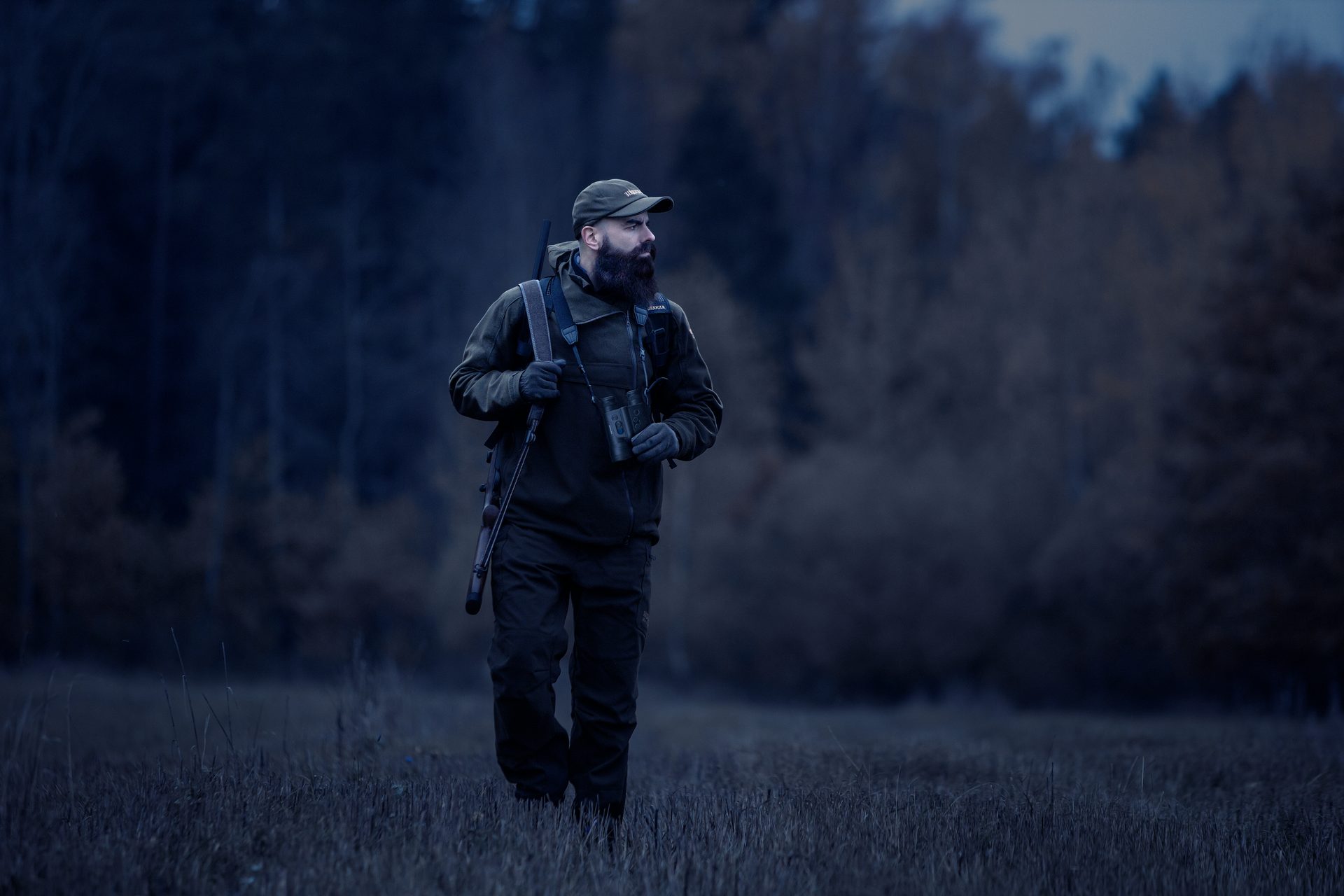
Key safety and ethical considerations
- Respect nighttime wildlife: Use thermals for observation first, not over-harvest.
- Follow local laws: Agencies like Colorado Parks and Wildlife and Montana FWP outline specific lighting and firearm rules.
- Maintain situational awareness: Thermals don’t show fences or holes—use dim navigation lights for mobility.
- Prioritize ethical dispatch: Humane harvest remains the standard for hunters.
Thermal technology should complement ethical fieldcraft, not replace it.
Conclusion
Rabbit hunting at night demands precision, patience, and the right technology. As darkness falls, rabbits become more active, and every sound or movement can decide the outcome of the hunt. Success comes from understanding animal behavior, moving quietly, and using reliable optics to detect heat and movement in total darkness.
Pulsar thermal devices provide the clarity, range, and confidence needed for accurate identification and ethical shots. They help hunters stay effective across any terrain while maintaining respect for wildlife and the environment.
Explore Pulsar’s full catalog of thermal imaging devices to equip yourself for safe, effective night hunts that respect wildlife and the land.
FAQ
Can you hunt rabbits legally at night with thermal scopes?
Legality depends on the region. Many U.S. states and UK districts allow nighttime rabbit control under specific permits. Always check rules from your local wildlife agency.
Are thermal scopes better than night vision for small game?
Thermal scopes make rabbits pop within range regardless of available light; night vision depends on it.
What’s the detection range for a rabbit-sized target?
The Telos XG50 detects rabbits out to 1,000 meters in clear conditions, though identification range drops to 300–400 meters depending on terrain and weather.
What time of night are rabbits most active?
Peak movement occurs between 9 p.m. and 3 a.m., especially on calm, humid nights with light cloud cover.
Can thermal scouting help with conservation?
Yes. Non-invasive thermal observation provides valuable population data without disturbing rabbits, supporting long-term habitat management efforts.
Further Reading:
About the Experts

Co-Author:
Joshua Skovlund
Joshua Skovlund has covered stories for Task & Purpose, Outdoor Life, and Coffee or Die Magazine. He has photographed and filmed multinational military exercises and hunting trips in austere environments around the world, with his first archery kill in Kona, Hawaii.
Joshua grew up in South Dakota, learning how to scout and hunt deer, turkey, pheasant, and waterfowl. He currently scouts and hunts black bears, turkeys, and deer, while taking every opportunity to go to the range and further hone his pistol and rifle shooting skills.

Expert Contributor:
Riccardo Tamburini
Riccardo Tamburini is a lifelong outdoorsman, hunter, fisherman, and professional wildlife photographer and filmmaker.
With over 35 years of experience across plains and mountains in Italy and abroad, he combines field expertise with a mechanical engineering background to explain the technology behind rifles, optics, and digital devices.
Before purchasing any night or thermal vision device, please make sure you adhere to the local legislation and only use it when it is allowed. Our ambassadors come from various countries and travel a lot, which allows them to test different devices. We do not encourage or support the illegal use of our devices in any events. If you wish to learn more about export and sales restriction policy, please visit the following link: Export and Sales Restriction Policy.